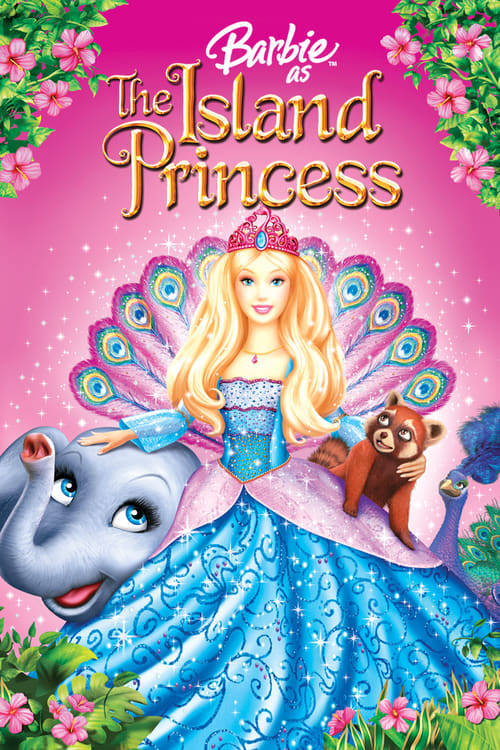
Barbie as the Island Princess (2007)
Directed by Greg Richardson
No — Barbie as the Island Princess is not woke, scoring 10 out of 100 on our wokeness meter.
Barbie as the Island Princess arrives from 2007 as the eleventh entry in a direct-to-video franchise built on a toy line, and it conducts itself with the quiet competence of a product that knows its audience precisely.
Consciousness Markers
The film centers on a female protagonist, Rosella, who is the primary focus of the narrative, providing a baseline level of representation for a young woman in a fantasy setting.
Rosella demonstrates significant agency and resourcefulness, saving the prince and navigating complex social situations, though her ultimate arc remains within the traditional framework of finding a suitable partner.
The conflict involves the rigid social hierarchy of the kingdom versus Ro's freedom, offering a very mild critique of aristocratic power structures.
The setting is a tropical island, and the plot involves nature and animals, but there is no explicit commentary or 'crusade' regarding environmental issues.
There are no discernible LGBTQ+ themes, relationships, or representation within the film's plot or character dynamics.
The film operates within a generic fantasy setting and does not engage with or comment upon specific racial dynamics or issues.
The narrative focuses on Ro's beauty and grace within the context of royal society, without promoting explicit body positivity or challenging traditional beauty standards.
No characters exhibit or are discussed in relation to neurodivergent traits.
The film is a fictional fairy tale and does not engage with historical events or revisionist narratives.
As a musical fantasy aimed at a family audience, the film does not employ didactic techniques or lecture the audience on social issues.
Why it received this score
Barbie as the Island Princess arrives from 2007 as the eleventh entry in a direct-to-video franchise built on a toy line, and it conducts itself with the quiet competence of a product that knows its audience precisely. A girl washes ashore, is raised by a red panda, a peacock, and an elephant, learns their language, and grows into a young woman who rescues a prince from crocodiles. Then come the kingdom, the scheming queen, the poisoned wedding cake, and the lost lullaby that restores a memory. It is all very tidy.
The cultural accounting is modest. Our heroine, Rosella, carries the whole narrative and shows genuine resourcefulness: she saves the prince, brews an antidote, and accuses a villain in open court. That grants a baseline of female agency, even as the story steers her toward marriage with the patience of a river finding the sea. A faint friction between aristocratic obligation and personal freedom surfaces when the king arranges a match for his son, though the film treats rank as a puzzle solved by a good heart, not a system to be pulled down. The tropical setting supplies palm trees and chatty animals, and nothing else. No one lectures us about the reef.
Everything else is silence. There is no romance outside the heterosexual pairing, no engagement with race, no interrogation of beauty standards, no neurodivergent reading, no history to revise, no sermon. The film wants only to charm, and by most accounts it manages, which leaves the classifier with little to do but record the absence and move along. A sweet, unassuming trifle, pleasant enough, and nearly innocent of the anxieties of a later decade. We score it, file it, and reach for the next reel.
Analysis generated by our Consciousness Algorithm


Synopsis
Young Rosella is saved by a few kind animals after a shipwreck. Now called Ro, she learns to talk to animals. One day, she saves the life of a prince and returns to civilisation to discover her past.
Questions about Barbie as the Island Princess
Is Barbie as the Island Princess woke?
No — Barbie as the Island Princess is not woke, scoring 10 out of 100 on our wokeness meter. That earns it a verdict of Ultra Based.
Does Barbie as the Island Princess have any woke elements?
1 of the 10 markers register at 30 or above, led by Representation Casting (30). On Representation Casting: The film centers on a female protagonist, Rosella, who is the primary focus of the narrative, providing a baseline level of representation for a young woman in a fantasy setting.
How does Barbie as the Island Princess compare to other 2007 movies?
It ranks #80 of the 201 films from 2007 we've scored; their average is 12. The wokest is Like Stars on Earth (92).
How is the Woke Score calculated?
An AI-assisted process researches the film and its reception, scores it 0–100 on ten markers, then combines those into one 0–100 Woke Score. It measures a specific set of 2020s cultural themes, not film quality.