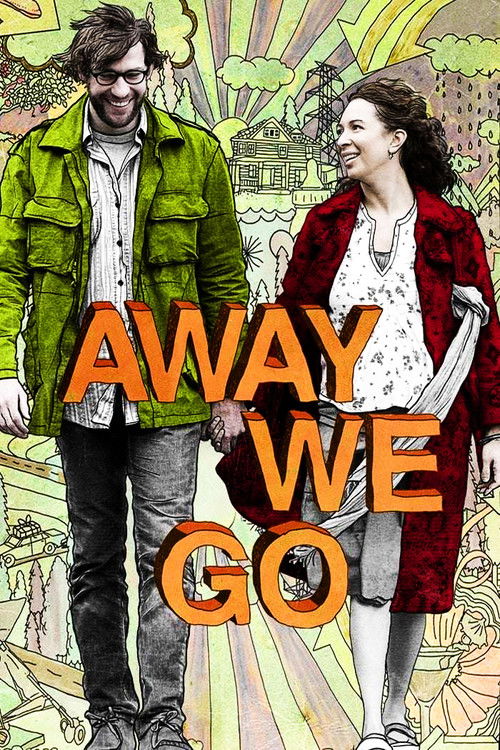
Away We Go (2009)
Directed by Sam Mendes
No — Away We Go is not woke, scoring 14 out of 100 on our wokeness meter.
Sam Mendes directed this 2009 road trip through the American family, and it arrives with the quiet confidence of a film that knows its characters are the most sensitive people in any room.
Consciousness Markers
Maya Rudolph, who is biracial, leads as Verona in an interracial relationship with John Krasinski's Burt, a pairing flagged by TMDB keywords 'interracial relationship' and 'biracial.' The casting is notable for 2009 but is presented naturally without commentary.
Verona is a co-protagonist whose pregnancy and family choices drive the plot, and the film was co-written by Vendela Vida, but there is no articulated feminist argument or critique of patriarchy.
Characters like LN and Roderick deliver satirical lectures on 'continuum' parenting, and the film ponders what kind of parents to be, but the tone is wry rather than preachy.
The interracial lead couple and the Montreal family's adopted children of diverse backgrounds exist in the story, but race is never discussed or made a thematic concern.
The film mildly satirizes a wealthy, inherited-money professor with radical parenting views, but this is mockery of a lifestyle rather than an anti-capitalist critique.
No LGBTQ+ characters, relationships, or themes appear anywhere in the film.
Environmental themes are entirely absent; the road trip is about family and geography, not ecology.
Verona's pregnancy is depicted matter-of-factly, but the film makes no statement about body image or body acceptance.
No neurodivergent characters or themes are present.
The film is a contemporary fictional story with no historical subject matter to revise.
Why it received this score
Sam Mendes directed this 2009 road trip through the American family, and it arrives with the quiet confidence of a film that knows its characters are the most sensitive people in any room. Burt and Verona, played by John Krasinski and Maya Rudolph, drive from Phoenix to Madison to Montreal, sampling other people's households the way a sommelier samples spoiled wine. The film's mild progressive credential is structural: a biracial lead actress in an interracial relationship, presented without a single line of commentary, which in 2009 was still a small act of casting nerve. Nothing about the couple's racial difference is ever discussed, and the Montreal household with its adopted children of various backgrounds sits in the frame just as silently.
Elsewhere the ledger is thin. There are no queer characters, no environmental conscience, no argument about bodies or about capital. The closest thing to a politics is LN and Roderick, the inherited-money professor and her husband, who lecture our heroes on the continuum home and the evils of the stroller. The film mocks them, gently, for their smugness about parenting, and the mockery lands as lifestyle satire instead of economic critique. Verona's pregnancy drives the plot and the film was co-written by Vendela Vida, but the movie never builds an argument about motherhood as a social condition.
The result is a wry, mildly superior comedy about two people deciding what kind of parents to be. It ponders. It does not preach. The lectures it contains are placed in the mouths of characters we are invited to find ridiculous, which is the crucial distinction. A film can be full of opinions and still refuse to deliver a sermon. This one refuses, and it is better for the restraint, even if the restraint leaves it feeling weightless.
Analysis generated by our Consciousness Algorithm
Part of


Synopsis
Verona and Burt have moved to Colorado to be close to Burt's parents but, with Verona expecting their first child, Burt's parents inexplicably decide to move to Belgium, now leaving them in a place they hate and without a support structure in place. They set off on a whirlwind tour of of disparate locations where they have friends or relatives, sampling not only different cities and climates but also different families. Along the way they realize that the journey is less about discovering where they want to live and more about figuring out what type of parents they want to be.
Questions about Away We Go
Is Away We Go woke?
No — Away We Go is not woke, scoring 14 out of 100 on our wokeness meter. That earns it a verdict of Ultra Based.
Does Away We Go have any woke elements?
1 of the 10 markers register at 30 or above, led by Representation Casting (45). On Representation Casting: Maya Rudolph, who is biracial, leads as Verona in an interracial relationship with John Krasinski's Burt, a pairing flagged by TMDB keywords 'interracial relationship' and 'biracial.' The casting is notable for 2009 but is presented naturally without commentary.
How does Away We Go compare to other 2009 movies?
It ranks #72 of the 230 films from 2009 we've scored; their average is 14. The wokest is Home (79).
How is the Woke Score calculated?
An AI-assisted process researches the film and its reception, scores it 0–100 on ten markers, then combines those into one 0–100 Woke Score. It measures a specific set of 2020s cultural themes, not film quality.