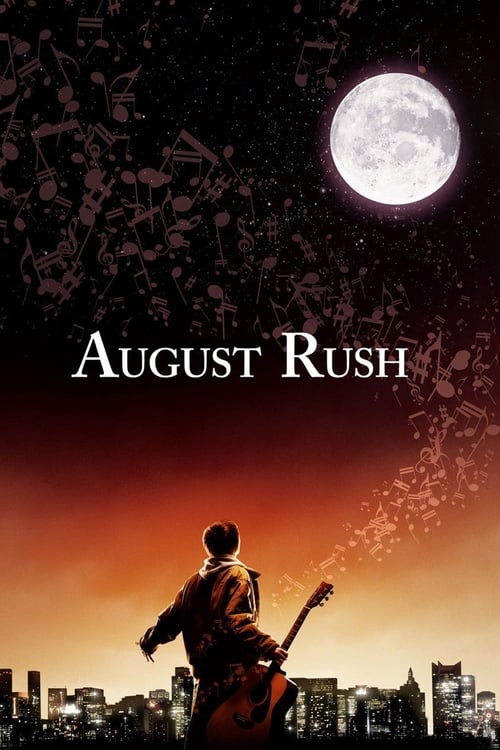
August Rush (2007)
Directed by Kirsten Sheridan
No — August Rush is not woke, scoring 8 out of 100 on our wokeness meter.
August Rush arrived in 2007 as a musical melodrama so thoroughly pickled in sentiment that critics could smell the brine from the press screening.
Consciousness Markers
The cast includes Terrence Howard, Mykelti Williamson, Leon Thomas III, and Jamia Simone Nash in roles that exist naturally within the story, with no commentary on their presence. A modestly diverse ensemble, but nothing that reads as deliberate representation casting.
Directed by a woman (Kirsten Sheridan), and Lyla is a professional cellist with her own artistic arc, but the film's emotional engine is a sentimental family reunion rather than any feminist argument.
The Wizard's exploitation of homeless children for profit offers a faint critique of predatory commerce, but it is framed as one villain's greed rather than a systemic indictment of capitalism.
Evan is described as a musical savant with perfect pitch and savant-like abilities, which carries a faint neurodivergent coding, but the film frames this as magical giftedness rather than any exploration of neurodivergence.
Black characters (the social worker, the reverend, Arthur, Hope) are present and treated with dignity, but the film makes no racial commentary and the story is entirely colorblind in its concerns.
The film is drenched in sentimentality and its 'follow the music' philosophy is stated repeatedly, but it preaches about destiny and family rather than any social or political message.
No LGBTQ+ characters, themes, or subtext of any kind appear in the film.
No environmental themes whatsoever; the film is set in urban New York and concerns music and family.
No body-positive themes or messaging; body image is not a subject of the film.
No historical revisionism; the film is a contemporary fictional melodrama with no engagement with historical narrative.
Why it received this score
August Rush arrived in 2007 as a musical melodrama so thoroughly pickled in sentiment that critics could smell the brine from the press screening. Kirsten Sheridan directs the tale of Evan Taylor, an orphan with perfect pitch who flees the boys' home, follows the music to New York, and falls in with a Fagin-like vagrant called Wizard. The plot runs on coincidence the way a jukebox runs on quarters. Roger Ebert gave it three stars and conceded the thing was drenched in feeling, which was the point. Nearly everyone else reached for the word schmaltz and went home.
Where social consciousness is concerned, the film keeps its ambitions modest. The cast includes Terrence Howard, Mykelti Williamson, Leon Thomas III and Jamia Simone Nash in roles that carry no commentary on their own presence, and the screenplay asks nothing of them beyond competence. Lyla, played by Keri Russell, is a Juilliard-trained cellist with a career and a grief of her own, and the picture was directed by a woman, yet the emotional machinery exists to deliver a family reunion. Wizard's exploitation of homeless children gestures at the cruelty of adults who monetize talent, though the villainy stays personal and never systemic. Evan's savant abilities are framed as magic instead of a condition anyone actually lives with.
No LGBTQ characters appear. No climate anxiety intrudes on Central Park. Body image never surfaces as a subject. The film's preachiness is reserved for destiny, for the notion that music will reassemble a broken family if we simply believe hard enough, a sermon delivered with strings swelling underneath. Historians need not trouble themselves. What remains is a gentle, colorblind humanism of the sort already going out of fashion by 2007, sincere in its warmth and innocent of the cultural battles soon to consume the discourse. It is a film about listening. It has very little to say.
Analysis generated by our Consciousness Algorithm
Part of


Synopsis
Evan, a musically gifted orphan, runs away from his orphanage and searches New York City for his birth parents. On his journey, he's taken under the wing of the Wizard, a homeless man who lives in an abandoned theater. After discovering his talent, the Wizard gives Evan the name "August Rush" and devises a plan to profit from his talent. Little does Evan know that his parents, Lyla and Louis, are searching for him too.
Questions about August Rush
Is August Rush woke?
No — August Rush is not woke, scoring 8 out of 100 on our wokeness meter. That earns it a verdict of Ultra Based.
Does August Rush have any woke elements?
Very few. None of the 10 markers reaches 30, the level where a marker counts as present; the highest is Representation Casting at 22.
How does August Rush compare to other 2007 movies?
It ranks #93 of the 201 films from 2007 we've scored; their average is 12. The wokest is Like Stars on Earth (92).
How is the Woke Score calculated?
An AI-assisted process researches the film and its reception, scores it 0–100 on ten markers, then combines those into one 0–100 Woke Score. It measures a specific set of 2020s cultural themes, not film quality.