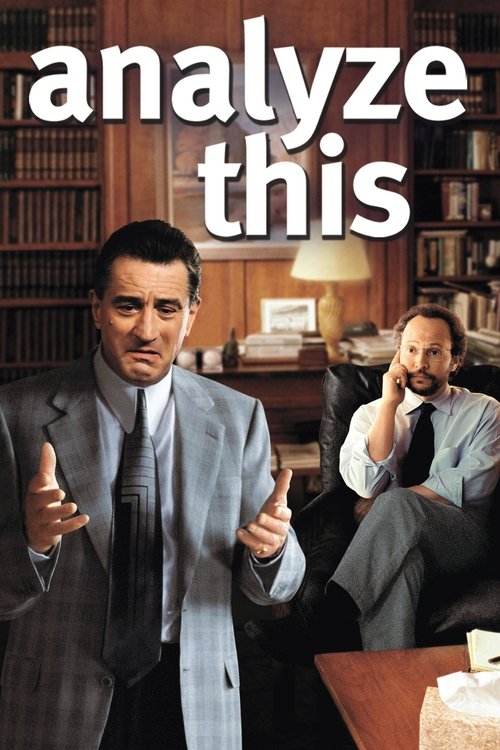
Analyze This (1999)
Directed by Harold Ramis
No — Analyze This is not woke, scoring 0 out of 100 on our wokeness meter.
Analyze This arrives from 1999, a year in which a mobster's panic attacks could be played for laughs without anyone reaching for a diagnostic pamphlet.
Consciousness Markers
The plot centers on a mobster's panic attacks and anxiety treated by a psychiatrist, but this is mined purely for comedy rather than framed as neurodivergence advocacy or representation.
The cast is overwhelmingly white Italian-American men, with Lisa Kudrow as the sole prominent female role; no diverse or commented-upon casting choices are present.
There are no LGBTQ+ characters, themes, or subtext anywhere in the film.
Lisa Kudrow's character exists as a conventional fiancée/wife figure; the film offers no feminist critique or gender-conscious framing.
The film engages no racial themes or commentary whatsoever; it is a white ethnic mob comedy.
No environmental or climate-related content appears in the film.
The mafia setting is played for laughs and genre homage, not as a critique of capitalism or wealth inequality.
No body-positivity themes or messaging are present.
The film is a fictional mob comedy with no historical revisionism.
The film is a light mainstream comedy that never lectures or moralizes to its audience.
Why it received this score
Analyze This arrives from 1999, a year in which a mobster's panic attacks could be played for laughs without anyone reaching for a diagnostic pamphlet. Harold Ramis directs Robert De Niro and Billy Crystal through a premise of elegant simplicity: the feared capo Paul Vitti needs a shrink, and the shrink needs a quiet life that neither of them will get. The film is a spoof of wiseguy pictures, and it is content to remain one. Lisa Kudrow appears as the fiancee, then the wife, and is given precisely the amount of interior life a 1999 studio comedy allotted to the fiancee, then the wife, which is to say enough to be pleasant and not enough to be inconvenient.
The therapeutic material is the engine, and the film treats anxiety with the same seriousness it treats a car trunk that will not close. Vitti's panic attacks are a plot device, mined for the incongruity of a violent man hyperventilating in a waiting room. There is no framing of mental health as identity, no advocacy, no vocabulary of neurodivergence, and the film does not ask to be credited for any of it. In this respect it is refreshingly unburdened.
We search for the familiar markers and find the film cheerfully indifferent to all of them. The cast is white, Italian-American, and male by overwhelming majority. Race is not a subject. The mafia is genre furniture, not a metaphor for wealth extraction. Nobody lectures. The film wants to be liked, and it is liked, having opened at number one and earned itself a sequel. A sommelier of this vintage would note the absence of additives and call it a clean pour. Unremarkable, perhaps, but honest about what it is.
Analysis generated by our Consciousness Algorithm
Part of


Synopsis
Countless wiseguy films are spoofed in this film that centers on the neuroses and angst of a powerful Mafia racketeer who suffers from panic attacks. When Paul Vitti needs help dealing with his role in the "family," unlucky shrink Dr. Ben Sobel is given just days to resolve Vitti's emotional crisis and turn him into a happy, well-adjusted gangster.
Questions about Analyze This
Is Analyze This woke?
No — Analyze This is not woke, scoring 0 out of 100 on our wokeness meter. That earns it a verdict of Ultra Based.
Does Analyze This have any woke elements?
Very few. None of the 10 markers reaches 30, the level where a marker counts as present; the highest is Neurodivergence at 10.
How does Analyze This compare to other 1999 movies?
It ranks #94 of the 103 films from 1999 we've scored; their average is 14. The wokest is Boys Don't Cry (60).
How is the Woke Score calculated?
An AI-assisted process researches the film and its reception, scores it 0–100 on ten markers, then combines those into one 0–100 Woke Score. It measures a specific set of 2020s cultural themes, not film quality.