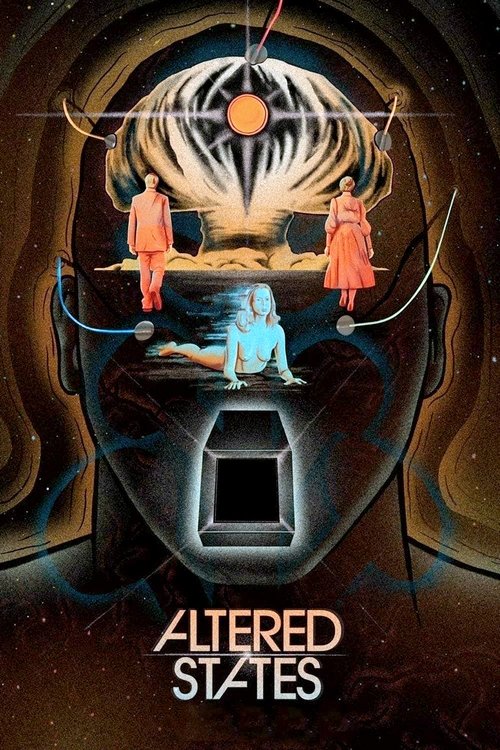
Altered States (1980)
Directed by Ken Russell
No — Altered States is not woke, scoring 7 out of 100 on our wokeness meter.
Altered States arrives from 1980 with the confidence of a film that believes consciousness itself is a worthy antagonist.
Consciousness Markers
The cast is almost entirely white, with Miguel Godreau as the caveman incarnation and Charles White-Eagle as the brujo, plus documentary footage of Tarahumara people. These are natural casting choices for the story, carrying no representational commentary.
Chayefsky's famously verbose script delivers lengthy disquisitions on the death of God and the origins of man, but this is philosophical monologuing rather than modern social-justice sermonizing.
Indigenous peoples (the Hinchi, the Tarahumara) appear as exotic sources of psychedelic ritual and 'primordial' wisdom rather than as subjects of racial justice; this is cultural appropriation as set dressing, not racial consciousness.
Edward studies schizophrenia and pursues altered states of consciousness, giving the film a psychological/psychiatric texture, but his obsessive experimentation is framed as transgressive science rather than as neurodivergent identity.
Emily is largely a passive, reactive figure who exists to anchor Edward's humanity. No feminist framing of gender, autonomy, or patriarchy is present.
The film's antagonism is toward metaphysics, academia, and consciousness itself, not capital. There is no critique of wealth, class, or economic systems.
No LGBTQ+ characters or themes whatsoever; the central relationship is a heterosexual marriage in crisis.
No environmental or climate themes appear anywhere in the film.
The body horror elements (devolution, transformation into primordial matter) are about dread and dissolution of self, the opposite of body acceptance.
No historical record is revised; the film is speculative fiction about consciousness and human origins, not a reworking of documented events.
Why it received this score
Altered States arrives from 1980 with the confidence of a film that believes consciousness itself is a worthy antagonist. Ken Russell directs Paddy Chayefsky's verbose script about Edward Jessup, a Harvard psychopathologist who climbs into a flotation tank and emerges, eventually, as a caveman, a gorilla, and a mass of primordial matter. The production history is livelier than most films released this year: Chayefsky disowned the picture, Arthur Penn quit during rehearsals, and the screenplay wound up credited to Sidney Aaron. None of this constitutes social consciousness. It constitutes two strong artists sharing a room and losing.
On the representational front, the film offers little worth cataloguing. The cast is white, and the Indigenous peoples of Mexico serve as dispensers of sacred mushrooms and primordial wisdom, which is appropriation deployed as set dressing. No racial argument is being made. Emily, the wife, exists to pull Edward back from dissolution, and the film shows no interest in her autonomy or in the structures that might constrain it. The body horror runs the opposite direction: devolution as dread, flesh as something to be escaped. Edward's fixation on schizophrenia and altered states lends a psychiatric texture, but he reads as a transgressor of science, not a portrait of neurodivergence.
Where the film lectures, it lectures about the death of God and the origins of man, not about justice, equity, or the sins of capital. Its antagonist is metaphysics. Chayefsky's characters deliver long philosophical speeches, and Russell shoots them as visually interesting as he can manage before the tank starts glowing. This is a film about the self dissolving into matter, made by men quarreling over the color of the paint on the isolation tank.
Analysis generated by our Consciousness Algorithm
Part of


Synopsis
A research scientist explores the boundaries and frontiers of human consciousness. Using sensory deprivation and hallucinogenic mixtures from Native American shamans, he explores these altered states of cognizance and finds that memory, time, and reality itself are states of mind.
Questions about Altered States
Is Altered States woke?
No — Altered States is not woke, scoring 7 out of 100 on our wokeness meter. That earns it a verdict of Ultra Based.
Does Altered States have any woke elements?
Very few. None of the 10 markers reaches 30, the level where a marker counts as present; the highest is Representation Casting at 18.
How does Altered States compare to other 1980 movies?
It ranks #17 of the 37 films from 1980 we've scored; their average is 10. The wokest is Nine to Five (42).
How is the Woke Score calculated?
An AI-assisted process researches the film and its reception, scores it 0–100 on ten markers, then combines those into one 0–100 Woke Score. It measures a specific set of 2020s cultural themes, not film quality.