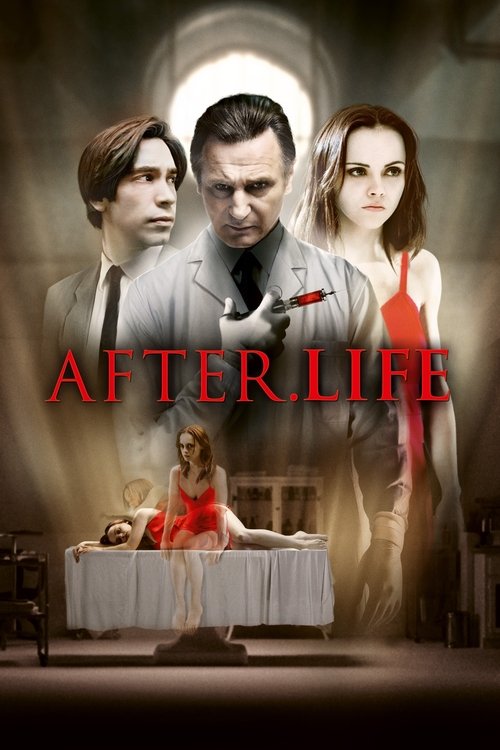
After.Life (2009)
Directed by Agnieszka Wojtowicz-Vosloo
No — After.Life is not woke, scoring 4 out of 100 on our wokeness meter.
After.Life arrives from 2009 with a premise that sounds like a puzzle box and plays like a long, cold bath.
Consciousness Markers
The film centers on a woman's psychological trauma and survival, which is a minor thematic focus, but it does not engage with a modern feminist agenda or critique systemic patriarchy.
The film utilizes a standard, non-challenging ensemble cast typical of its 2009 release, offering no significant commentary on representation.
The setting is a funeral home, a commercial enterprise, but the conflict remains personal and supernatural rather than a critique of economic structures.
The mortician delivers philosophical monologues about death, but these are existential musings, not didactic lectures on modern social justice issues.
There are no discernible LGBTQ+ themes, characters, or narrative arcs present in the film's premise or summary.
The narrative makes no attempt to address or critique racial dynamics or systemic racism.
The film's focus is entirely on existential dread and mortality, showing zero interest in environmental activism or climate change narratives.
The film does not engage with body image, size, or the celebration of diverse physical forms.
There is no evidence of characters exhibiting traits related to neurodivergence or related conditions.
As a fictional psychological thriller, the film does not attempt to challenge or rewrite established historical facts.
Why it received this score
After.Life arrives from 2009 with a premise that sounds like a puzzle box and plays like a long, cold bath. A middle school teacher named Anna wakes on an embalming table after a car crash, and the mortician who owns the funeral home insists she is dead, or perhaps not, and the film spends ninety minutes declining to clarify. Agnieszka Wojtowicz-Vosloo directs her own script with an admirable commitment to ambiguity. The result is a chamber piece about mortality, grief, and the stubborn refusal of the dead to stay explained. Critics at the time found it plodding. They were not wrong, though the atmosphere holds.
For the purposes of classification, the film is nearly inert. The cast is a standard 2009 ensemble, assembled for name recognition and nothing further, and the narrative shows no awareness of representation as a question. There are no LGBTQ threads. The feminist reading is faint: Anna suffers, screams, and endures, and the camera studies Christina Ricci's body with a devotion that reads as exploitation more than empowerment. No racial dynamics are engaged. The environment never enters the frame. The funeral home is a commercial enterprise, a fact the film notes and then ignores, because its villain is a metaphysician, not a landlord. Body image, neurodivergence, and historical revision are all absent, not suppressed but simply never conceived.
What remains is the mortician's talk. Liam Neeson delivers long, soft monologues about transition, death, and the gift he shares with a child, and the boy buries a live chick to prove it. These are theological musings, not sermons on social arrangements. The film wants to unsettle, not instruct, and it mostly succeeds at neither. A difficult vintage, thin on the palate, with no social aftertaste to speak of. It sits in the cellar and gathers dust, which is the appropriate fate for a thriller whose deepest conviction is that being alive is a matter of opinion.
In the end, the film's cultural footprint is a shrug. It has one idea, and it repeats that idea until the credits. There is no movement here, no argument, no cause. Just a woman in a casket and a man with scissors, and the quiet suspicion that neither of them has anything to teach us about the world outside the room. We score it accordingly, and we move on to the next bottle.
Thematic tags: none apply. The film won no Academy Awards, spawned no sequels and no remakes, is not based on real events or a published book, features no superheroes, and never reached number one at the domestic box office during its limited release.
Analysis generated by our Consciousness Algorithm


Synopsis
Following a terrible car crash, a woman awakes to find an enigmatic mortician preparing her for burial.
Questions about After.Life
Is After.Life woke?
No — After.Life is not woke, scoring 4 out of 100 on our wokeness meter. That earns it a verdict of Ultra Based.
Does After.Life have any woke elements?
Very few. None of the 10 markers reaches 30, the level where a marker counts as present; the highest is Feminist Agenda at 10.
How does After.Life compare to other 2009 movies?
It ranks #169 of the 230 films from 2009 we've scored; their average is 14. The wokest is Home (79).
How is the Woke Score calculated?
An AI-assisted process researches the film and its reception, scores it 0–100 on ten markers, then combines those into one 0–100 Woke Score. It measures a specific set of 2020s cultural themes, not film quality.