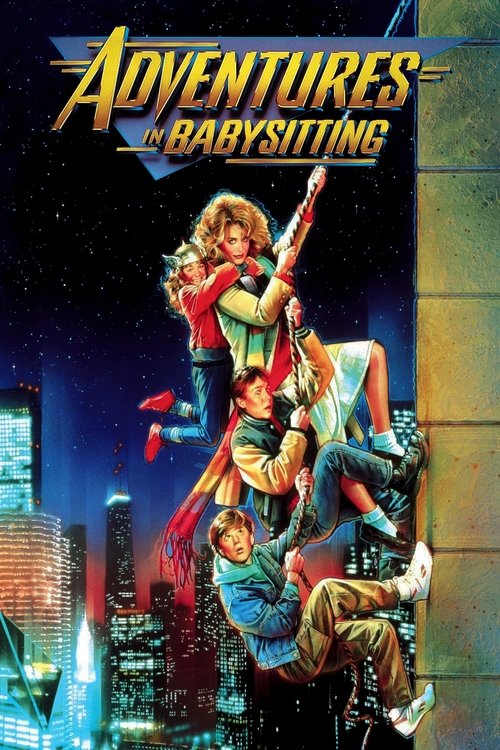
Adventures in Babysitting (1987)
Directed by Chris Columbus
No — Adventures in Babysitting is not woke, scoring 7 out of 100 on our wokeness meter.
Adventures in Babysitting arrived in the summer of 1987 as the directorial debut of Chris Columbus, and it has aged into a modest cult fixture on the strength of Elisabeth Shue's amiability and one genuinely good blues number.
Consciousness Markers
The cast is overwhelmingly white, with Black performers (Calvin Levels, Albert Collins) appearing only in the South Side sequence as incidental characters. No deliberate diverse casting agenda is present.
Chris is a capable female lead who drives the action, but the film is a conventional teen comedy with no feminist thesis or commentary on gender structures.
Black characters populate the blues club and car-theft subplot, but they function as colorful set dressing rather than vehicles for racial commentary — a point Ebert himself criticized.
No LGBTQ+ characters or themes. Anthony Rapp's later coming-out is irrelevant to the film, and the only related element is an offensive slur that Disney+ edits out.
No environmental themes whatsoever.
The car-theft ring is a criminal enterprise, not a critique of capitalism. No economic messaging.
No body-positivity themes or messaging.
No neurodivergent characters or themes.
A straightforward 1980s teen romp with no historical revisionism.
The film is a light comedic caper with no preachy or didactic agenda; it aims to entertain, not instruct.
Why it received this score
Adventures in Babysitting arrived in the summer of 1987 as the directorial debut of Chris Columbus, and it has aged into a modest cult fixture on the strength of Elisabeth Shue's amiability and one genuinely good blues number. As a document of social consciousness it is nearly inert. There is no environmental messaging, no economic critique, no engagement with body image, neurodivergence, or the rewriting of history. The film concerns a station wagon, a flat tire, and a series of escalating inconveniences. That is the whole of its ambition.
On representation, the ledger is thin. The cast is white to a degree that barely registers as a decision, and the Black performers who appear (Calvin Levels as the car thief Joe Gipp, Albert Collins fronting the blues band) exist inside the South Side sequence as local color. Roger Ebert noted this at the time, observing that the film had good raw material and left it unrealized. The blues club scene is the picture's best, and it treats its musicians as atmosphere. Anthony Rapp appears as Daryl, and the film's lone gesture toward queer content is a slur, which Disney+ now scrubs from its streaming copy. That is a curiosity of censorship, not a theme.
Shue's Chris is competent and drives the plot, which earns a flicker of credit, though the film proposes nothing about gender and never intends to. Gene Siskel faulted the movie for a lack of social awareness, a fair reading and also beside the point. This is a caper. It wants to be Ferris Bueller with a curfew, and it mostly is. The absence of a sermon is, in the end, its most distinguishing feature.
Analysis generated by our Consciousness Algorithm


Synopsis
When plans with her boyfriend fall through, high school senior Chris Parker ends up babysitting the Anderson kids, Brad and Sara. What should be a quiet night in, however, turns into a series of ridiculous exploits, starting when they leave the house to pick up Chris' friend Brenda. Soon, Brad's buddy Daryl is involved, and the group must contend with car thieves, blues musicians and much more.
Questions about Adventures in Babysitting
Is Adventures in Babysitting woke?
No — Adventures in Babysitting is not woke, scoring 7 out of 100 on our wokeness meter. That earns it a verdict of Ultra Based.
Does Adventures in Babysitting have any woke elements?
Very few. None of the 10 markers reaches 30, the level where a marker counts as present; the highest is Representation Casting at 15.
How does Adventures in Babysitting compare to other 1987 movies?
It ranks #23 of the 59 films from 1987 we've scored; their average is 8. The wokest is Maurice (68).
How is the Woke Score calculated?
An AI-assisted process researches the film and its reception, scores it 0–100 on ten markers, then combines those into one 0–100 Woke Score. It measures a specific set of 2020s cultural themes, not film quality.