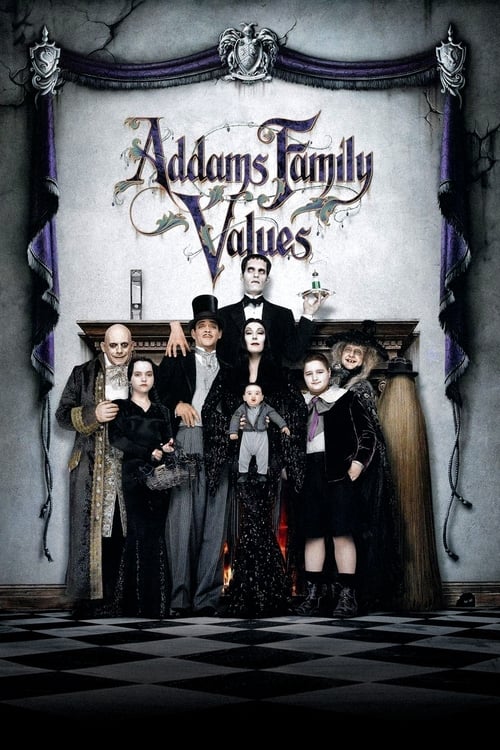
Addams Family Values (1993)
Directed by Barry Sonnenfeld
No — Addams Family Values is not woke, scoring 17 out of 100 on our wokeness meter.
Addams Family Values arrives in 1993 as a sequel to a film nobody expected to work, and it improves on the original in the way that matters to a certain kind of viewer: it is meaner, funnier, and less interested in being liked.
Consciousness Markers
Wednesday and Morticia are memorably self-possessed and macabre women, and Debbie is a gleefully unrepentant femme fatale, but the film's gender politics are subversive comedy rather than a feminist thesis.
The film's centerpiece rebellion against the saccharine First Thanksgiving pageant amounts to a cheeky revisionist rewrite of a founding myth, delivered as slapstick rather than scholarship.
The Camp Chippewa Thanksgiving pageant, in which Wednesday is cast as Pocahontas and then torches the stage, satirizes the sanitized Pilgrim myth, though the target is white-bread conformity more than racial justice.
Debbie's gold-digging serial-killer scheme and the smug materialism of the Buckman yuppies offer a satirical jab at greed and status, but the film is too fond of its own macabre wealth to mount an eat-the-rich argument.
The title itself is a wink at Dan Quayle's 1992 'family values' speech, and the Harmony Hut sequences mock forced cheer, but the satire stays arch and comic rather than preachy.
The cast is overwhelmingly white, with the notable exception of Raúl Juliá as Gomez; the ensemble is otherwise a parade of pale Addams relatives and campers, with no meaningful representation agenda at work.
No LGBTQ+ themes or characters appear; the drag performer Charles Busch plays a cousin at a wedding, but the role carries no queer text.
No environmental themes whatsoever; the only thing burning is a summer camp stage.
The Addams clan celebrates the grotesque and the unusual, but this is gothic camp rather than any body-positive message.
The family's oddity is supernatural and comedic, not framed as neurodivergence; no such themes are present.
Why it received this score
Addams Family Values arrives in 1993 as a sequel to a film nobody expected to work, and it improves on the original in the way that matters to a certain kind of viewer: it is meaner, funnier, and less interested in being liked. The title is a jab at Dan Quayle's 1992 speech about family values, and Paul Rudnick's script keeps that arch, sardonic register from the first frame to the last. The Addams clan remains a wealthy, morbid, self-satisfied unit, and the film is fond of them in a way that quietly undercuts any serious critique of their money.
The centerpiece is Camp Chippewa, where Wednesday and Pugsley are packed off and where the film stages its most pointed sequence: a Thanksgiving pageant in which Wednesday, cast as Pocahontas, refuses the script, leads the outcasts in burning the stage, and takes the counselors hostage. It is a cheeky rewrite of a founding myth, delivered as slapstick, and the target is the forced cheer of white-bread conformity more than any sustained argument about colonization. The Harmony Hut, where children are made to watch wholesome programming until they comply, is the film's sharpest joke about coerced optimism. It lands because the film never stops to explain itself. The cast is overwhelmingly pale, with Raul Julia the notable exception, and no representation agenda is at work.
Joan Cusack's Debbie is the engine of the greed satire, a gold-digging serial killer who murders husbands for their inheritances and recounts her crimes with a slide show. The Buckman yuppies get their share of mockery as well. Yet the film loves its own macabre wealth too much to mount a real argument about money, and the jabs stay decorative. There is no environmental theme, no body-positive message, no neurodivergent framing, and no queer text, though Charles Busch turns up as a cousin at the wedding. The gender politics are subversive comedy, not a thesis. What remains is a superior sequel with a taste for anarchy and a light touch, which is its own kind of integrity.
{"thematic_tags": ["sequel", "book_adaptation", "box_office_number_one"]}
Analysis generated by our Consciousness Algorithm
Part of


Synopsis
Siblings Wednesday and Pugsley Addams will stop at nothing to get rid of Pubert, the new baby boy adored by parents Gomez and Morticia. Things go from bad to worse when the new "black widow" nanny, Debbie Jellinsky, launches her plan to add Fester to her collection of dead husbands.
Questions about Addams Family Values
Is Addams Family Values woke?
No — Addams Family Values is not woke, scoring 17 out of 100 on our wokeness meter. That earns it a verdict of Ultra Based.
Does Addams Family Values have any woke elements?
Very few. None of the 10 markers reaches 30, the level where a marker counts as present; the highest is Feminist Agenda at 25.
How does Addams Family Values compare to other 1993 movies?
It ranks #22 of the 97 films from 1993 we've scored; their average is 11. The wokest is Bound by Honor (60).
How is the Woke Score calculated?
An AI-assisted process researches the film and its reception, scores it 0–100 on ten markers, then combines those into one 0–100 Woke Score. It measures a specific set of 2020s cultural themes, not film quality.