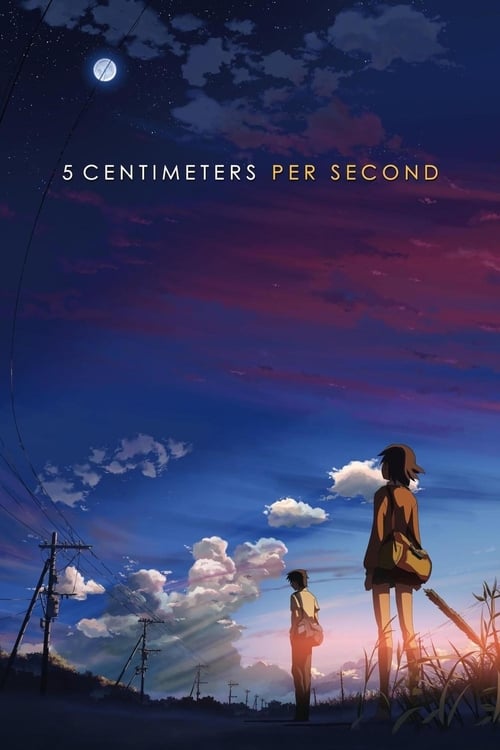
5 Centimeters per Second (2007)
Directed by Makoto Shinkai
No — 5 Centimeters per Second is not woke, scoring 0 out of 100 on our wokeness meter.
Makoto Shinkai's 5 Centimeters per Second arrived in 2007, before the culture decided that a movie about two children drifting apart required an accompanying thesis.
Consciousness Markers
The film features an entirely Japanese cast and characters in a Japanese setting, with no modern diversity-casting agenda or commentary.
There are no LGBTQ+ themes, characters, or subtext in the film.
Female characters have emotional depth, but the film does not advance a feminist agenda or critique patriarchal structures.
Race and racial identity are not thematic concerns; the story is a personal romance set in Japan.
There is no environmental or climate-crisis messaging in the film.
The film contains no critique of capitalism, wealth inequality, or economic systems.
Body image, size acceptance, and related themes are absent from the film.
The film does not depict or discuss neurodivergence, mental health conditions, or neurodiversity as a theme.
The film is a fictional coming-of-age romance and does not revise or reinterpret historical events.
The film is quiet, lyrical, and emotionally indirect, with no preachy or lecture-like messaging.
Why it received this score
Makoto Shinkai's 5 Centimeters per Second arrived in 2007, before the culture decided that a movie about two children drifting apart required an accompanying thesis. The film runs seventy minutes across three segments, following Takaki Tōno from a snowbound station platform in 1995 to a Tokyo sidewalk in 2008, and it concerns itself with trains that run late, letters that go undelivered, and cherry petals that fall at the speed named in the title. Nobody in it explains anything to anybody. That is the entire point.
The middle segment places a girl named Kanae on a surfboard, watching a rocket climb over Tanegashima while she decides not to confess her feelings. This is a story about the difficulty of saying things, and it stays with that difficulty for its whole running time. The film never stops to inform the viewer how to feel about any of it. There is no narrator arriving to contextualize the loneliness, no montage shaped to make an argument. Just a boy writing emails he never sends and deleting them afterward, presented without comment, as a fact of his life.
In 2007 the culture asked for very little from a romance, and this one gave less than that on purpose. The film ends at a train crossing, with two adults almost recognizing each other while a passing train erases the moment. The final shot settles on blossoms stirring in the train's wake. It is a small, cold, gorgeous piece of work, and it offers the classification apparatus nothing to grip. There is only weather, distance, and the slow arithmetic of letting go.
Analysis generated by our Consciousness Algorithm


Synopsis
Three moments in Takaki's life: his relationship with Akari and their forced separation; his friendship with Kanae, who is secretly in love with him; the demands and disappointments of adulthood, an unhappy life in a cold city.
Questions about 5 Centimeters per Second
Is 5 Centimeters per Second woke?
No — 5 Centimeters per Second is not woke, scoring 0 out of 100 on our wokeness meter. That earns it a verdict of Ultra Based.
Does 5 Centimeters per Second have any woke elements?
No. All 10 markers score zero.
How does 5 Centimeters per Second compare to other 2007 movies?
It ranks #174 of the 201 films from 2007 we've scored; their average is 12. The wokest is Like Stars on Earth (92).
How is the Woke Score calculated?
An AI-assisted process researches the film and its reception, scores it 0–100 on ten markers, then combines those into one 0–100 Woke Score. It measures a specific set of 2020s cultural themes, not film quality.