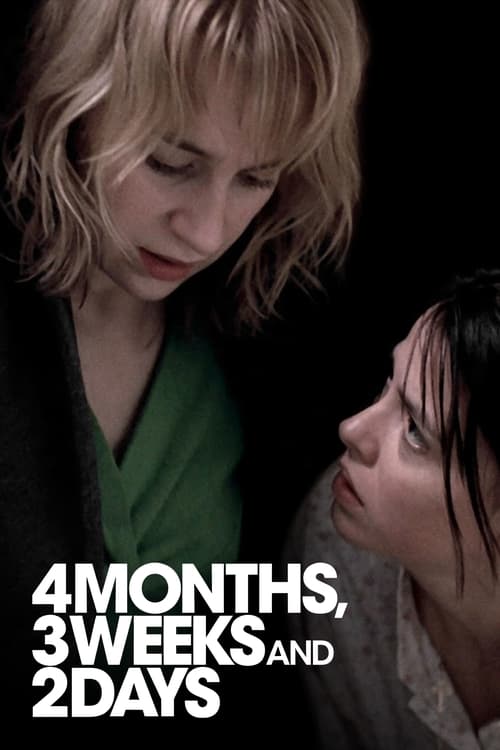
4 Months, 3 Weeks and 2 Days (2007)
Directed by Cristian Mungiu
No — 4 Months, 3 Weeks and 2 Days is not woke, scoring 12 out of 100 on our wokeness meter.
4 Months, 3 Weeks and 2 Days arrives from 2007 Romania with grim patience.
Consciousness Markers
The film centers two women navigating an illegal abortion under a regime that treats their bodies as state property, and dramatizes the sexual exploitation they must endure; it is genuinely concerned with female autonomy and solidarity, though it works through tragic realism rather than polemic.
Poverty, food queues, and bartering for Western goods appear as texture under Ceaușescu's scarcity, and the dinner scene indicts smug middle-class intellectuals against Otilia's rural origins; the target is totalitarian scarcity more than capitalism itself.
An ensemble of Romanian actors headed by two women, but the casting reflects the film's national and naturalistic ambitions rather than any modern diversity mandate.
Mungiu deliberately avoided pushing a political point, keeping communism unnamed and the decree implied, letting the suffering speak for itself.
No LGBTQ+ characters, themes, or subtext appear anywhere in the narrative.
The story involves no racial themes or consciousness; the cast and subject are ethnically homogeneous.
No environmental or climate content whatsoever.
Themes of bodily autonomy are present but framed around coercion and degradation, not body acceptance or body-positivity discourse.
No neurodivergent characters or themes are present.
The film is a historically grounded depiction of 1987 Communist Romania rather than a revisionist reframing of established history.
Why it received this score
4 Months, 3 Weeks and 2 Days arrives from 2007 Romania with grim patience. Two student roommates, Otilia and Gabita, navigate a black market abortion in the final years of the Ceausescu regime. The cast is Romanian, the leads are women, and the film's attention to female experience is real. It is also not a diversity exercise. These performers are here because the story is Romanian. There is no LGBTQ content, no racial consciousness, no climate concern, and no body-positive framing. The bodily autonomy on display is violated and desperate, not celebratory. The feminist current is present but tragic, concerned with solidarity under coercion. It does not stop to explain itself.
The film's political texture is one of scarcity. Food queues, bartered Western goods, and cramped hotel rooms sketch a state that has made daily life a negotiation. The dinner party is the sharpest sequence: smug professionals boast of their degrees, sneer at Otilia's rural origins, and mistake decorum for virtue. That is a critique of class contempt, though its target is totalitarian poverty more than capitalism as such. Mungiu never names communism or Ceausescu and only implies the decree. The suffering speaks for itself. This restraint keeps the lecture energy low. There is no neurodivergent theme, no revisionist history, no attempt to reframe the past for contemporary convenience. The film is historically grounded and emotionally exact.
This is a severe, accomplished work that earns a modest place in the social-consciousness ledger. It cares about women, but it does not campaign. It notices class, but it does not preach. It depicts a regime's cruelty without turning the audience into a classroom. The final scene, with Otilia staring blankly across a restaurant table, is the opposite of a sermon. It offers no remedy, no slogan, no invitation to applaud. We are left with exhaustion, complicity, and the quiet aftermath of survival. As a candidate for contemporary cultural alignment, the film is a period piece. Its sensibilities belong to 1987 Romania and to the art house, not to the current discourse. That is not a flaw. It is simply the classification.
Analysis generated by our Consciousness Algorithm


Synopsis
Two college roommates have 24 hours to make the ultimate choice as they finalize arrangements for a black market abortion.
Questions about 4 Months, 3 Weeks and 2 Days
Is 4 Months, 3 Weeks and 2 Days woke?
No — 4 Months, 3 Weeks and 2 Days is not woke, scoring 12 out of 100 on our wokeness meter. That earns it a verdict of Ultra Based.
Does 4 Months, 3 Weeks and 2 Days have any woke elements?
1 of the 10 markers register at 30 or above, led by Feminist Agenda (35). On Feminist Agenda: The film centers two women navigating an illegal abortion under a regime that treats their bodies as state property, and dramatizes the sexual exploitation they must endure; it is genuinely concerned with female autonomy and solidarity, though it works through tragic realism rather than polemic.
How does 4 Months, 3 Weeks and 2 Days compare to other 2007 movies?
It ranks #66 of the 201 films from 2007 we've scored; their average is 12. The wokest is Like Stars on Earth (92).
How is the Woke Score calculated?
An AI-assisted process researches the film and its reception, scores it 0–100 on ten markers, then combines those into one 0–100 Woke Score. It measures a specific set of 2020s cultural themes, not film quality.