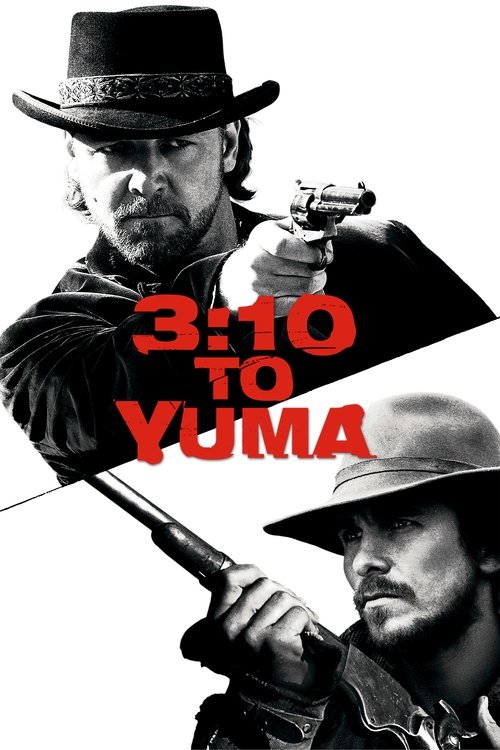
3:10 to Yuma (2007)
Directed by James Mangold
No — 3:10 to Yuma is not woke, scoring 6 out of 100 on our wokeness meter.
The 2007 model of 3:10 to Yuma arrives with a cast of pale faces and a frontier populated by Native warriors who exist to be shot and Chinese laborers who exist to be shot at.
Consciousness Markers
The Southern Pacific Railroad and the predatory banker Hollander are depicted as corrupt moneyed powers, though the film frames this as frontier cynicism rather than systemic critique.
The cast is overwhelmingly white, with Native Americans and Chinese laborers appearing only as anonymous combatants and background figures in the frontier setting.
Mangold keeps the moralizing implicit, letting the father-son redemption and honor themes play out through action rather than sermon.
Gretchen Mol and Vinessa Shaw occupy conventional wife and barmaid roles; the film's concerns are entirely the honor and redemption of its male protagonists.
The drought-plagued ranch motivates Evans's desperation, but it is a personal hardship device rather than any environmental message.
No LGBTQ+ characters, themes, or subtext of any kind appear in this 1884 Arizona Western.
Apache warriors and Chinese laborers function as plot obstacles rather than subjects of any racial commentary or critique.
Dan Evans's amputated leg is a source of shame and backstory, not a body-positivity statement.
No neurodivergent characters or themes are present.
The film is a straightforward genre Western remake, not a reworking of historical record.
Why it received this score
The 2007 model of 3:10 to Yuma arrives with a cast of pale faces and a frontier populated by Native warriors who exist to be shot and Chinese laborers who exist to be shot at. Neither group is granted a line worth remembering or a moment of interiority. The camera regards them as terrain. Gretchen Mol and Vinessa Shaw occupy the wife and barmaid stations with professional competence, and the film's emotional engine runs entirely on the honor of two men. No romantic subtext stirs between any pair of characters, same-sex or otherwise. The saloon is a place of business, not a place of discovery.
The drought that ruins Dan Evans is a plot device, a reason for a man to need two hundred dollars. The Southern Pacific and the banker Hollander are drawn as corrupt moneyed interests, and the film enjoys their villainy the way a Western always has, as frontier cynicism rather than a thesis about systems. Evans's amputated leg is a wound he hides and a shame he confesses, which is the opposite of a celebration. The film has no interest in minds that work differently. It has interest in a man who can shoot.
Mangold does not lecture. He lets the father and the son and the outlaw work out their redemption through gunfire, which keeps the sermonizing to a minimum. This is a remake of a 1957 picture, drawn from an Elmore Leonard short story, and it does not attempt to revise the historical record or correct the genre's sins. It simply tells a sturdy story about a train, a debt, and a man who wants his boys to see him stand. The moralizing stays implicit. The result is a well-made Western that asks nothing of the audience beyond attention.
On the whole, the picture is a competent, unsentimental piece of genre craftsmanship, and its cultural awareness extends about as far as the nearest saloon door. It knows what it is. That is not nothing, but it is also not much to classify. The ledger is short, and the entries are faint. We file it accordingly and move on to the next screening, where perhaps someone will have something to say about the world we actually live in. Perhaps not. The projector hums either way, indifferent to our hopes, and so, increasingly, are we.
The final reel offers a man redeemed by a bullet and a boy who learns that killing is not the answer, a lesson delivered without a single speech. It is the sort of quiet moral arithmetic the genre has practiced for a century. Nothing in it insists on being read as commentary, and nothing in it rewards the attempt. The film simply stands there, dusty and well-lit, waiting for the train. We respect the restraint, and we note the absence of anything else worth noting. The Western endures. So does the silence around it. We score the markers, we close the ledger, we wait for the 3:10 to arrive.
What remains is a film that trusts its performers and distrusts its audience only in the mildest degree. Crowe and Bale do the heavy lifting, and the heavy lifting is mostly lifting revolvers. The women wait at the homestead. The railroad waits at the depot. The Apaches wait on the ridge to be dispatched. Everyone knows their station, which is the point of a Western and also the reason there is so little to analyze here. It is a well-oiled machine, and machines do not have opinions. We file it, we nod, we move on. The next picture is already queued, and the lights are dimming. We are, as ever, ready. The ledger closes. The train departs. The whistle fades into the canyon, and the dust settles on a story that was never trying to say anything at all. We respect that. We always do. The end credits roll, and we sit through them, because leaving early would be a kind of judgment, and judgment is our job, not theirs. The theater empties. The screen goes dark. Somewhere, a horse gallops after a train, faithful to the last, asking no questions. Neither do we. The classification stands. The record is complete. We move to the next title on the docket, pen in hand, patient as ever, waiting for something to actually happen. It rarely does. We keep watching anyway. That is the work. That is always the work.
Analysis generated by our Consciousness Algorithm
Part of


Synopsis
In Arizona in the late 1800s, infamous outlaw Ben Wade and his vicious gang of thieves and murderers have plagued the Southern Railroad. When Wade is captured, Civil War veteran Dan Evans, struggling to survive on his drought-plagued ranch, volunteers to deliver him alive to the "3:10 to Yuma", a train that will take the killer to trial.
Questions about 3:10 to Yuma
Is 3:10 to Yuma woke?
No — 3:10 to Yuma is not woke, scoring 6 out of 100 on our wokeness meter. That earns it a verdict of Ultra Based.
Does 3:10 to Yuma have any woke elements?
Very few. None of the 10 markers reaches 30, the level where a marker counts as present; the highest is Eat the Rich at 15.
How does 3:10 to Yuma compare to other 2007 movies?
It ranks #115 of the 201 films from 2007 we've scored; their average is 12. The wokest is Like Stars on Earth (92).
How is the Woke Score calculated?
An AI-assisted process researches the film and its reception, scores it 0–100 on ten markers, then combines those into one 0–100 Woke Score. It measures a specific set of 2020s cultural themes, not film quality.