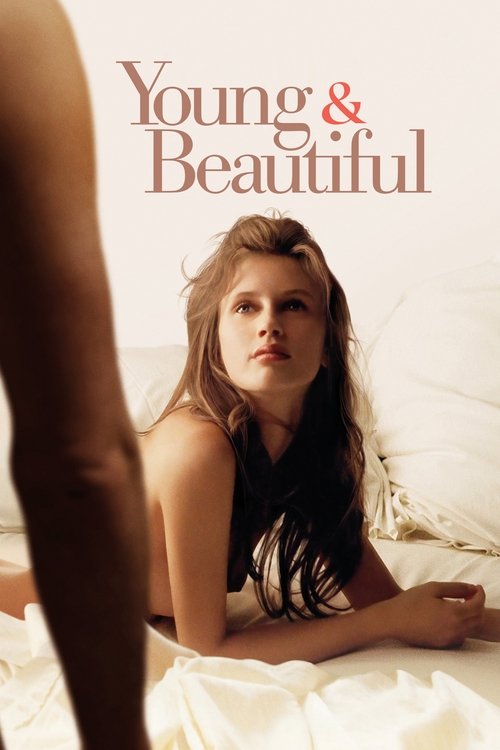
Young & Beautiful (2013)
Directed by François Ozon
No — Young & Beautiful is not woke, scoring 4 out of 100 on our wokeness meter.
If a film can hold its subject at arm's length while undressing it, François Ozon's Young and Beautiful manages the trick with a jeweler's composure.
Consciousness Markers
The film centers on a young woman's sexual agency, but critics (e.g. Bradshaw) dismissed it as a 'very male fantasy' rather than a feminist statement. It observes rather than advocates.
A French production with a predominantly white cast; a couple of non-white actors appear in minor, unremarked roles. No deliberate diverse-casting agenda is evident.
Ozon's film is deliberately subdued and observational, avoiding moralizing or preachy messaging about its subject matter.
Prostitution is depicted as a transactional economy and a student money-making trend, but the film offers no critique of capitalism or wealth.
No LGBTQ+ characters, themes, or subtext appear in the film.
Race is not a subject of the film; no racial themes or commentary are present.
No environmental or climate themes whatsoever.
No body-positivity messaging; the film's nudity is aesthetic and erotic rather than a statement about body acceptance.
No neurodivergent characters or themes are present.
A contemporary fictional character study with no historical revisionism.
Why it received this score
If a film can hold its subject at arm's length while undressing it, François Ozon's Young and Beautiful manages the trick with a jeweler's composure. Isabelle, seventeen and adrift, loses her virginity to a German boy on a summer holiday, finds the experience hollow, and returns to Paris to quietly open for business under the name Léa. The camera watches. It does not scold and it does not celebrate. Charlotte Rampling drifts in near the close as the widow of a client who expired mid-encounter, and the final scene between the two women carries more warmth than anything that came before it.
The film concerns a young woman's sexual self-possession, which invites the expectation of a statement. What arrives instead is a mood. Peter Bradshaw, no reactionary, called it a very male fantasy, the polite European way of saying the camera enjoys what it claims to study. There is agency here, chilly and unresolved. There is no argument bolted to it, no thesis, no program. The movie watches a girl treat intimacy as a transaction and refuses to lecture about either.
The usual apparatus of contemporary social concern is absent. Race is not a subject. Neither is class grievance, though money does change hands and the trade is rendered as a student side hustle. The therapist appears for one scene and offers no sermon. Isabelle's mother slaps her, apologizes, grounds her, and the film lets the mess stand. What we get is a portrait, cool and slightly cruel, of a girl the movie declines to diagnose. It is elegant, unsettling, and entirely without a message, which in this climate feels like its own quiet provocation.
Analysis generated by our Consciousness Algorithm


Synopsis
Isabelle, a 17-year-old student, loses her virginity during a quick holiday romance. When she returns home, she begins a secret life as a prostitute for a year.
Questions about Young & Beautiful
Is Young & Beautiful woke?
No — Young & Beautiful is not woke, scoring 4 out of 100 on our wokeness meter. That earns it a verdict of Ultra Based.
Does Young & Beautiful have any woke elements?
Very few. None of the 10 markers reaches 30, the level where a marker counts as present; the highest is Feminist Agenda at 12.
How does Young & Beautiful compare to other 2013 movies?
It ranks #210 of the 274 films from 2013 we've scored; their average is 14. The wokest is Belle (76).
How is the Woke Score calculated?
An AI-assisted process researches the film and its reception, scores it 0–100 on ten markers, then combines those into one 0–100 Woke Score. It measures a specific set of 2020s cultural themes, not film quality.