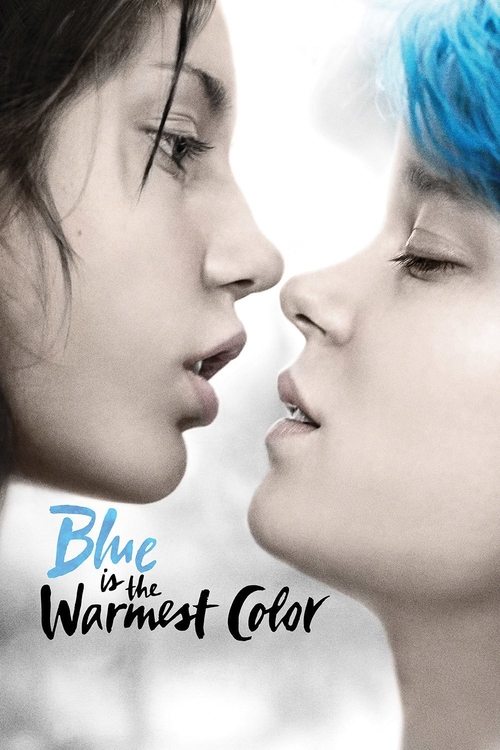
Blue Is the Warmest Color (2013)
Directed by Abdellatif Kechiche
Yes — Blue Is the Warmest Color is woke, scoring 60 out of 100 on our wokeness meter.
Abdellatif Kechiche's 2013 drama follows Adele, a French teenager, from a restless high school romance with a boy through her awakening into a consuming relationship with Emma, a blue-haired art student.
Consciousness Markers
Lesbian sexuality, coming out, homophobia, gay bars, and a pride parade are central to the narrative and the protagonist's self-discovery.
The film centers two female leads and a lesbian relationship, with some supporting gay and ethnically diverse characters, but the principal cast remains predominantly white and the diversity is not a modern intersectional showcase.
The film explores female desire, identity, and autonomy, but its explicit lesbian sex scenes and male directorial gaze have drawn sustained feminist criticism rather than clear feminist endorsement.
The film contrasts working-class and bourgeois milieus and includes a brief education protest with a Communist Party song, but class critique remains a subtle backdrop rather than an anti-capitalist crusade.
The film is emotionally immersive and character-driven rather than preachy, with only mild thematic gestures toward social class and education.
Race and racism are not thematic concerns; any background diversity in protest scenes is incidental and not explored.
There is no engagement with climate change or environmental themes.
Nudity and sexuality are present, but the film does not advance body-positivity themes or body-acceptance messaging.
No characters or themes related to neurodivergence are present.
The film is a contemporary romantic drama adapted from a graphic novel, not a historical revisionist work.
Why it received this score
Abdellatif Kechiche's 2013 drama follows Adele, a French teenager, from a restless high school romance with a boy through her awakening into a consuming relationship with Emma, a blue-haired art student. The film runs three hours and refuses to blink. We watch Adele eat, teach, cry, and lose herself across a decade of small rooms. It won the Palme d'Or at Cannes, handed jointly to the director and his two leads, a gesture the festival has repeated sparingly since. The narrative is adapted from Julie Maroh's graphic novel, though the adaptation drifts some distance from its source.
For a film so consumed by a lesbian love affair, its treatment of that affair sits in a strange light. The relationship is the whole architecture: the coming out, the gay bar, the pride march, the homophobic schoolyard, the closeted dinners with conservative parents. This is a full account of queer self-discovery, and it carries real weight. What it does not deliver is any sustained engagement with race, environment, or disability. Those concerns are simply absent, and the film does not pretend otherwise. Class fares slightly better. Adele's working-class family eats differently from Emma's bourgeois artistic set, and a song of the French Communist Party plays over one protest march. The critique stays a backdrop, never a crusade.
The feminist reading is murkier. The film grants Adele desire and autonomy, yet the explicit sex scenes, shot at length by a heterosexual director, drew years of criticism from scholars who found the gaze less observational than proprietorial. The result is a work of genuine emotional force and contested politics. It is immersive, not sermonizing. Whatever social argument it carries arrives through the body and the dinner table, never through a speech. We are left with a portrait of desire that resists tidy classification, which is either its triumph or its evasion, depending on the evening and the critic.
{"thematic_tags": ["book_adaptation"]}
Analysis generated by our Consciousness Algorithm


Synopsis
Adèle's life is changed when she meets Emma, a young woman with blue hair, who will allow her to discover desire, to assert herself as a woman and as an adult. In front of others, Adele grows, seeks herself, loses herself, finds herself.
Questions about Blue Is the Warmest Color
Is Blue Is the Warmest Color woke?
Yes — Blue Is the Warmest Color is woke, scoring 60 out of 100 on our wokeness meter. That earns it a verdict of Woke.
What makes Blue Is the Warmest Color woke?
3 of the 10 markers register at 30 or above, led by LGBTQ+ Themes (95), Feminist Agenda (40) and Representation Casting (40). On LGBTQ+ Themes: Lesbian sexuality, coming out, homophobia, gay bars, and a pride parade are central to the narrative and the protagonist's self-discovery.
How does Blue Is the Warmest Color compare to other 2013 movies?
It ranks #5 of the 274 films from 2013 we've scored; their average is 14. The wokest is Belle (76).
How is the Woke Score calculated?
An AI-assisted process researches the film and its reception, scores it 0–100 on ten markers, then combines those into one 0–100 Woke Score. It measures a specific set of 2020s cultural themes, not film quality.