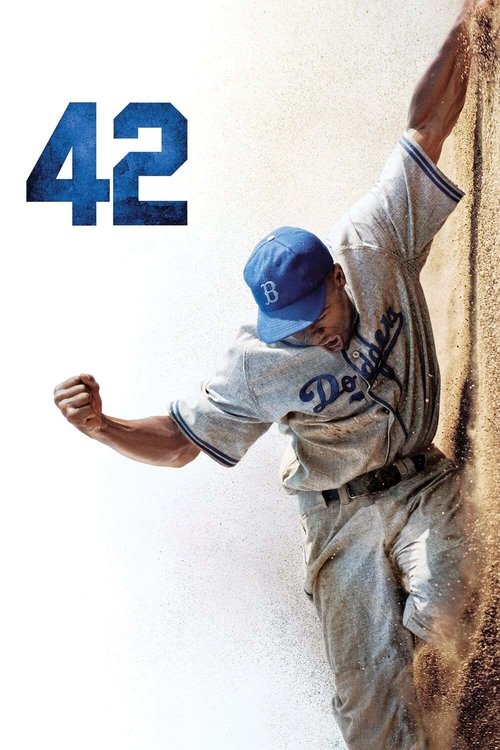
42 (2013)
Directed by Brian Helgeland
Yes — 42 is woke, scoring 74 out of 100 on our wokeness meter.
Brian Helgeland's 42 arrives with the solemnity of a monument and the pacing of a well-kept box score.
Consciousness Markers
The entire narrative confronts segregation, racial slurs, and the color line in baseball, explicitly dramatizing racism and integration.
The film centers on a Black historical figure and features a predominantly Black principal cast, including Chadwick Boseman, Nicole Beharie, and André Holland, in a major studio production.
The film includes earnest moral speeches about equality, restraint, and racial progress, but its message is delivered in a traditional inspirational-sports-drama mode.
There are no LGBTQ+ characters, relationships, or themes in the film.
Rachel Robinson is portrayed as a supportive spouse, but the film does not advance a feminist agenda or center women's agency.
No environmental or climate themes are present.
The film celebrates Brooklyn Dodgers owner Branch Rickey as a moral capitalist who integrates baseball, with no critique of wealth or capitalism.
No body-positivity themes or plus-size representation are present.
No neurodivergent characters or themes are present.
The film presents a conventional, historically grounded biopic of Jackie Robinson rather than a revisionist reinterpretation of history.
Why it received this score
Brian Helgeland's 42 arrives with the solemnity of a monument and the pacing of a well-kept box score. It concerns Jackie Robinson's passage from the Kansas City Monarchs to the Brooklyn Dodgers between 1945 and 1947, and it treats that passage as a civic event. Chadwick Boseman plays Robinson with a coiled stillness, and the supporting cast is populated largely by Black performers of real presence: Nicole Beharie as Rachel, André Holland as the chronicler Wendell Smith. A major studio, in 2013, handed a substantial budget to a predominantly Black ensemble and let them carry the picture. That is an industrial fact, and it registers.
The film's cultural awareness is not incidental. It is the engine. Segregation is dramatized in dugouts and dining rooms, at the gas station where Robinson is refused service before he has thrown a pitch. Ben Chapman's taunting is rendered at length, the slurs unsoftened, and the camera declines to look away from the cost of restraint. Pee Wee Reese's arm over Robinson's shoulder lands as the intended sacrament. The color line is the subject, and the film knows it.
Where the picture settles into comfort is its sermonizing. Branch Rickey, played by Harrison Ford behind prosthetics and a fat suit, delivers speeches about courage and profit with the same unblinking gravity, and the film treats his business instincts as moral heroism. No such ambivalence troubles the rest of the frame. There is no feminist argument here, no queer presence, no environmental conscience, no critique of the money that built the ballpark. Just a good man, a great wrong, and a jersey number retired in perpetuity.
The result is earnest, well-mounted, and entirely conventional in its virtues. We have seen this shape before, and we will see it again, and we will dutifully record it as what it is: a history lesson delivered in a comfortable chair, with peanuts.
{"thematic_tags": ["true_story", "box_office_number_one"]}
Analysis generated by our Consciousness Algorithm


Synopsis
In 1947, Jackie Robinson becomes the first Black man to play in Major League Baseball facing unabashed racism from the public, the press and other players.
Questions about 42
Is 42 woke?
Yes — 42 is woke, scoring 74 out of 100 on our wokeness meter. That earns it a verdict of Woke.
What makes 42 woke?
3 of the 10 markers register at 30 or above, led by Racial Consciousness (85), Representation Casting (75) and Lecture Energy (50). On Racial Consciousness: The entire narrative confronts segregation, racial slurs, and the color line in baseball, explicitly dramatizing racism and integration.
How does 42 compare to other 2013 movies?
It ranks #2 of the 274 films from 2013 we've scored; their average is 14. The wokest is Belle (76).
How is the Woke Score calculated?
An AI-assisted process researches the film and its reception, scores it 0–100 on ten markers, then combines those into one 0–100 Woke Score. It measures a specific set of 2020s cultural themes, not film quality.