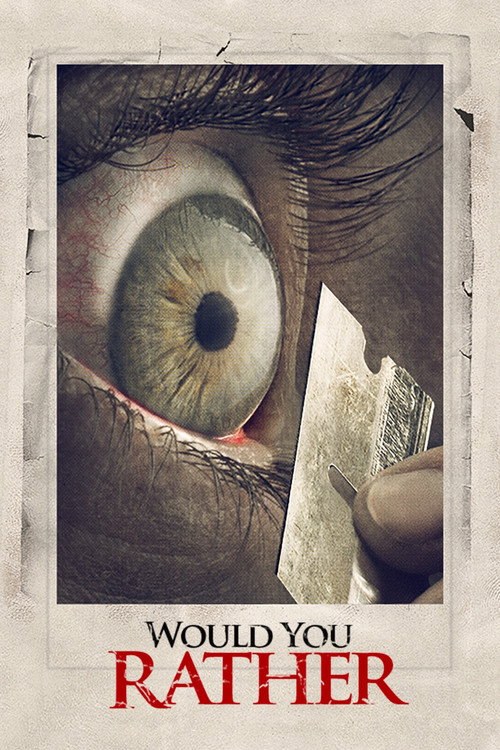
Would You Rather (2013)
Directed by David Guy Levy
No — Would You Rather is not woke, scoring 12 out of 100 on our wokeness meter.
Would You Rather arrives from 2012 with the grim efficiency of a party game nobody wanted to attend.
Consciousness Markers
The villain is a sadistic aristocrat who buys desperate people's suffering for sport, giving the film a genuine rich-vs-poor predation streak, though it plays as a horror trope rather than a political argument.
The cast includes a couple of Black actors in supporting roles (Lawrence Gilliard Jr., Eddie Steeples), but they exist naturally in the ensemble with no commentary on identity or representation.
Iris is a resourceful female survivor, but the film offers no feminist thesis; the rape attempt on her is a stock horror beat rather than a gendered critique.
The film is a lean torture-game thriller that never pauses to deliver a moral lesson or social message.
No LGBTQ+ characters, themes, or subtext appear anywhere in the film.
No engagement with race or racial dynamics; the class conflict is economic, not racial.
No environmental or climate themes whatsoever.
No body-positivity themes; the paralyzed character is used for shock and peril, not representation.
No neurodivergent characters or themes are present.
No historical revisionism; the film is a contemporary fictional thriller.
Why it received this score
Would You Rather arrives from 2012 with the grim efficiency of a party game nobody wanted to attend. Iris needs money for her brother's leukemia treatment, a philanthropist named Shepard Lambrick offers a dinner invitation, and the evening descends into electric shocks, ice picks, and a barrel of water. The film is lean, mean, and entirely uninterested in explaining itself. It kills its characters quickly and moves on, which is its one genuine virtue.
The class resentment here is real but unexamined. Shepard is an aristocrat who purchases the suffering of the desperate for sport, and the film clearly enjoys watching him do it. That is a rich-versus-poor predation streak, though it functions as a horror staple, not an argument. The cast includes a few Black performers in the ensemble, present and unremarked upon, which is exactly how it should be and also exactly why it registers so faintly. Iris proves resourceful under pressure, stabbing her would-be rapist in the leg with an ice pick, but the assault plays as a stock beat of the genre. No thesis accompanies it.
A paralyzed elderly woman exists mostly so that an ice pick can find her artery. Nobody pauses to deliver a moral. The film is too busy drowning people to lecture anyone about anything, and the absence of a sermon is a relief. Instead we get ninety minutes of escalating cruelty that ends with a young woman shooting her last opponent and going home to discover her brother has overdosed anyway. The nihilism is honest. The social commentary is not present, and the film does not pretend otherwise. It is a nasty little chamber piece, and it knows it.
Analysis generated by our Consciousness Algorithm


Synopsis
Desperate to help her ailing brother, a young woman agrees to compete in a deadly game of "Would You Rather" hosted by a sadistic aristocrat.
Questions about Would You Rather
Is Would You Rather woke?
No — Would You Rather is not woke, scoring 12 out of 100 on our wokeness meter. That earns it a verdict of Ultra Based.
Does Would You Rather have any woke elements?
1 of the 10 markers register at 30 or above, led by Eat the Rich (35). On Eat the Rich: The villain is a sadistic aristocrat who buys desperate people's suffering for sport, giving the film a genuine rich-vs-poor predation streak, though it plays as a horror trope rather than a political argument.
How does Would You Rather compare to other 2013 movies?
It ranks #104 of the 274 films from 2013 we've scored; their average is 14. The wokest is Belle (76).
How is the Woke Score calculated?
An AI-assisted process researches the film and its reception, scores it 0–100 on ten markers, then combines those into one 0–100 Woke Score. It measures a specific set of 2020s cultural themes, not film quality.