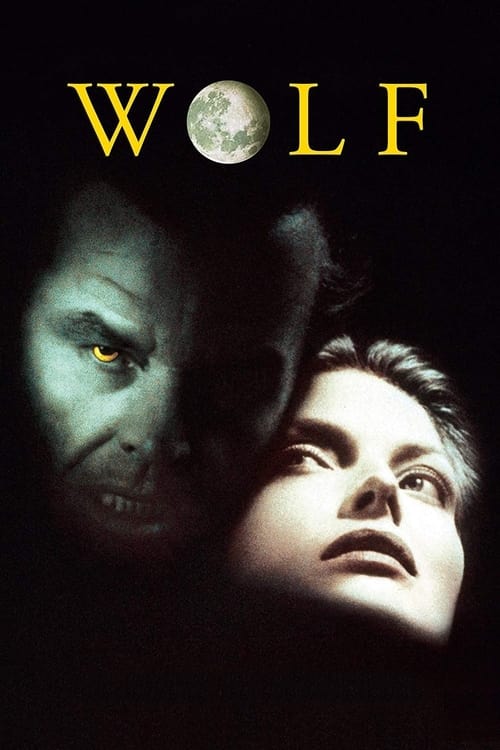
Wolf (1994)
Directed by Mike Nichols
No — Wolf is not woke, scoring 13 out of 100 on our wokeness meter.
Mike Nichols made a werewolf picture for people who read book reviews, which is to say a werewolf picture in which the mauling is tasteful and the real horror is a corporate restructuring.
Consciousness Markers
The corporate-jungle satire targets a publishing house swallowed by a tycoon, and Will's writers' mutiny has faint anti-corporate bite, but it is office-politics comedy rather than systemic critique of capitalism.
Laura Alden is described as 'headstrong' and ultimately dispatches Swinton with a gun, giving her a measure of agency, but the narrative remains firmly centered on Will's male midlife crisis and unleashed libido.
The cast is overwhelmingly white, though Om Puri appears as the mystical Dr. Vijay Alezais, adding a single non-white supporting presence without comment.
Critics noted the film explores its werewolf-as-metaphor premise somewhat seriously, but it prioritizes seductive genre entertainment over didactic messaging.
Om Puri's character functions as a generic exotic mystic dispensing folk wisdom about paganism; there is no engagement with racial politics or consciousness.
No LGBTQ+ characters, themes, or subtext appear in the film.
The film touches on wild nature and deer-mauling but makes no environmental or climate argument.
No body-positivity themes are present; the film traffics in conventional Hollywood attractiveness and physical transformation as horror.
The werewolf transformation is framed as a metaphor for midlife virility and primal id, not as neurodivergence or mental-health representation.
The film is a contemporary werewolf fantasy with no historical revisionism.
Why it received this score
Mike Nichols made a werewolf picture for people who read book reviews, which is to say a werewolf picture in which the mauling is tasteful and the real horror is a corporate restructuring. Jack Nicholson plays Will Randall, a New York editor demoted by a tycoon, bitten by a wolf in Vermont, and subsequently restored to rude health and sharper senses. The metaphor is not buried. Unleashed libido, office politics, the law of the corporate jungle, all of it announced early and never quite resolved. Jim Harrison wanted Dionysus and got something closer to a well-groomed terrier, and he left Hollywood over it, which tells us the wolf was always going to be housebroken.
On the matter of social consciousness, the film is a period piece from a gentler era. The cast is overwhelmingly white, with Om Puri arriving as a pagan expert to dispense folk wisdom and vanish, a single non-white presence offered without comment or consequence. Michelle Pfeiffer's Laura is called headstrong and does eventually shoot the villain, though the camera stays fixed on a middle-aged man's awakening. There is faint anti-corporate bite in the writers' mutiny against the new owner, but it amounts to office comedy, not a verdict on capital. No queer subtext, no climate argument, no body politics, no neurodivergence, no revisionist history. The film is about a man who grows hair and feels better.
What we have, then, is a slick studio entertainment that flirts with seriousness and declines to commit. Critics of the day praised its first hour and watched it unravel after the midpoint. Ennio Morricone scored it beautifully. A Saturn Award came for the screenplay. The cultural instruction manual remains, on this evidence, unopened.
Analysis generated by our Consciousness Algorithm


Synopsis
Aging publisher Will Randall is at the end of his rope when a younger co-worker snatches his job out from under his nose. But after being bitten by a wolf, Will suddenly finds himself full of youthful vigor. As he struggles to regain his position, he becomes enthralled with Laura Alden, his former boss's daughter. And, as increasingly animal-like urges begin to overwhelm him, Randall worries that he may be turning into the creature that bit him.
Questions about Wolf
Is Wolf woke?
No — Wolf is not woke, scoring 13 out of 100 on our wokeness meter. That earns it a verdict of Ultra Based.
Does Wolf have any woke elements?
Very few. None of the 10 markers reaches 30, the level where a marker counts as present; the highest is Eat the Rich at 25.
How does Wolf compare to other 1994 movies?
It ranks #19 of the 86 films from 1994 we've scored; their average is 10. The wokest is On Deadly Ground (75).
How is the Woke Score calculated?
An AI-assisted process researches the film and its reception, scores it 0–100 on ten markers, then combines those into one 0–100 Woke Score. It measures a specific set of 2020s cultural themes, not film quality.