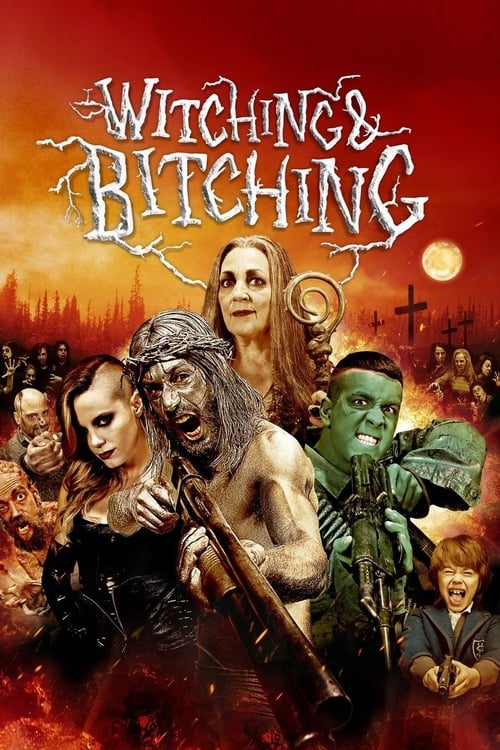
Witching & Bitching (2013)
Directed by Álex de la Iglesia
No — Witching & Bitching is not woke, scoring 8 out of 100 on our wokeness meter.
Álex de la Iglesia's Witching & Bitching arrives with a title that promises mischief and a plot that delivers more of it than anyone requested.
Consciousness Markers
The film stages a literal battle of the sexes between a matriarchal cannibal coven and bumbling male thieves, and Eva defies her mother for a man, but this is exploitation of witch tropes rather than a feminist statement. It interrogates gender dynamics without advocating for them.
The heist is motivated by post-crisis financial desperation, with unemployed men robbing a pawn shop, giving a faint economic-underclass grievance, but it is never developed into a critique of capitalism.
The cast is uniformly Spanish and ethnically homogeneous, with no visible effort at diverse or inclusive casting. Nothing in the film comments on representation.
No LGBTQ+ characters, themes, or subtext appear anywhere in the film.
Race is entirely absent as a subject; the film operates in a racially undifferentiated Spanish context.
No environmental or climate themes whatsoever.
The grotesque fertility-statue goddess is deployed for body horror and disgust, the opposite of body-positive messaging.
No neurodivergent characters or themes are present.
The Zugarramurdi locale evokes the historical Basque witch trials, but the film is pure supernatural fantasy with no revisionist historical argument.
This is a gleefully tasteless gross-out horror comedy with no preachy or didactic agenda to deliver.
Why it received this score
Álex de la Iglesia's Witching & Bitching arrives with a title that promises mischief and a plot that delivers more of it than anyone requested. Two desperate men rob a pawn shop in Madrid, kidnap a taxi driver, and flee north into Navarre, where a coven of cannibal witches waits with an oven, a pyre, and a fertility goddess the size of a small building. The film is loud, sticky, and cheerfully revolting. It collected eight Goyas, mostly for technical work, which tells us where the craft lives: in the prosthetics, the lighting, and the sheer logistical effort of staging a giant woman swallowing a child and returning him alive.
The social content is glancing at best. The robbery is motivated by financial desperation in a post-crisis Spain, which grants the men a faint whiff of economic grievance that the screenplay never bothers to develop. The witches rule as a matriarchy and the thieves bumble as men, and Eva betrays her mother for a handsome stranger, so gender is on the table. It is there as spectacle, though, not argument. The towering fertility idol exists to be hideous, which is the opposite of any affirmative politics of the body. Race, queerness, and the environment make no appearance at all. Nobody in this film has a lesson to impart, and nobody seems to want one.
The film does possess a disreputable energy that is hard to resist and harder to respect. De la Iglesia stages chaos with real precision, and the closing gag, in which the witches survive and settle in to wait for the couple's happiness to curdle, is genuinely mean. We are left with something nasty, funny, and entirely without a message. In this instance, that absence is the only virtue on offer.
Analysis generated by our Consciousness Algorithm


Synopsis
A gang of gold thieves land in a coven of witches who are preparing for an ancient ritual... and in need of a sacrifice.
Questions about Witching & Bitching
Is Witching & Bitching woke?
No — Witching & Bitching is not woke, scoring 8 out of 100 on our wokeness meter. That earns it a verdict of Ultra Based.
Does Witching & Bitching have any woke elements?
Very few. None of the 10 markers reaches 30, the level where a marker counts as present; the highest is Feminist Agenda at 15.
How does Witching & Bitching compare to other 2013 movies?
It ranks #137 of the 274 films from 2013 we've scored; their average is 14. The wokest is Belle (76).
How is the Woke Score calculated?
An AI-assisted process researches the film and its reception, scores it 0–100 on ten markers, then combines those into one 0–100 Woke Score. It measures a specific set of 2020s cultural themes, not film quality.