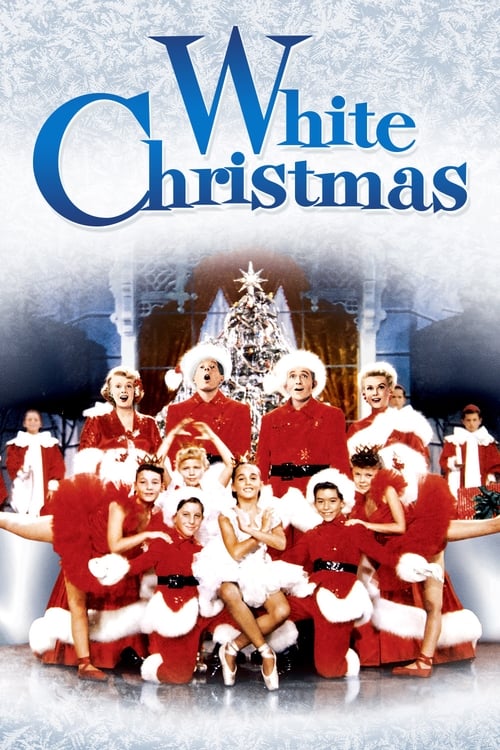
White Christmas (1954)
Directed by Michael Curtiz
No — White Christmas is not woke, scoring 5 out of 100 on our wokeness meter.
White Christmas arrives from 1954 with VistaVision polish, Irving Berlin tunes, and a plot that moves from a wartime Christmas show to a Vermont inn in need of snow and paying guests.
Consciousness Markers
The Haynes sisters have performing careers and some professional agency, but the plot is a conventional 1950s matchmaking romance that subordinates them to the men's schemes.
The film is warm and sentimental but not preachy; its moralizing is limited to gentle themes of loyalty and generosity toward a retired general.
The cast is entirely white, with no meaningful racial or ethnic diversity in any role.
No LGBTQ+ characters or themes appear anywhere in the film.
The film contains a minstrel-style number ('I'd Rather See a Minstrel Show'/'Mister Bones'), which is the opposite of racial consciousness and reflects period racial insensitivity rather than critique.
The lack of snow is a plot device driving the inn's financial troubles, not an environmental or climate-change statement.
The film's ethos is sentimental charity toward a beloved general, not any critique of wealth, capitalism, or class structures.
No body-positivity themes; the film adheres to conventional mid-century beauty standards.
No neurodivergent characters or themes are present.
The WWII and post-war setting is presented in a nostalgic, uncritical, period-appropriate manner with no historical revisionism.
Why it received this score
White Christmas arrives from 1954 with VistaVision polish, Irving Berlin tunes, and a plot that moves from a wartime Christmas show to a Vermont inn in need of snow and paying guests. Bing Crosby and Danny Kaye sing and dance. Rosemary Clooney and Vera-Ellen play the Haynes sisters. The film is a warm, efficient entertainment machine, and its social awareness is close to zero. The cast is uniformly white. No queer lives, no environmental anxiety, no critique of wealth. The snow is a plot device for a failing business, not a planetary alarm. The minstrel number, 'I'd Rather See a Minstrel Show' and 'Mister Bones', is period racial insensitivity presented as harmless fun. That is not consciousness. That is a time capsule with the lid nailed shut.
Gender gets a flicker. The Haynes sisters have a professional act and a measure of control over their careers. The story still arranges them into a double matchmaking scheme, with the men doing the planning and the women doing the emotional cleanup. The film's moral center is generosity toward a retired general, which is touching and entirely safe. There is no eat-the-rich energy, no body-positivity message, no neurodivergent perspective. The Second World War is remembered as a reunion of lovable soldiers, not as a subject for revision or critique. Nostalgia is the house style.
Lecture energy is low. The film prefers a gentle nudge about loyalty and kindness to a podium. It wants us to feel good, sing along, and perhaps buy a record. That is not a crime. It is also not a challenge to any inherited structure. White Christmas endures as a seasonal confection: smooth, tuneful, and dated in ways its makers never had to notice. We file it under sentimental mid-century comfort, with a faint feminist pulse and a minstrel number that keeps the past uncomfortably present.
Analysis generated by our Consciousness Algorithm
Part of


Synopsis
Two talented song-and-dance men team up after the war to become one of the hottest acts in show business. In time they befriend and become romantically involved with the beautiful Haynes sisters who comprise a sister act.
Questions about White Christmas
Is White Christmas woke?
No — White Christmas is not woke, scoring 5 out of 100 on our wokeness meter. That earns it a verdict of Ultra Based.
Does White Christmas have any woke elements?
Very few. None of the 10 markers reaches 30, the level where a marker counts as present; the highest is Feminist Agenda at 8.
How does White Christmas compare to other 1954 movies?
It ranks #3 of the 14 films from 1954 we've scored; their average is 4. The wokest is Seven Brides for Seven Brothers (12).
How is the Woke Score calculated?
An AI-assisted process researches the film and its reception, scores it 0–100 on ten markers, then combines those into one 0–100 Woke Score. It measures a specific set of 2020s cultural themes, not film quality.