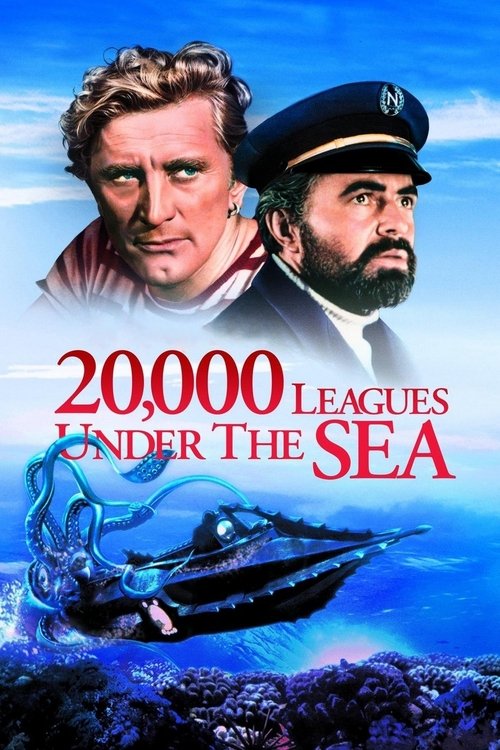
20,000 Leagues Under the Sea (1954)
Directed by Richard Fleischer
No — 20,000 Leagues Under the Sea is not woke, scoring 4 out of 100 on our wokeness meter.
Richard Fleischer's 1954 adaptation of the Verne novel is a Technicolor heirloom, and we examine it the way a sommelier examines a bottle from a cellar nobody has opened since the Eisenhower administration.
Consciousness Markers
Nemo delivers a closing homily about hope for the future and a 'new and better life,' but the moralizing is brief and romantic rather than a sustained sermon on contemporary social issues.
Nemo's withdrawal from civilization and his attack on a munitions ship carry a faint anti-war, anti-imperialist whiff, but there is no economic critique of wealth or class in the modern 'eat the rich' sense.
The cast is entirely white men, and Captain Nemo — an Indian prince in Verne's novel — is here played by the English James Mason, erasing the character's non-European origins. No modern representation casting whatsoever.
No LGBTQ+ characters, themes, or subtext of any kind.
No feminist content; the sole female presence is an uncredited background performer. The film's gender politics are purely 19th-century adventure fare.
Nemo's grievance against 'this hated nation' is left deliberately vague and framed as personal revenge rather than any racial or colonial critique. No racial consciousness is articulated.
No environmental or climate themes; the sea is a wonder to be harvested and explored, not a cause to be defended.
No body positivity themes present.
Nemo is described as 'cracked' (insane), but this is a Victorian melodramatic trope of the vengeful madman, not a modern neurodivergence narrative.
A work of speculative fiction with no historical revisionism; it invents rather than reinterprets the past.
Why it received this score
Richard Fleischer's 1954 adaptation of the Verne novel is a Technicolor heirloom, and we examine it the way a sommelier examines a bottle from a cellar nobody has opened since the Eisenhower administration. Kirk Douglas sings a song about a whale. James Mason broods beneath the waves as Captain Nemo. A squid is fought with harpoons and grim determination. The picture won two Academy Awards and reached the top of the domestic box office, facts we record without editorializing, because the archive demands accuracy.
We searched the Nautilus for signs of contemporary social consciousness and found the viewport empty. Nemo, an Indian prince in the source material, is here an Englishman, his origins erased along with any colonial grievance. The lone woman in the cast is an uncredited background performer. There is no LGBTQ content, no body positivity, no neurodivergence narrative, no climate crusade. The sea is a pantry and a playground, not a cause. Nemo is called cracked, which is the Victorian shorthand for a vengeful madman, not a diagnosis with dignity.
Two faint signals flicker. Nemo renounces civilization and sinks a munitions ship, a gesture with a whiff of anti-war sentiment but no economic critique worth the name. His closing homily about hope for the future lasts a moment and asks nothing of us. This is adventure cinema of the old school, its moralizing romantic and brief. We score it accordingly and move on.
Analysis generated by our Consciousness Algorithm
Part of


Synopsis
A ship sent to investigate a wave of mysterious sinkings encounters the advanced submarine, the Nautilus, commanded by Captain Nemo.
Questions about 20,000 Leagues Under the Sea
Is 20,000 Leagues Under the Sea woke?
No — 20,000 Leagues Under the Sea is not woke, scoring 4 out of 100 on our wokeness meter. That earns it a verdict of Ultra Based.
Does 20,000 Leagues Under the Sea have any woke elements?
Very few. None of the 10 markers reaches 30, the level where a marker counts as present; the highest is Lecture Energy at 10.
How does 20,000 Leagues Under the Sea compare to other 1954 movies?
It ranks #5 of the 14 films from 1954 we've scored; their average is 4. The wokest is Seven Brides for Seven Brothers (12).
How is the Woke Score calculated?
An AI-assisted process researches the film and its reception, scores it 0–100 on ten markers, then combines those into one 0–100 Woke Score. It measures a specific set of 2020s cultural themes, not film quality.