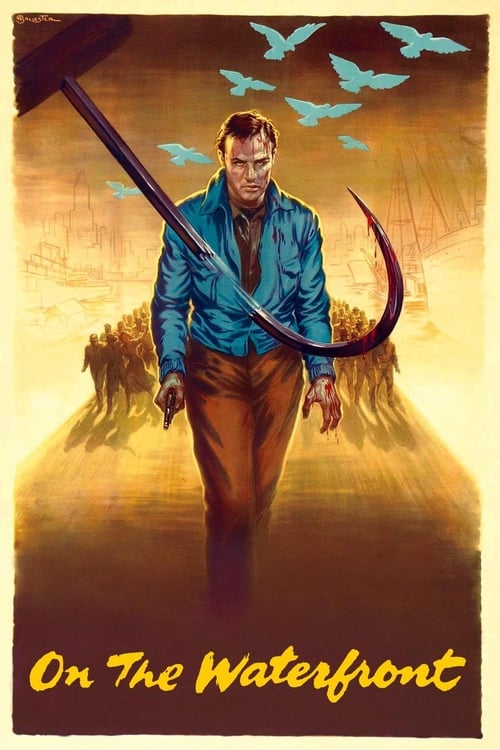
On the Waterfront (1954)
Directed by Elia Kazan
No · Ultra Based
How we score movies →Consciousness Markers
While the film critiques labor union corruption, it does so through a lens of individual moral failure rather than systemic critique. Reform is presented as a matter of personal virtue, not structural change.
The film occasionally indulges in moral exposition, particularly in scenes between the priest and protagonist, but this is restrained compared to more preachy works. The narrative mostly shows rather than tells.
The cast reflects the ethnic composition of 1950s New York working-class communities, but this representation is incidental rather than intentional. No meaningful effort toward diverse casting for leadership roles.
The film presents labor unions and their representatives as sources of corruption and violence, a framing that, while not entirely inaccurate, simplifies complex historical realities and aligns with anti-union sentiment of the period.
The film presents a working-class environment with some ethnic diversity in supporting roles, but there is no meaningful exploration of racial dynamics or racial consciousness.
Eva Marie Saint's character exists primarily as a romantic prize and moral validation for the male protagonist. She has minimal agency and no independent arc.
No LGBTQ+ themes or characters present in the film. The romantic subplot is entirely heterosexual and conventional.
Climate concerns are entirely absent from the film's thematic concerns. No environmental consciousness is present.
The film contains no explicit commentary on body positivity or acceptance of diverse body types. Physical standards are conventional for the era.
No representation of or engagement with neurodivergence or mental disability in any form.


Synopsis
A prizefighter-turned-longshoreman with a conscience goes up against labor leaders to expose corruption, extortion, and murder among the union ranks.
Why it received this score
On the Waterfront stands as a monument to mid-century American filmmaking, a work of such technical mastery and narrative clarity that it has become easy to mistake its surface political engagement for something it does not possess. The film presents labor corruption as a moral failing of individual men rather than a systemic condition, and in doing so it aligns with a conservative vision of reform through personal conscience. Marlon Brando's Terry Malloy becomes a hero precisely because he betrays his community to authorities, a narrative choice that reflects not progressive sensibility but rather a Cold War era suspicion of collective action and institutional power.
The film's representation of women, particularly Eva Marie Saint's Edie, exists entirely in service to male redemption. She is a prize to be won, a moral compass that confirms the protagonist's virtue through romantic attachment. Her agency is minimal, her characterization thin. The working-class milieu is rendered with documentary authenticity in visual terms, yet the actual working people of the dock function largely as a backdrop to one man's moral crisis. Their collective interests are subordinated to the narrative of individual heroism through informing.
Elia Kazan's own historical position complicates any reading of this film as genuinely progressive. The director's later cooperation with HUAC and his public defense of that cooperation has cast a retrospective shadow over his artistic legacy. On the Waterfront, viewed through this lens, becomes a work that dramatizes and vindicates the very act of informing that Kazan himself would perform in real life. The film is a masterpiece of craft, but its political sensibility belongs firmly to its era, and that era was not one of progressive cultural awareness.
Analysis generated by our Consciousness Algorithm
Critic Reviews
“The acting and the best dialogue passages have an impact that has not dimmed; it is still possible to feel the power of the film and of Brando and Kazan, who changed American movie acting forever. ”
“A draining experience from beginning to end, relentless in its portrayal of inhumanity. ”
“The chance to watch a four-star classic the way it was meant to be seen -- fresh print, big screen -- is so rare as to be worth the trip. ”
“Brando made one of his most indelible impressions in this relentlessly dramatic, ever-controversial tale of loyalty and betrayal in the world of working-class unions.”