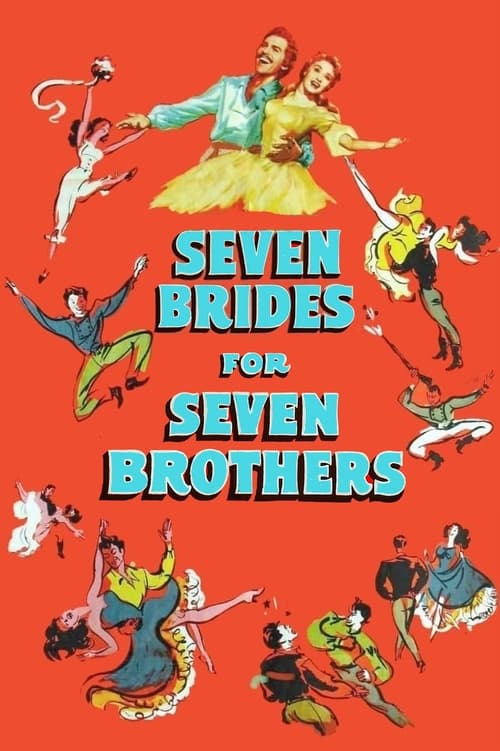
Seven Brides for Seven Brothers (1954)
Directed by Stanley Donen
No — Seven Brides for Seven Brothers is not woke, scoring 12 out of 100 on our wokeness meter.
Seven Brides for Seven Brothers arrives from 1954 with a cultural ledger so clean it looks scrubbed.
Consciousness Markers
Milly is a notably strong-willed protagonist who rebukes Adam, exiles the brothers to the barn, and the women collectively conspire ('mine!') to claim their own futures. However, the plot engine is the literal abduction of women to become wives, and the resolution is a shotgun wedding; this is 1950s domestic comedy, not a feminist agenda.
The entire cast is white, drawn from MGM's contract roster of dancers and singers; there is no attempt at ethnic representation of any kind.
No LGBTQ+ characters, themes, or subtext appear anywhere in the film.
No engagement with race or racial politics; the Oregon Territory setting is populated entirely by white settlers without comment.
Snow, avalanches, and the mountain pass are plot mechanics for the 'snowed in' premise, not environmental advocacy.
The backwoods-versus-town dynamic is a comedic social contrast, not a critique of wealth or capitalism.
No body-positivity themes; the cast is composed of conventionally attractive professional dancers.
No neurodivergent characters or themes are present.
The film adapts a Roman legend and a short story into a period frontier setting; it makes no revisionist claims about historical events.
The film is a song-and-dance musical with no didactic messaging; Milly's etiquette lessons are comic plot beats, not moral instruction to the audience.
Why it received this score
Seven Brides for Seven Brothers arrives from 1954 with a cultural ledger so clean it looks scrubbed. Stanley Donen directs, Michael Kidd choreographs, and MGM's contract roster of dancers and singers fills every frame with uniformly white faces. The Oregon Territory of 1850 serves as a backdrop for wood chopping, barn raising, and snowbound courtship. Nobody comments on race. Nobody comments on capital. The mountain pass and the avalanche are plot machinery, not a meditation on the natural world. The cast is composed of conventionally attractive professionals, which leaves the matter of body image entirely unaddressed. There are no neurodivergent characters. There is no revision of history, only a Roman legend transplanted to the frontier and set to Johnny Mercer lyrics.
A faint signal does register, and it belongs to Milly. Jane Powell plays her as a woman with opinions and a temper. She ruins dinner when she learns her new husband expects a servant, bans him from the bedroom, and later exiles the brothers to the barn. When the townsmen arrive and the brides answer "mine!" in unison, there is a genuine spark of collective self-determination. Yet the plot runs on the abduction of six women to become wives, and the resolution is a shotgun wedding conducted by a reverend who has just discovered a baby. This is domestic comedy from the Eisenhower years, not a feminist program.
The film lectures no one. Its moral instruction is limited to Milly teaching hygiene and table manners, which plays as farce and not sermon. It won an Academy Award for its scoring and sits in the National Film Registry, honors earned by craft. Our classification finds almost nothing to log, save a modest credit for Milly's indignation and the brides' conspiracy. The rest is snow, dancing, and a very old story about taking what you want.
In closing, the picture remains a kinetic marvel and a social document of near-perfect inertness, which is its own kind of distinction. We file it accordingly, with respect and without further remark. The snow melts, the couples pair off, and the ledger stays blank to the end. Some vintages simply do not require a second glass, and we record the fact without complaint, since the work of classification demands neither enthusiasm nor regret, only accuracy and a steady hand on the pen, and this particular artifact asks nothing more of us than that we note, cleanly and without ceremony, what it is not, which in this case is nearly everything our present moment tends to look for, leaving only the dancing, which remains, after all these years, quite good.
We submit the classification and move on to the next title in the queue, where the odds of finding something to mark are, statistically speaking, considerably better, though one never knows, and that uncertainty is the only pleasure this profession reliably provides, besides the filing itself, which is its own reward, or so we tell ourselves each morning before the screenings begin and the notebooks come out and the long, patient work of judgment resumes in earnest, as it must, and as it always does, without applause, without complaint, and without end.
Analysis generated by our Consciousness Algorithm


Synopsis
In 1850 Oregon, when a backwoodsman brings a wife home to his farm, his six brothers decide that they want to get married too.
Questions about Seven Brides for Seven Brothers
Is Seven Brides for Seven Brothers woke?
No — Seven Brides for Seven Brothers is not woke, scoring 12 out of 100 on our wokeness meter. That earns it a verdict of Ultra Based.
Does Seven Brides for Seven Brothers have any woke elements?
Very few. None of the 10 markers reaches 30, the level where a marker counts as present; the highest is Feminist Agenda at 20.
How does Seven Brides for Seven Brothers compare to other 1954 movies?
It is the wokest of the 14 films from 1954 we've scored; their average is 4.
How is the Woke Score calculated?
An AI-assisted process researches the film and its reception, scores it 0–100 on ten markers, then combines those into one 0–100 Woke Score. It measures a specific set of 2020s cultural themes, not film quality.