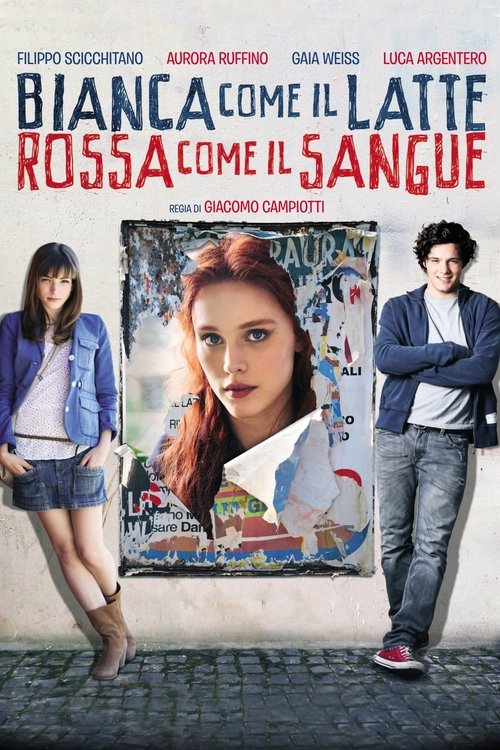
White as Milk, Red as Blood (2013)
Directed by Giacomo Campiotti
No — White as Milk, Red as Blood is not woke, scoring 0 out of 100 on our wokeness meter.
Giacomo Campiotti's 2013 adaptation of Alessandro D'Avenia's novel arrives with the modest ambitions of a European coming-of-age romance and fulfills them without incident.
Consciousness Markers
The cast is entirely white Italian actors, with no meaningful racial or ethnic diversity in the story.
There are no LGBTQ+ characters, relationships, or themes in the film.
Female characters are defined primarily through romantic attachment and emotional support, with no feminist critique or agenda.
The film does not engage with race, racism, or racial identity in any form.
There is no environmental or climate-related content in the story.
The film contains no critique of capitalism, wealth inequality, or economic systems.
Illness and leukemia are treated as tragedy, not as a platform for body-positivity messaging.
No neurodivergent characters or themes are present.
The film is a contemporary coming-of-age story and does not revise or reinterpret historical events.
The inspirational teacher offers life lessons about dreams and love, but not modern progressive social-justice lecturing.
Why it received this score
Giacomo Campiotti's 2013 adaptation of Alessandro D'Avenia's novel arrives with the modest ambitions of a European coming-of-age romance and fulfills them without incident. Leo rides motorbikes and ignores his teachers. He organizes the world into colors: red for the girl he worships from the bus stop, white for the emptiness that leukemia will eventually bring. A substitute history teacher nicknamed The Dreamer urges the students to chase their dreams. That is the entire philosophical apparatus. The film has no interest in how societies are arranged, only in how a sixteen-year-old feels about them.
The supporting cast is drawn from a homogeneous Italian ensemble, and the screenplay assigns its women the traditional functions of romantic fixation and emotional consolation. Silvia loves Leo quietly and waits. Beatrice loves him nobly and dies. Neither is granted an interior life that extends beyond what the boy requires of her. The illness is treated as grief, full stop, not as an occasion for messaging about bodies or acceptance. There is no critique of money, no environmental alarm, no reworking of the historical record. The Dreamer's lessons concern love and ambition, delivered with a warm smile, and they stop there.
This is not a failing, strictly speaking. The film knows what it is, a tearful romance for adolescents, and it executes the assignment with competent sentimentality. It does not participate in any of the cultural conversations that dominate the current decade. We are left with a work that could have been made in 1998 without a single alteration, which for a classifier is a clarifying thing. It registers a zero across every category we track, and we record that finding without malice. Some films simply refuse to argue with the present.
Analysis generated by our Consciousness Algorithm
Synopsis
Like all sixteen-year-olds, Leo prefers the company of friends, motorbike rides and music to school. None of the teachers seem to be able to arouse his interest until the arrival in his class of a young history and philosophy substitute who, with his modern methods, helps him see the world with different eyes. In love with Beatrice, the ethereal girl of his dreams, Leo divides the world by colours. Beatrice is the red of love but he is forced to confront his own beliefs and fears when he discovers that the girl is suffering from leukemia, a disease that he links to white, a symbol of emptiness and loss.
Questions about White as Milk, Red as Blood
Is White as Milk, Red as Blood woke?
No — White as Milk, Red as Blood is not woke, scoring 0 out of 100 on our wokeness meter. That earns it a verdict of Ultra Based.
Does White as Milk, Red as Blood have any woke elements?
No. All 10 markers score zero.
How does White as Milk, Red as Blood compare to other 2013 movies?
It ranks #249 of the 274 films from 2013 we've scored; their average is 14. The wokest is Belle (76).
How is the Woke Score calculated?
An AI-assisted process researches the film and its reception, scores it 0–100 on ten markers, then combines those into one 0–100 Woke Score. It measures a specific set of 2020s cultural themes, not film quality.