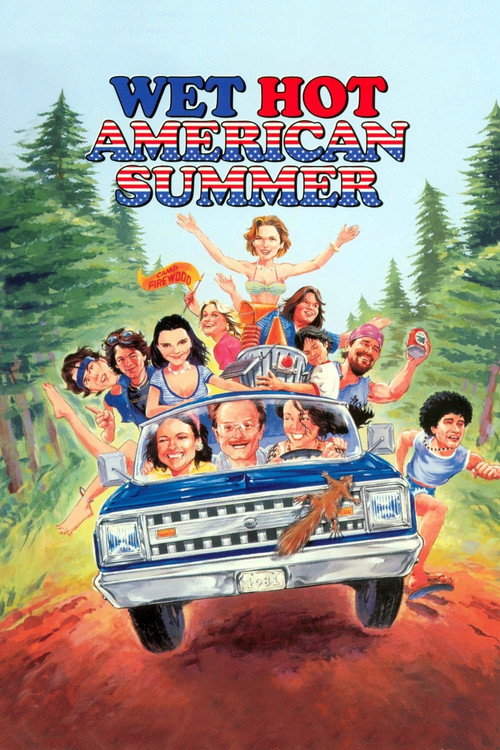
Wet Hot American Summer (2001)
Directed by David Wain
No — Wet Hot American Summer is not especially woke, scoring 33 out of 100 on our wokeness meter.
Wet Hot American Summer arrives as a 1981 summer-camp spoof with a large ensemble and a Skylab threat.
Consciousness Markers
Ben and McKinley's romance, sexual encounter, and symbolic marriage form an explicit subplot, though it is played for absurdist comedy rather than modern advocacy.
The cast is overwhelmingly white and the film makes no deliberate effort at inclusive or representative casting.
Female characters exist and a woman runs the camp, but the film offers no feminist critique or agenda; its gender politics are largely spoofing 1980s sex comedies.
There is no engagement with racial identity, racism, or racial justice themes.
The Skylab debris threat is a comedic plot device, not an environmental or climate-crisis allegory.
The film contains no critique of capitalism, wealth inequality, or corporate power.
Coop's buff transformation is played for laughs and romantic desperation, not as a body-positivity statement.
No characters or themes are framed around neurodivergence or neurodiversity.
The 1981 setting is nostalgic spoof material, not a revisionist historical narrative.
The film is a silly ensemble comedy and makes no attempt to lecture or moralize to its audience.
Why it received this score
Wet Hot American Summer arrives as a 1981 summer-camp spoof with a large ensemble and a Skylab threat. It is a silly, shaggy comedy, and its cultural sensibilities belong mostly to the teen sex comedies it parodies. The cast is white by default, not by argument. No racial identity or justice theme surfaces. No climate sermon attaches to the falling debris. The film treats the apocalypse as a punchline, not a policy failure.
The single area where modern social consciousness finds purchase is the Ben and McKinley thread. They have sex, declare love, and are symbolically married by Beth by the lake. The film presents this without apology and without a lecture. It is absurdist comedy, not advocacy. That distinction matters. The romance is explicit and sustained, and it earns a measurable place in the film's cultural profile, though the surrounding story has no interest in turning it into a lesson. Elsewhere, female characters run the camp and pursue romance, but the film is spoofing old gender roles, not critiquing them. Coop's buff transformation is a gag about desperation, not a body-positive statement. No character is framed around neurodivergence. The Vietnam veteran cook and the talking vegetable are surreal, not therapeutic.
The film has no anti-capitalist bite, no revisionist history, and no lecture energy. It wants laughs and a cult following, and it got the latter. The 1981 setting is a nostalgic playground, not a historical argument. The result is a comedy with a single genuine progressive flash and a great deal of silliness around it. We can respect the Ben and McKinley subplot without pretending the rest of Camp Firewood is a seminar. It is a film about horny counselors and a falling space station. That is the whole thesis.
Analysis generated by our Consciousness Algorithm


Synopsis
It's the last day of Camp Firewood's season, but there's still time for the big talent show, a little romance… and for everyone to be wiped out by the piece of NASA's Skylab that's hurtling toward Earth.
Questions about Wet Hot American Summer
Is Wet Hot American Summer woke?
No — Wet Hot American Summer is not especially woke, scoring 33 out of 100 on our wokeness meter. That earns it a verdict of Based.
Does Wet Hot American Summer have any woke elements?
1 of the 10 markers register at 30 or above, led by LGBTQ+ Themes (55). On LGBTQ+ Themes: Ben and McKinley's romance, sexual encounter, and symbolic marriage form an explicit subplot, though it is played for absurdist comedy rather than modern advocacy.
How does Wet Hot American Summer compare to other 2001 movies?
It ranks #12 of the 148 films from 2001 we've scored; their average is 12. The wokest is Monster's Ball (60).
How is the Woke Score calculated?
An AI-assisted process researches the film and its reception, scores it 0–100 on ten markers, then combines those into one 0–100 Woke Score. It measures a specific set of 2020s cultural themes, not film quality.