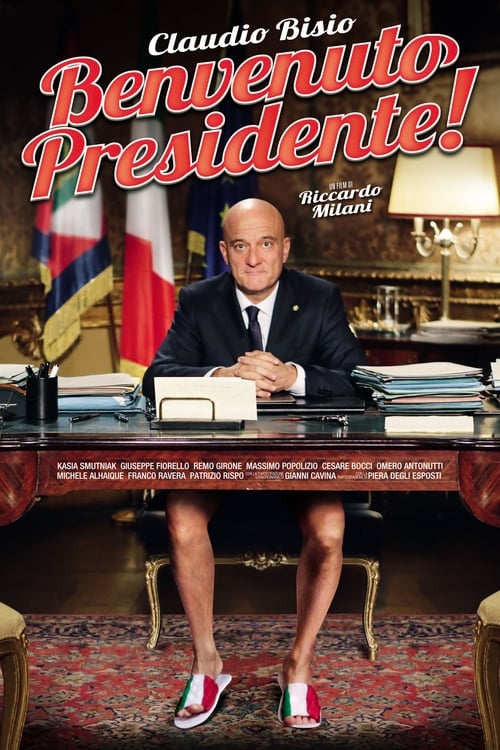
Welcome Mr. President! (2013)
Directed by Riccardo Milani
No — Welcome Mr. President! is not woke, scoring 18 out of 100 on our wokeness meter.
Welcome Mr. President (2013) arrives with a premise engineered for a nation that treats its own parliament as a recurring embarrassment.
Consciousness Markers
The climax features a poignant parliamentary speech in which the protagonist ridicules the politicians and the Italian public, delivering an explicit moral lecture on corruption.
The film satirizes the corrupt Italian political class and its self-serving leaders, offering a populist 'common man versus the establishment' critique, though it targets political elites rather than capitalism itself.
Janis Clementi is a competent Deputy Secretary General who manages the chaotic president, but the film frames her as a foil and romantic interest rather than advancing any feminist thesis.
The cast is a standard Italian ensemble with a prominent female co-lead (Kasia Smutniak) and a Brazilian president cameo, but diversity is incidental rather than a stated aim.
No LGBTQ+ characters, themes, or subtext appear anywhere in the film.
The film is entirely concerned with Italian political corruption and class; race plays no role in its narrative or themes.
There is no environmental or climate-related content in the film.
No body positivity themes or messaging are present.
No neurodivergent characters or themes are depicted.
The film is a fictional satire and makes no historical revisionist claims, despite borrowing the name of the historical figure Giuseppe Garibaldi.
Why it received this score
Welcome Mr. President (2013) arrives with a premise engineered for a nation that treats its own parliament as a recurring embarrassment. A Piedmontese librarian named Giuseppe Garibaldi is accidentally elected head of state because the parties, deadlocked and petulant, cast protest votes for a historical figure who happens to share a name with a living man. He fishes. He reads. He is thrust into Rome. The farce clicks along with professional efficiency, and director Riccardo Milani keeps the gears greased.
The film builds its moral capital from contempt for the political class. The satire aims at elites, at men in suits trading favors, at a system that treats governance as a private arrangement. This is a populist fantasy, the honest commoner against the establishment, and it is content to stop there. It has no quarrel with capital itself, only with the people who currently hold office. The closing speech to parliament, in which Peppino scolds the politicians and the public alike, is a sermon delivered with full conviction and no ambiguity about who should feel ashamed.
Kasia Smutniak plays the Deputy Secretary General as competent and watchful, and the film uses her as a foil and a slow-burning romantic interest. She manages the chaos. The screenplay asks nothing further of her. Elsewhere there is little to report: no LGBTQ presence, no engagement with race, no environmental concern, no interest in bodies or minds that deviate from a narrow norm. The cast is a standard Italian ensemble with a Brazilian presidential cameo, diverse by accident, not by design. The result is a genial, well-oiled comedy about corruption that flatters its audience by placing the audience and the politicians in the same dock. It lectures, it shrugs, it resolves nothing. This is civic catharsis for a country that has been having this argument since unification. Charming enough to get away with it. Entirely of its moment, and entirely comfortable there.",
Analysis generated by our Consciousness Algorithm
Synopsis
In a small mountain village lives a man with a challenging name, Giuseppe Garibaldi (one of Italy's "fathers of the fatherland"), but everybody call him with the nickname Peppino. Love fishing, the company of friends, the library where he works as a precarious employee. He is an optimistic person even if his child accuse him of being a wannabe. One day, due to a mess of politicians, an amazing thing happens: Peppino is mistakenly elected President of the Italian Republic. Pulled out from his quiet life, is to play a role for which he knows he is obviously inappropriate, but his common sense and his instinctive gestures are incredibly effective, except for the etiquette, for which he is in trouble. The inflexible and fascinating Deputy Secretary General of the Presidency of the Republic, Janis Clementi, is anxious to no avail in an attempt to regulate the unpredictable actions of the President...
Questions about Welcome Mr. President!
Is Welcome Mr. President! woke?
No — Welcome Mr. President! is not woke, scoring 18 out of 100 on our wokeness meter. That earns it a verdict of Ultra Based.
Does Welcome Mr. President! have any woke elements?
2 of the 10 markers register at 30 or above, led by Lecture Energy (45) and Eat the Rich (35). On Lecture Energy: The climax features a poignant parliamentary speech in which the protagonist ridicules the politicians and the Italian public, delivering an explicit moral lecture on corruption.
How does Welcome Mr. President! compare to other 2013 movies?
It ranks #68 of the 274 films from 2013 we've scored; their average is 14. The wokest is Belle (76).
How is the Woke Score calculated?
An AI-assisted process researches the film and its reception, scores it 0–100 on ten markers, then combines those into one 0–100 Woke Score. It measures a specific set of 2020s cultural themes, not film quality.