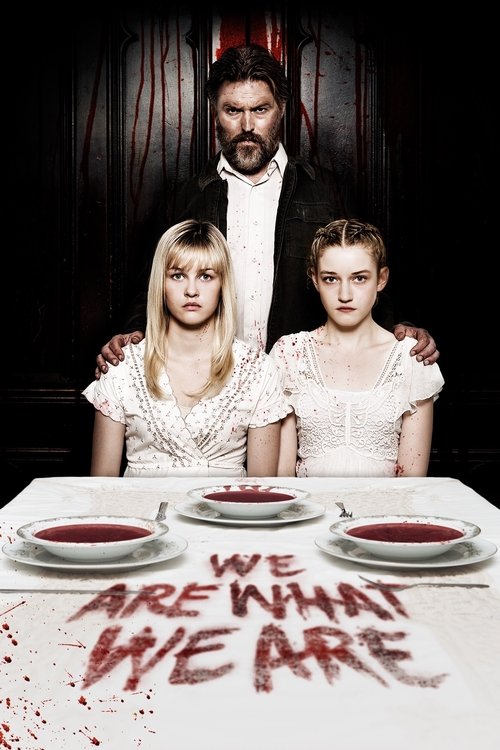
We Are What We Are (2013)
Directed by Jim Mickle
No — We Are What We Are is not woke, scoring 11 out of 100 on our wokeness meter.
Jim Mickle did not want to direct a remake, which is the sort of detail that makes a critic feel a small, unearned kinship with the man.
Consciousness Markers
The narrative centers on two sisters assuming ritual duties and ultimately rebelling against their domineering father, offering a mild patriarchal-rebellion arc, but it is framed as horror rather than an explicit feminist statement.
Critics read the film as an indictment of religious extremism and brainwashing, but the commentary is atmospheric and implicit rather than preachy or didactic.
The cast is entirely white, with no diverse or non-traditional casting choices made for representation purposes.
There are no LGBTQ+ characters, themes, or subtext present in the film.
The film engages no racial themes, commentary, or consciousness whatsoever.
A torrential downpour serves as a plot device to expose buried remains, but there is no environmental or climate-advocacy messaging.
The film contains no critique of capitalism, wealth, or class structures.
No body-positivity themes are present; the film's treatment of bodies is strictly within the cannibal-horror register.
There is no exploration or representation of neurodivergence.
The film is a fictional horror story and makes no historical claims to revise.
Why it received this score
Jim Mickle did not want to direct a remake, which is the sort of detail that makes a critic feel a small, unearned kinship with the man. He did it anyway, transplanting the 2010 Mexican original to the Catskill Mountains, where the Parker family keeps to ancient customs, a locked shed, and a period of ritual fasting that no neighbor has been invited to inspect. A torrential downpour does the heavy lifting of the plot, washing a bone fragment into a creek and the family matriarch into a ditch. The rain is weather. It is not a sermon, and there is no drowned polar bear in the frame. We should be grateful for small mercies.
The Parkers eat people. This is presented as a family tradition, observed with prayer and scripture and a certain grim domesticity, and the film's real interest lies in two daughters, Iris and Rose, who inherit the duty when their mother dies. They butcher a captive at their father's command, then eventually turn on him, tearing into the old man with their teeth. A case can be made for a patriarchal-rebellion arc, sisters seizing the rite and destroying the patriarch who imposed it. The case is modest. The film treats this as horror first and allegory second, and it never stops to explain itself.
Critics at the time called it an indictment of religious extremism, of brainwashing and poison visited upon innocent souls, and that reading is available. The film merely declines to argue. It sits in the dread and lets the audience draw the conclusion. No racial themes, no class critique, no environmental message, no representation of any kind beyond the standard-issue white family in a farmhouse. Kelly McGillis appears as a kindly vegetarian neighbor, the closest thing to a value system the film offers, and she is killed for it. The whole affair is a grim, well-made exercise in atmosphere, and its social content amounts to a raised eyebrow. We classify it accordingly.
Analysis generated by our Consciousness Algorithm


Synopsis
The Parkers, reclusive people who cling to ancient customs, find their secret lives threatened when a torrential downpour and the death of the family matriarch forces daughters Iris and Rose to assume special responsibilities.
Questions about We Are What We Are
Is We Are What We Are woke?
No — We Are What We Are is not woke, scoring 11 out of 100 on our wokeness meter. That earns it a verdict of Ultra Based.
Does We Are What We Are have any woke elements?
Very few. None of the 10 markers reaches 30, the level where a marker counts as present; the highest is Feminist Agenda at 15.
How does We Are What We Are compare to other 2013 movies?
It ranks #111 of the 274 films from 2013 we've scored; their average is 14. The wokest is Belle (76).
How is the Woke Score calculated?
An AI-assisted process researches the film and its reception, scores it 0–100 on ten markers, then combines those into one 0–100 Woke Score. It measures a specific set of 2020s cultural themes, not film quality.