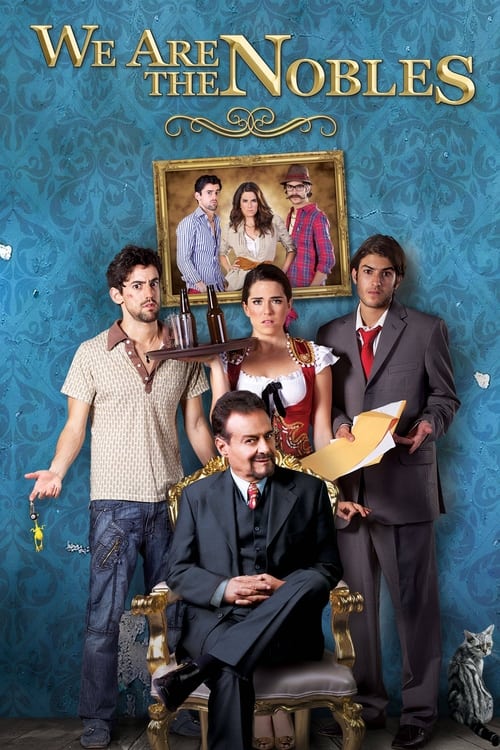
We Are the Nobles (2013)
Directed by Gary Alazraki
No — We Are the Nobles is not woke, scoring 17 out of 100 on our wokeness meter.
The film concerns Germán Noble, a Mexico City businessman who fakes a financial scandal to force his three grown children into a dilapidated house on the poor side of town and, worse, into employment.
Consciousness Markers
Javier's dyslexia is explicitly revealed as a concrete trait explaining his struggles, giving the film a modest but identifiable neurodivergence element.
The film delivers a moral about the value of hard work and family, but wraps it in broad comedic farce rather than preachy sermonizing.
The idle rich are mildly skewered, but the film's resolution is bootstrap-capitalist wish fulfillment—getting jobs, starting businesses—so it reinforces rather than rejects the system.
A Mexican production naturally cast with Mexican performers for a Mexican-set story; this is regional authenticity rather than a deliberate modern representation-casting agenda.
Bárbara has a self-discovery arc from socialite to waitress, but her value is still largely defined by romance with Lucho and her father's approval—no feminist framework is present.
The film's central axis is class, not race; the 'poor side of town' is a lesson in humility about money rather than a racial-consciousness critique.
Bárbara's bulimia is revealed as a personal confession, but the film never frames it through a body-positivity or body-image acceptance lens.
No LGBTQ+ characters, themes, or subtext appear anywhere in the film.
No environmental or climate themes appear in the story.
No historical reinterpretation is attempted; the film is a contemporary comedy reworking a 1949 Buñuel plot.
Why it received this score
The film concerns Germán Noble, a Mexico City businessman who fakes a financial scandal to force his three grown children into a dilapidated house on the poor side of town and, worse, into employment. Alazraki's camera regards the arrangement with the cheerful cruelty of a farceur, and the resulting comedy is efficient, warm, and entirely untroubled by the structures it is busy endorsing. The axis here is class, never race. Poverty functions as a pedagogical theme park, a place the wealthy visit to acquire humility and then leave. That the neighborhood is populated by decent, hardworking people is offered as a lesson about money, not a critique of anything larger.
The film does allow its characters interiority, briefly. Javier's dyslexia surfaces as an explanation for a lifetime of drifting, and Bárbara's confession of bulimia lands as a quiet, painful beat. These are real, and they are handled without sanctimony. They are also confessions, not arguments. The film has no framework for either condition beyond the father's guilt, and Bárbara's worth is ultimately settled by her engagement to Lucho and by her father's approval. The social consciousness on display is the mild, pre-2015 variety: the rich are silly, the poor are noble, and everyone should probably get a job.
Which is the point. For all its ribbing of privilege, the resolution is a bootstrap fantasy. Carlos finds work, Javier opens a business, Bárbara waits tables and gets the good man. The system is not the villain. Idleness is. The moral arrives with a shrug and a laugh, preachy only in the way of a father's lecture delivered through a closed bathroom door. It is a competent, likable comedy about the value of hard work, and it means none of it very hard. The remake rights have since been sold in four countries. The lesson travels well.
Analysis generated by our Consciousness Algorithm

Synopsis
Tells the "riches to rags" story of the Nobles, three upper-class twenty-somethings that appear to have no limits to their checkbooks, and no direction in their lives. Until one day, their father tries to teach them a lesson by staging a financial scandal that forces the whole family to escape to an old house in the poor side of town, and leads the "kids" to do what they haven't done before: get jobs.
Questions about We Are the Nobles
Is We Are the Nobles woke?
No — We Are the Nobles is not woke, scoring 17 out of 100 on our wokeness meter. That earns it a verdict of Ultra Based.
Does We Are the Nobles have any woke elements?
1 of the 10 markers register at 30 or above, led by Neurodivergence (35). On Neurodivergence: Javier's dyslexia is explicitly revealed as a concrete trait explaining his struggles, giving the film a modest but identifiable neurodivergence element.
How does We Are the Nobles compare to other 2013 movies?
It ranks #76 of the 274 films from 2013 we've scored; their average is 14. The wokest is Belle (76).
How is the Woke Score calculated?
An AI-assisted process researches the film and its reception, scores it 0–100 on ten markers, then combines those into one 0–100 Woke Score. It measures a specific set of 2020s cultural themes, not film quality.