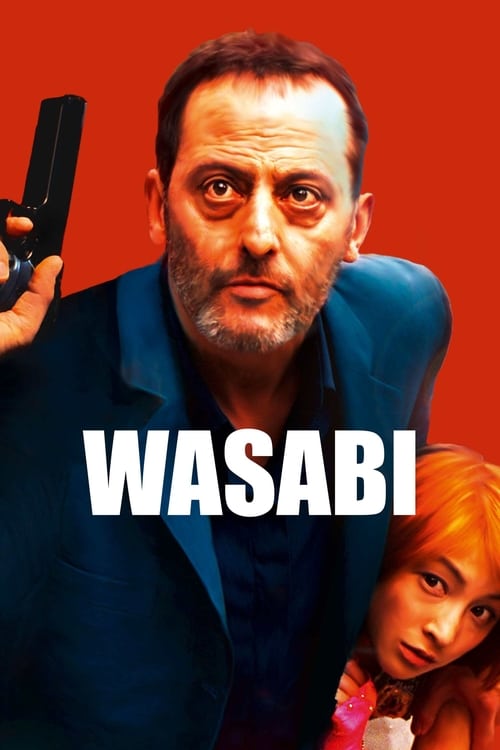
Wasabi (2001)
Directed by Gérard Krawczyk
No — Wasabi is not woke, scoring 8 out of 100 on our wokeness meter.
Wasabi arrives from 2001, a Franco-Japanese co-production with a screenplay by Luc Besson and direction by Gérard Krawczyk, in which Jean Reno plays a Paris commissaire of unusually sharp methods who is packed off to Tokyo to settle the estate of a woman he loved nineteen years earlier.
Consciousness Markers
The film is a French-Japanese co-production with Japanese actors in prominent roles, but this reflects its Tokyo setting rather than a modern diversity mandate.
A drag queen appears briefly as a target of police brutality, but the film does not explore LGBTQ+ themes or offer positive representation.
Female characters exist but the film does not advance a feminist agenda or critique patriarchy.
The cross-cultural French-Japanese setting provides no racial commentary or consciousness.
No environmental or climate themes are present.
Yakuza criminality and a bank heist are plot devices, not an anti-capitalist critique.
No body positivity themes are present.
Yumi is described as eccentric, but this is not framed as neurodivergence.
No historical revisionism is present.
The film is an action comedy with no preachy or lecture-like energy.
Why it received this score
Wasabi arrives from 2001, a Franco-Japanese co-production with a screenplay by Luc Besson and direction by Gérard Krawczyk, in which Jean Reno plays a Paris commissaire of unusually sharp methods who is packed off to Tokyo to settle the estate of a woman he loved nineteen years earlier. He discovers a daughter, Yumi, played by Ryōko Hirosue, and a fortune stolen from the yakuza. He also eats an entire serving of wasabi without flinching, which the film treats as characterization. That is the whole of the picture's interior life, and it is enough for the genre.
The Tokyo setting places Japanese performers in substantial roles, though this reflects geography and a co-production arrangement, not any modern casting mandate. The opening scene offers a drag queen, but only as the recipient of a fist and a pair of handcuffs, after which she vanishes from the narrative and from its concerns. Yumi is described as eccentric, a word the film uses to mean loud, and nothing more clinical. There is no feminist argument here, no racial commentary, no climate anxiety, and no indictment of capital. The yakuza are criminals with a bank account, not a system.
Above all, the film does not lecture. It ricochets from slapstick to gunfire and back, dispatching its villains single-handedly and without casualties among the good guys, then ends on a customs inspection and a pair of metal suitcases. Roger Ebert gave it one and a half stars. It opened second in France behind American Pie 2 before climbing to first the following week. A clean specimen, and a reminder of a moment when a French policeman could assault a nightclub full of patrons and the movie simply moved on to the next scene.
Analysis generated by our Consciousness Algorithm
Synopsis
Hubert is a French policeman with very sharp methods. After being forced to take 2 months off by his boss, who doesn't share his view on working methods, he goes back to Japan, where he used to work 19 years ago, to settle the probate of his girlfriend who left him shortly after marriage without a trace.
Questions about Wasabi
Is Wasabi woke?
No — Wasabi is not woke, scoring 8 out of 100 on our wokeness meter. That earns it a verdict of Ultra Based.
Does Wasabi have any woke elements?
Very few. None of the 10 markers reaches 30, the level where a marker counts as present; the highest is Representation Casting at 20.
How does Wasabi compare to other 2001 movies?
It ranks #64 of the 148 films from 2001 we've scored; their average is 12. The wokest is Monster's Ball (60).
How is the Woke Score calculated?
An AI-assisted process researches the film and its reception, scores it 0–100 on ten markers, then combines those into one 0–100 Woke Score. It measures a specific set of 2020s cultural themes, not film quality.