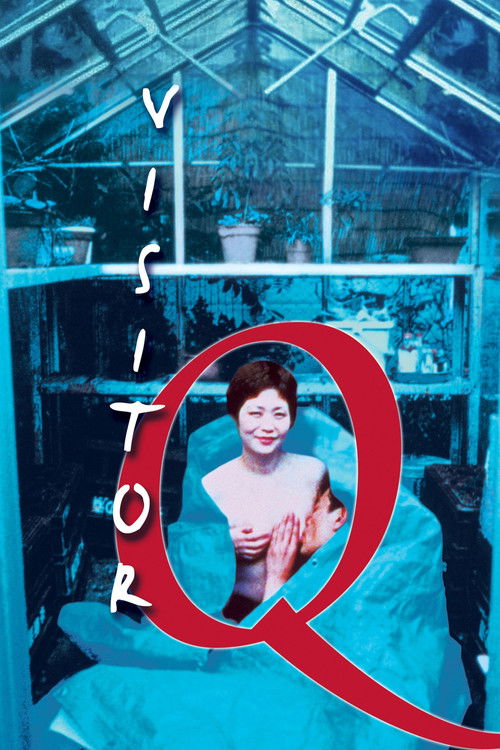
Visitor Q (2001)
Directed by Takashi Miike
No — Visitor Q is not woke, scoring 0 out of 100 on our wokeness meter.
Takashi Miike's Visitor Q arrived in 2001 as the sixth and final entry in the Love Cinema series, a set of low-budget digital video experiments screened at a single small Tokyo cinema.
Consciousness Markers
The film focuses entirely on deeply dysfunctional and often abusive characters, offering no progressive commentary on representation.
The narrative is focused on extreme domestic pathology and sexual deviance, not on LGBTQ+ themes or positive representation.
The female characters are primarily depicted as victims of abuse, participants in transgressive acts, or objects of sexual deviance, failing to advance a feminist agenda.
The film contains no commentary or specific focus on racial dynamics or consciousness.
There is no environmental message or 'Climate Crusade' present in this nihilistic black comedy.
While the characters are financially precarious, the film's critique is focused on personal decay and chaos, not systemic economic failure.
Bodies are used for shock, violence, and sexual transgression, not celebrated for positive body image or diversity.
There is no exploration or commentary on neurodivergent experiences or mental health in a progressive context.
The film is a piece of fictional black comedy and does not attempt to challenge established historical narratives.
The film presents chaos and shock without offering any didactic social commentary or lecture to the audience.
Why it received this score
Takashi Miike's Visitor Q arrived in 2001 as the sixth and final entry in the Love Cinema series, a set of low-budget digital video experiments screened at a single small Tokyo cinema. It concerns the Yamazaki household: a father who films his own son being beaten in the street, a mother who injects heroin between acts of prostitution, a daughter who charges her father for sex, and a son who strikes his mother with a rug beater. Into this arrangement walks a stranger in a red shirt who hits the father with a rock, teaches the mother to lactate, and leaves the family, somehow, happier. The film mimics home video and documentary footage, a formal choice that lends its grotesqueries a flat, unblinking realism.
We might expect such material to arrive wrapped in commentary. It does not. Nothing here argues a position, proposes a remedy, or invites the audience toward any improved understanding of the world. The cruelty is the point and also the entire text. Domestic violence, incest, necrophilia, and assault are staged for discomfort and laughter in equal measure, with no framework offered to interpret them. A viewer searching for a thesis will find only a rock to the skull.
This is not a failure of nerve. Miike has made pointed films elsewhere. Visitor Q simply has no interest in instruction. Its bodies are props for shock, its economics incidental, its history invented, its sympathies nowhere in evidence. What remains is a nasty, disciplined, frequently funny exercise in provocation, made by people who understood exactly what they were doing and declined to explain it. On the scale of social instruction, the film registers nothing at all, and it commits to that nothing with real conviction.
Analysis generated by our Consciousness Algorithm
Synopsis
In a dysfunctional family where the mother is a heroin addict and prostitute, beaten by her son, and the father is an ex-TV reporter, sleeping with his daughter and filming his son being beaten up, ‘Q’, a complete stranger enters the bizarre family, changing their lives for the better, finding a balance in their disturbing natures.
Questions about Visitor Q
Is Visitor Q woke?
No — Visitor Q is not woke, scoring 0 out of 100 on our wokeness meter. That earns it a verdict of Ultra Based.
Does Visitor Q have any woke elements?
No. All 10 markers score zero.
How does Visitor Q compare to other 2001 movies?
It ranks #128 of the 148 films from 2001 we've scored; their average is 12. The wokest is Monster's Ball (60).
How is the Woke Score calculated?
An AI-assisted process researches the film and its reception, scores it 0–100 on ten markers, then combines those into one 0–100 Woke Score. It measures a specific set of 2020s cultural themes, not film quality.