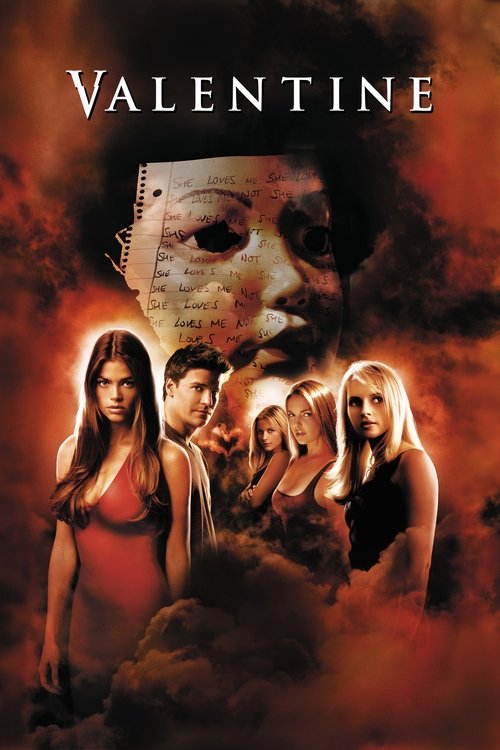
Valentine (2001)
Directed by Jamie Blanks
No — Valentine is not woke, scoring 15 out of 100 on our wokeness meter.
Valentine arrives in 2001 as a slasher film assembled from familiar parts: a Cupid mask, a holiday, a group of female friends in San Francisco, and a killer with a grudge dating back to a middle school dance.
Consciousness Markers
Retrospective critics have reframed this as a 'feminist slasher' centered on a female ensemble and the everyday dangers and harassment women navigate, though the film itself never articulates an explicit feminist thesis.
Dorothy's arc explicitly engages weight stigma and the 'fat girl' label she resents, though the film frames this as motive for villainy rather than a body-positive message.
The ensemble is uniformly white, with no meaningful racial or ethnic diversity in the cast or roles.
No LGBTQ+ characters, relationships, or themes appear anywhere in the film.
No engagement with race or racial dynamics; the story is entirely concerned with gender and social cruelty.
No environmental or climate themes whatsoever.
A con-artist subplot exists but carries no anti-capitalist or class-conscious message.
Jeremy's institutionalization is a plot device, not a depiction of neurodivergence as identity or theme.
No historical revisionism; the film is a contemporary-set slasher with no historical subject matter.
The film delivers scares and kills rather than moral instruction; no preachy or didactic messaging.
Why it received this score
Valentine arrives in 2001 as a slasher film assembled from familiar parts: a Cupid mask, a holiday, a group of female friends in San Francisco, and a killer with a grudge dating back to a middle school dance. The critical consensus at the time was dismissive, and the film earned it. Four credited writers produced a screenplay whose mystery nobody seems invested in solving, and the kills are staged with more care than the characters. The film does possess, in modest quantities, an interest in how men treat women, and how women absorb that treatment over the years.
Retrospective criticism has been kinder, and some of it has reframed the picture as a feminist slasher, pointing to its female ensemble and its attention to the small harassments and threats that shape the women's daily lives. That reading is defensible without being fully earned. The film observes male-female dynamics with a certain cruelty and never articulates a thesis about them. The closest it comes to a social argument is Dorothy, whose resentment over being seen as the fat girl drives the final act. Weight stigma is present and named, but the film treats it as a motive for murder, not as a wrong to be corrected. This is not a body-positive text.
Beyond those two threads, the film carries almost no cultural freight. The cast is uniformly white, the story has no interest in race, and no character is written as queer. There is no environmental anxiety, no class consciousness, no neurodivergent identity, no historical revisionism, and no sermonizing. The con-artist subplot involving Campbell exists to generate suspects and nothing else. Valentine wants to scare its audience and occasionally unsettle it, and it is honest about that ambition. For a film so often accused of being behind the times, it is at least not pretending to be anything else.
Analysis generated by our Consciousness Algorithm
Part of


Synopsis
Four friends start to receive morbid Valentine cards and realise they are being stalked by someone they had spurned 13 years ago. A masked killer is on the loose and Valentine's day is soon approaching.
Questions about Valentine
Is Valentine woke?
No — Valentine is not woke, scoring 15 out of 100 on our wokeness meter. That earns it a verdict of Ultra Based.
Does Valentine have any woke elements?
1 of the 10 markers register at 30 or above, led by Feminist Agenda (35). On Feminist Agenda: Retrospective critics have reframed this as a 'feminist slasher' centered on a female ensemble and the everyday dangers and harassment women navigate, though the film itself never articulates an explicit feminist thesis.
How does Valentine compare to other 2001 movies?
It ranks #36 of the 148 films from 2001 we've scored; their average is 12. The wokest is Monster's Ball (60).
How is the Woke Score calculated?
An AI-assisted process researches the film and its reception, scores it 0–100 on ten markers, then combines those into one 0–100 Woke Score. It measures a specific set of 2020s cultural themes, not film quality.