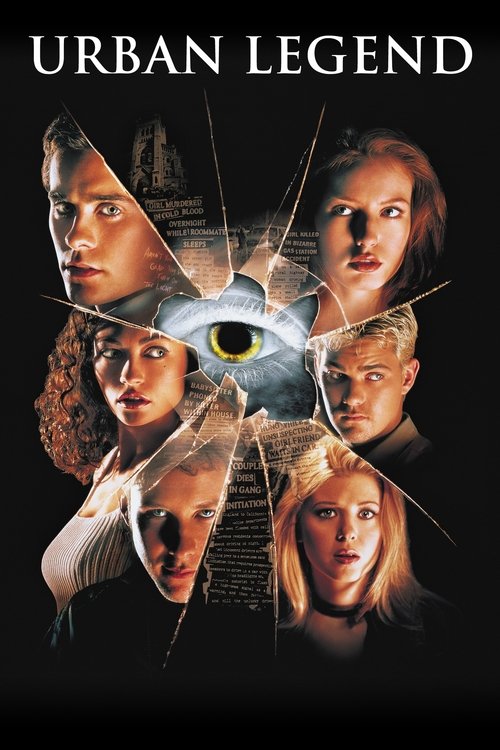
Urban Legend (1998)
Directed by Jamie Blanks
No — Urban Legend is not woke, scoring 6 out of 100 on our wokeness meter.
Urban Legend arrives from 1998, a slasher assembled from the folk tales that circulate in dormitory hallways, and it carries the cultural fingerprints of its moment with almost no interest in the social questions that would later preoccupy the genre.
Consciousness Markers
The cast is overwhelmingly white, with Loretta Devine as the campus police officer being the lone notable exception; her presence is unremarked upon and functions as ordinary casting rather than a statement.
Professor Wexler's folklore lectures and the characters' repeated explanations of urban legends give the film a didactic streak, but it is expository world-building rather than moral instruction.
Alicia Witt's Natalie is a capable final girl and Tara Reid's Sasha hosts a sex-advice radio show, but the film's treatment of women is pure slasher convention, with promiscuity punished and no articulated feminist critique.
No LGBTQ+ characters, themes, or subtext appear anywhere in the film.
Race is never a subject of the film; the campus is a racially unmarked slasher backdrop.
No environmental themes of any kind.
No economic critique; the film's only institutional villainy is a dean covering up a murder for reputational reasons, which is standard slasher furniture.
No body-positivity themes; the film's sexual politics are conventional and punitive.
No neurodivergent characters or themes.
The film invents a fictional 'Stanley Hall Massacre' as plot machinery, but this is genre invention, not a revisionist reading of real history.
Why it received this score
Urban Legend arrives from 1998, a slasher assembled from the folk tales that circulate in dormitory hallways, and it carries the cultural fingerprints of its moment with almost no interest in the social questions that would later preoccupy the genre. The campus of Pendleton University is a racially unmarked backdrop, its student body uniformly white save for Loretta Devine's campus police officer, whose presence the film treats as ordinary staffing. There is no comment, no thesis, no gesture toward the demographics of American higher education. The film needs a police officer and casts a good one. Race as a subject never surfaces.
The sexual politics are equally traditional. Alicia Witt's Natalie survives because she is the chaste one, and Tara Reid's Sasha, who dispenses advice about sex on campus radio, is punished for her candor with an axe. Promiscuity is fatal, as the genre demands. The film has no vocabulary for critique. It has a body count. A goth roommate meets the same fate, and to read a feminist argument into any of this would require more generosity than the screenplay earns.
Where the film carries a faint residue of instruction, it is in the lecture hall. Professor Wexler explains folklore to his students, and the characters spend much of the runtime explaining urban legends to each other, a habit that gives the proceedings a pedantic hum. This is exposition, not moral instruction. The film wants to scare us with the stories we already tell, and it manages that without a single lesson about how we ought to live. A relic, and an efficient one. The bodies fall, the campus stays silent, and nobody learns anything except the audience, which learns which legends to avoid repeating at summer camp.
Thematic tags: []
Analysis generated by our Consciousness Algorithm


Synopsis
A college campus is plagued by a vicious serial killer murdering students in ways that correspond to various urban legends.
Questions about Urban Legend
Is Urban Legend woke?
No — Urban Legend is not woke, scoring 6 out of 100 on our wokeness meter. That earns it a verdict of Ultra Based.
Does Urban Legend have any woke elements?
Very few. None of the 10 markers reaches 30, the level where a marker counts as present; the highest is Representation Casting at 12.
How does Urban Legend compare to other 1998 movies?
It ranks #75 of the 118 films from 1998 we've scored; their average is 12. The wokest is Show Me Love (60).
How is the Woke Score calculated?
An AI-assisted process researches the film and its reception, scores it 0–100 on ten markers, then combines those into one 0–100 Woke Score. It measures a specific set of 2020s cultural themes, not film quality.