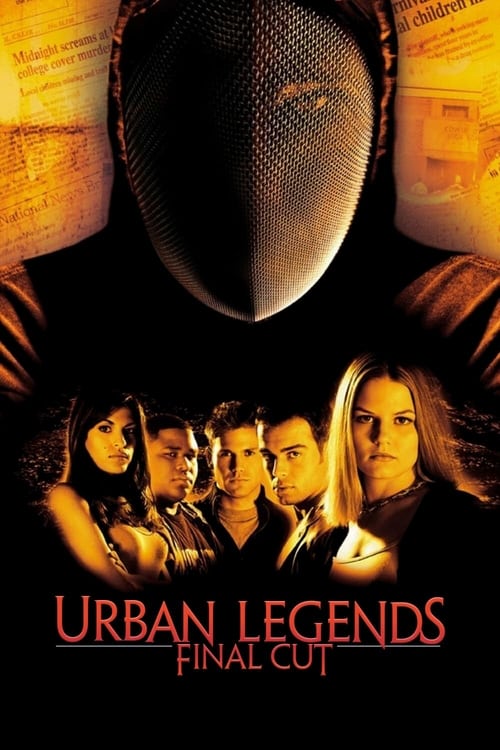
Urban Legends: Final Cut (2000)
Directed by John Ottman
No — Urban Legends: Final Cut is not woke, scoring 7 out of 100 on our wokeness meter.
A sequel arrives, as sequels do, and this one sets its slaughter inside a prestigious film school where the Hitchcock Award and its accompanying stipend are worth killing for.
Consciousness Markers
The cast includes Anthony Anderson, Eva Mendes, and Loretta Devine in supporting roles, but their presence is unremarked and incidental to a genre exercise; no casting is framed as a statement.
Amy is a female film student protagonist navigating a competitive program, but the film offers no feminist critique or commentary; she is simply the final girl.
A forged note implies Amy wrote of romantic feelings for Vanessa, briefly gesturing at same-sex attraction, but it is a throwaway red herring rather than a theme.
The killer's motive involves seizing a lucrative award stipend and stolen creative credit, a faint gesture at academic ambition, but it is not a critique of capital.
The film is self-referential about filmmaking and horror tropes, but it lectures no one about social issues.
No engagement with race, racism, or racial identity whatsoever; minority characters appear without any thematic weight.
No environmental themes of any kind.
No body-positivity themes; the film's treatment of bodies is strictly that of slasher fodder.
No neurodivergence themes; the asylum coda is a genre trope, not a depiction of neurodivergent experience.
No historical subject matter to revise.
Why it received this score
A sequel arrives, as sequels do, and this one sets its slaughter inside a prestigious film school where the Hitchcock Award and its accompanying stipend are worth killing for. John Ottman directs, edits, and scores his own debut, which is the most interesting fact about it. The students make a thesis film about urban legends while being murdered in the fashion of urban legends, a loop of self-reference that the film mistakes for cleverness. A fencing mask, a bell tower, a drained log flume standing in for a mine ride. The machinery is visible and none of it frightens anyone.
The cultural ledger here is thin, and honesty requires saying so. Minority performers appear in supporting roles, unremarked and incidental, their presence carrying no argument and no weight. A forged note suggests the heroine harbors romantic feelings for another woman, a thread dangled and dropped within a single scene, functioning as a red herring and nothing more. The protagonist is a woman navigating a competitive program, but she is a final girl by inheritance, not by thesis. Nobody in this film has a position on race, on money, on the body, or on the climate. The killer wants an award and stolen credit. That is the entire political economy on offer.
What the film does possess is a certain exhausting self-awareness, a running commentary on horror tropes that lectures nobody about anything except the genre's own depletion. Critics at the time were unanimous and unkind, and the passage of years has not improved the vintage. It topped the box office once, briefly, which proves only that appetites were strong that September. We classify it, we note its faint gestures, and we move on to the next bottle.
Analysis generated by our Consciousness Algorithm


Synopsis
The making of a horror movie takes on a terrifying reality for students at the most prestigious film school in the country. At Alpine University, someone is determined to win the best film award at any cost - even if it means eliminating the competition. No one is safe and everyone is a suspect.
Questions about Urban Legends: Final Cut
Is Urban Legends: Final Cut woke?
No — Urban Legends: Final Cut is not woke, scoring 7 out of 100 on our wokeness meter. That earns it a verdict of Ultra Based.
Does Urban Legends: Final Cut have any woke elements?
Very few. None of the 10 markers reaches 30, the level where a marker counts as present; the highest is Representation Casting at 18.
How does Urban Legends: Final Cut compare to other 2000 movies?
It ranks #81 of the 125 films from 2000 we've scored; their average is 13. The wokest is But I'm a Cheerleader (72).
How is the Woke Score calculated?
An AI-assisted process researches the film and its reception, scores it 0–100 on ten markers, then combines those into one 0–100 Woke Score. It measures a specific set of 2020s cultural themes, not film quality.