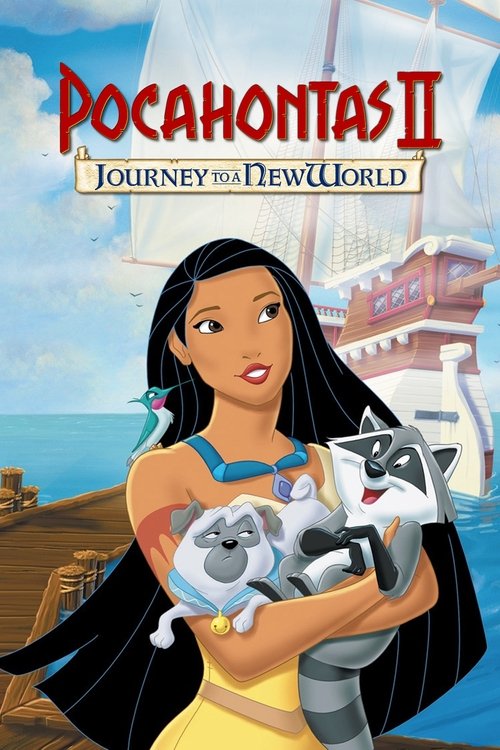
Pocahontas II: Journey to a New World (1998)
Directed by Tom Ellery
No — Pocahontas II: Journey to a New World is not especially woke, scoring 34 out of 100 on our wokeness meter.
Pocahontas II: Journey to a New World arrives in 1998 as a direct-to-video sequel, which is the studio's way of saying the first film made enough money to justify a second one but not enough to justify a theatrical release.
Consciousness Markers
Native American performers Irene Bedard, Russell Means, and Gregg Rainwater voice the Powhatan characters, a deliberate and notable casting choice for 1998, though it is organic to the story rather than a modern DEI initiative.
The film explicitly interrogates the English notion of 'civilised' versus 'savage,' with Pocahontas denouncing the King's bear-baiting as barbaric and exposing colonial hypocrisy, though framed as a gentle tolerance lesson.
The film heavily romanticizes and sanitizes the historical Pocahontas, inventing a diplomatic mission, a romance with John Rolfe, and omitting her death, presenting a softened revision of colonial history.
The film carries a steady moral about peace and mutual respect between cultures, delivered through Pocahontas's speeches and the King's comeuppance, though it stays within family-entertainment bounds.
Pocahontas travels to England in her father's stead as a diplomat and openly confronts the King, giving her agency, but this is standard Disney heroine material rather than a feminist agenda.
Governor Ratcliffe's greed for imagined Powhatan gold drives the villainy, a mild anti-greed motif, but it is a stock Disney villain trait rather than an eat-the-rich critique.
No LGBTQ+ characters, themes, or subtext of any kind appear in the film.
No environmental or climate themes are present; the conflict is diplomatic and territorial, not ecological.
No body positivity themes or messaging appear in the film.
No neurodivergent characters or themes are present.
Why it received this score
Pocahontas II: Journey to a New World arrives in 1998 as a direct-to-video sequel, which is the studio's way of saying the first film made enough money to justify a second one but not enough to justify a theatrical release. The animation is thinner, the songs are fewer, and the whole enterprise carries the faint air of a contractual obligation being discharged. Yet a genuine casting decision sits at the center of it: Irene Bedard, Russell Means, and Gregg Rainwater give voice to the Powhatan characters, a choice that was deliberate in 1998 and remains notable now. It reads as integrity, not as a marketing memo.
The film's real preoccupation is the English habit of calling itself civilised. Pocahontas travels to London in her father's stead, submits to etiquette lessons, and then watches the nobility cheer a bear-baiting. She accuses the King of savagery to his face. It is a tolerance lesson, gently administered, and the villain's motive amounts to a rumor of gold, which keeps the greed at stock-villain temperature. Her agency is real enough, though it is the standard agency of a Disney heroine with a diplomatic errand.
History, meanwhile, is treated as clay. A diplomatic mission is invented, a romance with John Rolfe is manufactured, and Pocahontas's death is simply omitted, leaving a sanitized colonial fable that ends with a kiss and a sunset. The moral about peace and mutual respect is delivered steadily, through speeches and a comeuppance, though it never leaves the family-entertainment paddock. Of the contemporary markers we now scan for, most are absent: no LGBTQ+ presence, no ecological concern, no body-positivity messaging, no neurodivergent characters. The film is a product of its moment, and its moment had other priorities.
Analysis generated by our Consciousness Algorithm


Synopsis
When news of John Smith's death reaches America, Pocahontas is devastated. She sets off to London with John Rolfe, to meet with the King of England on a diplomatic mission: to create peace and respect between the two great lands. However, Governor Ratcliffe is still around; he wants to return to Jamestown and take over. He will stop at nothing to discredit the young princess.
Questions about Pocahontas II: Journey to a New World
Is Pocahontas II: Journey to a New World woke?
No — Pocahontas II: Journey to a New World is not especially woke, scoring 34 out of 100 on our wokeness meter. That earns it a verdict of Based.
Does Pocahontas II: Journey to a New World have any woke elements?
4 of the 10 markers register at 30 or above, led by Racial Consciousness (45), Representation Casting (45) and Revisionist History (35). On Racial Consciousness: The film explicitly interrogates the English notion of 'civilised' versus 'savage,' with Pocahontas denouncing the King's bear-baiting as barbaric and exposing colonial hypocrisy, though framed as a gentle tolerance lesson.
How does Pocahontas II: Journey to a New World compare to other 1998 movies?
It ranks #8 of the 118 films from 1998 we've scored; their average is 12. The wokest is Show Me Love (60).
How is the Woke Score calculated?
An AI-assisted process researches the film and its reception, scores it 0–100 on ten markers, then combines those into one 0–100 Woke Score. It measures a specific set of 2020s cultural themes, not film quality.