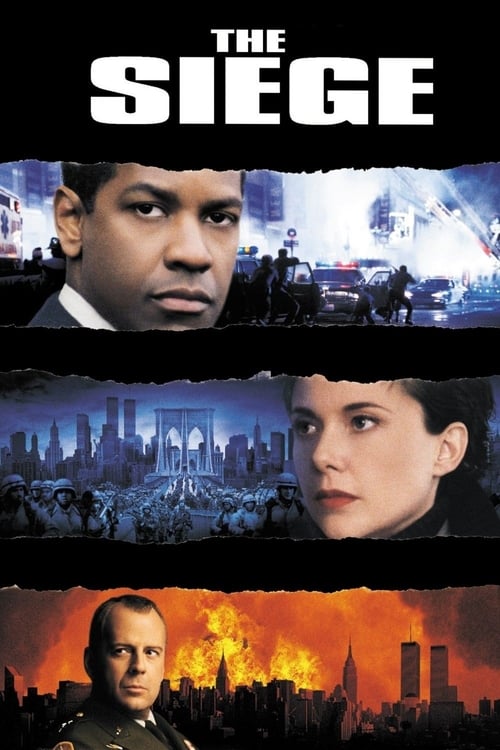
The Siege (1998)
Directed by Edward Zwick
No — The Siege is not especially woke, scoring 35 out of 100 on our wokeness meter.
The Siege arrives from 1998, a year when a studio thriller could still open with a paint bomb on a city bus and end with a constitutional standoff in an Army headquarters.
Consciousness Markers
The film's spine is the racial profiling and mass detention of Arab-American men under martial law, with Haddad's resignation, a multiethnic peace march, and Hubbard's civil-liberties stand against Devereaux. This is a sustained, explicit engagement with racial injustice.
Denzel Washington headlines as a Black FBI agent, with Tony Shalhoub as his Lebanese-American partner and a notably multiethnic supporting cast (Lance Reddick, Aasif Mandvi). The diversity is organic to the story rather than a modern casting statement.
The film builds toward an explicit moral lesson on civil liberties, culminating in Hubbard's speech to Devereaux about the rights his predecessors fought and died for. The messaging is earnest and didactic, though delivered through thriller mechanics.
Annette Bening's CIA operative is competent and central, but the film offers no feminist thesis or gendered critique; she functions as a standard thriller asset.
No LGBTQ+ characters or themes appear anywhere in the film.
No environmental or climate themes are present.
No economic critique of capitalism or class warfare; the antagonist is a rogue general, not a corporate or financial system.
No body-positivity themes or commentary on body image.
No neurodivergent characters or themes.
A fictional thriller, not a reworking of historical events; no revisionist historical claims.
Why it received this score
The Siege arrives from 1998, a year when a studio thriller could still open with a paint bomb on a city bus and end with a constitutional standoff in an Army headquarters. Edward Zwick directs with the grim efficiency of a man who has read the briefing papers and intends to share them. Denzel Washington's FBI agent Hubbard anchors the proceedings, Tony Shalhoub supplies the Lebanese-American partner Frank Haddad, and the supporting bureau is staffed with faces that reflect a real New York. None of this is announced. The diversity is simply there, doing its job, which is the most flattering thing that can be said about a casting decision.
The film's actual preoccupation is race and the machinery of suspicion. When the President declares martial law and the 101st Airborne seals Brooklyn, young Arab men are rounded up and held in a stadium without charge. Haddad resigns. A multi-ethnic peace march fills the streets. Hubbard, who has spent the film chasing bombers, ends up chasing his own government, and the screenplay means for us to notice. This is not subtext. The final confrontation in Devereaux's headquarters is a lecture on habeas corpus and the rights his predecessors fought and died for, delivered at gunpoint, and it lands with the subtlety of a gavel. Earnest, on-the-nose, effective anyway.
Other ledgers stay empty. No queer characters, no climate anxiety, no body-image commentary, no neurodivergent framing, and no economic critique: the antagonist is a rogue general, not a boardroom. Annette Bening's CIA operative is sharp and central, though the film has no thesis about her gender beyond letting her be competent and doomed. And the history is invented, not revised. What remains is a film that was picketed on release for its portrayal of Muslims and later cited by a Guantanamo detainee who recognized his own cell block in it. The sommelier notes: a difficult vintage. It has aged into something the filmmakers did not intend.
Analysis generated by our Consciousness Algorithm


Synopsis
The secret US abduction of a suspected terrorist from his Middle East homeland leads to a wave of terrorist attacks in New York. An FBI senior agent and his team attempt to locate and decommission the enemy cells, but must also deal with an Army General gone rogue and a female CIA agent of uncertain loyalties.
Questions about The Siege
Is The Siege woke?
No — The Siege is not especially woke, scoring 35 out of 100 on our wokeness meter. That earns it a verdict of Based.
Does The Siege have any woke elements?
3 of the 10 markers register at 30 or above, led by Racial Consciousness (65), Lecture Energy (45) and Representation Casting (45). On Racial Consciousness: The film's spine is the racial profiling and mass detention of Arab-American men under martial law, with Haddad's resignation, a multiethnic peace march, and Hubbard's civil-liberties stand against Devereaux.
How does The Siege compare to other 1998 movies?
It ranks #7 of the 118 films from 1998 we've scored; their average is 12. The wokest is Show Me Love (60).
How is the Woke Score calculated?
An AI-assisted process researches the film and its reception, scores it 0–100 on ten markers, then combines those into one 0–100 Woke Score. It measures a specific set of 2020s cultural themes, not film quality.