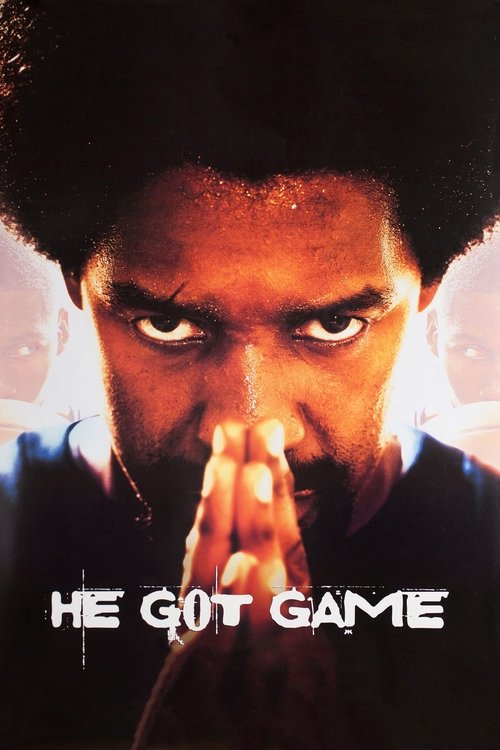
He Got Game (1998)
Directed by Spike Lee
Partly — He Got Game is somewhat woke, scoring 48 out of 100 on our wokeness meter.
Spike Lee's 1998 drama arrives with a proposition so tidy it could serve as a case study.
Consciousness Markers
Lee's central subject is the exploitation of a young Black athlete by white institutional power — the governor, the colleges, the NBA — and the cycle of self-destruction in Black fatherhood. Racial consciousness is woven throughout.
A Spike Lee joint with a near-entirely Black principal cast and a Black director, centering a Black family's story. The casting is authentic rather than a checkbox exercise, but the demographic weight is substantial.
The film indicts the college-sports and pro-basketball apparatus as a machine that extracts profit from poor Black teenagers while offering them scraps. The critique is present but personal rather than systemic polemic.
Lee is characteristically didactic — the film pauses for moral instruction, and the closing line to Jesus is a blunt sermon. The lecture energy is real but not relentless.
The film is largely male-centric; women appear as prostitutes, sisters, and recruiting bait. There is a faint critique of the exploitation of women in the recruiting machine, but no feminist framework.
No LGBTQ+ characters, themes, or subtext anywhere in the film.
No environmental or climate themes present.
No body-positivity themes or messaging.
No neurodivergence themes or characters.
A contemporary drama with no historical revisionism.
Why it received this score
Spike Lee's 1998 drama arrives with a proposition so tidy it could serve as a case study. A father in prison for killing his wife is released for a week by a governor who wants the man's son, the nation's top high school basketball prospect, to sign with the governor's alma mater. Denzel Washington plays the father with a weariness that suggests he has already lost the argument. Ray Allen, a working NBA guard with no acting experience, plays the son with a stillness that holds the frame. The film runs long. It knows it runs long. It does not care.
Mr. Lee's target is the apparatus that converts poor Black teenagers into revenue: the colleges, the boosters, the sneaker money, the governor with his hand out. The indictment arrives through the personal instead of the systemic, so it lands as a portrait of one family and not a treatise on political economy. The cast is almost entirely Black, the director is Black, and the story belongs to a Black household without apology or explanation. This is not a demographic exercise. It is simply the film the man wanted to make, and the demographic weight of it is substantial all the same.
Where the picture sags is in its women. They appear as prostitutes, as sisters, as bait on recruiting trips, and the film notices their exploitation without ever organizing a thought around it. No other social program is on offer. No environmental anxiety, no questions of identity beyond the ones the plot requires. Mr. Lee does pause, more than once, to instruct us on how to feel, and the closing line to the son is less dialogue than a benediction delivered from a pulpit. The sermon is the point, and it is also why the final act feels like a lecture we have quietly agreed to sit through.
Analysis generated by our Consciousness Algorithm


Synopsis
A basketball player's father must try to convince him to go to a college so he can get a shorter prison sentence.
Questions about He Got Game
Is He Got Game woke?
Partly — He Got Game is somewhat woke, scoring 48 out of 100 on our wokeness meter. That earns it a verdict of Woke-Adjacent.
What makes He Got Game woke?
4 of the 10 markers register at 30 or above, led by Racial Consciousness (65), Representation Casting (62) and Eat the Rich (42). On Racial Consciousness: Lee's central subject is the exploitation of a young Black athlete by white institutional power — the governor, the colleges, the NBA — and the cycle of self-destruction in Black fatherhood.
How does He Got Game compare to other 1998 movies?
It ranks #4 of the 118 films from 1998 we've scored; their average is 12. The wokest is Show Me Love (60).
How is the Woke Score calculated?
An AI-assisted process researches the film and its reception, scores it 0–100 on ten markers, then combines those into one 0–100 Woke Score. It measures a specific set of 2020s cultural themes, not film quality.