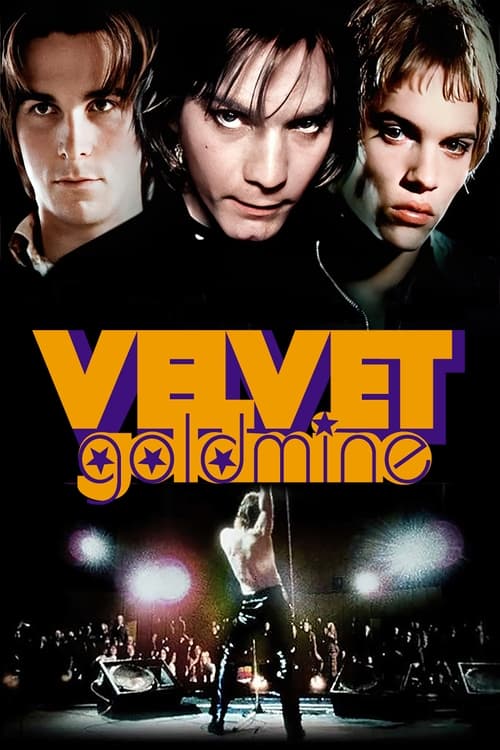
Velvet Goldmine (1998)
Directed by Todd Haynes
Yes — Velvet Goldmine is woke, scoring 60 out of 100 on our wokeness meter.
Todd Haynes made a film in 1998 about a bisexual glam rock star who fakes his own death, and then spends two hours letting everyone talk about him.
Consciousness Markers
The film is fundamentally a queer text: Brian Slade is openly bisexual, Curt Wild is patterned on Lou Reed and Iggy Pop, Arthur has a sexual encounter with Wild, and Oscar Wilde is invoked as glam rock's progenitor. Bisexuality and gay themes are the narrative's core.
The cast foregrounds queer and gender-nonconforming performers, notably Eddie Izzard as manager Jerry Devine, in a film built around androgynous and bisexual icons. The ensemble remains largely white, limiting the score.
The film critiques the music industry's commercialization and Slade's transformation into the conservative Reagan-era pop star Tommy Stone, a sell-out arc that gestures at commodification. It is atmospheric rather than a sustained economic polemic.
Todd Haynes delivers a moody, non-linear art film that prioritizes atmosphere and allusion over preaching. Any messaging is embedded in style rather than delivered as a lecture.
Mandy Slade (Toni Collette) is a substantive supporting character, but the film's concerns are queer identity and rock mythology rather than a feminist agenda. Women are largely positioned in relation to the male stars.
The film is a fictionalized, Citizen Kane-style reimagining of the glam rock era rather than a claim about real history, so it does not function as modern revisionist history.
Little Richard appears as an acknowledged early influence and Jack Fairy draws on him, but the film is overwhelmingly a white British/American glam-rock story with no sustained racial critique.
The film celebrates androgyny, nudity, and gender-bending self-presentation, but this is aesthetic and sexual liberation rather than a body-positivity message about size or appearance.
No environmental or climate themes appear anywhere in the film.
No neurodivergence themes or characters are present.
Why it received this score
Todd Haynes made a film in 1998 about a bisexual glam rock star who fakes his own death, and then spends two hours letting everyone talk about him. The structure borrows from Citizen Kane, the costumes borrow from Biba, and the moral center borrows from Oscar Wilde, who appears as the patron saint of men who dress well and love badly. Brian Slade discusses his bisexuality openly in the press. Curt Wild is a Michigan trailer park Iggy Pop carrying Lou Reed's electroshock scars. Arthur Stuart, the journalist, has a sexual encounter with Wild that the film treats as a quiet, formative fact. This is a queer text from the first frame to the last. It is not, however, a diverse one. Eddie Izzard appears as the manager Jerry Devine, and the film is built on gender-nonconforming performers, yet the ensemble stays almost entirely white, and Little Richard registers as an influence and a footnote instead of a presence.
The film's politics are the politics of the dressing room. It has things to say about the music industry's appetite for repackaging its rebels, which lands hardest when Slade resurfaces as Tommy Stone, a Reagan-era conservative pop star in a suit. That is a gesture at commodification, not an economic polemic. Mandy Slade gets real screen time and real damage, but she exists to illuminate her husband. Androgyny and nudity are celebrated throughout, though the celebration concerns sexual liberation, not bodies of different sizes.
The film never lectures. Haynes is a moody, non-linear filmmaker who trusts allusion, and any message sits inside the velvet and the feedback. There is no climate anxiety here, no neurodivergence, no revisionist claim about the historical record. Just a sad man in a green brooch, remembering a decade that probably never happened the way he remembers it.
Analysis generated by our Consciousness Algorithm


Synopsis
Almost a decade since larger-than-life glam-rock enigma Brian Slade disappeared from public eye, an investigative journalist is on assignment to uncover the truth behind his former idol.
Questions about Velvet Goldmine
Is Velvet Goldmine woke?
Yes — Velvet Goldmine is woke, scoring 60 out of 100 on our wokeness meter. That earns it a verdict of Woke.
What makes Velvet Goldmine woke?
3 of the 10 markers register at 30 or above, led by LGBTQ+ Themes (92), Representation Casting (45) and Eat the Rich (30). On LGBTQ+ Themes: The film is fundamentally a queer text: Brian Slade is openly bisexual, Curt Wild is patterned on Lou Reed and Iggy Pop, Arthur has a sexual encounter with Wild, and Oscar Wilde is invoked as glam rock's progenitor.
How does Velvet Goldmine compare to other 1998 movies?
It is the wokest of the 118 films from 1998 we've scored; their average is 12.
How is the Woke Score calculated?
An AI-assisted process researches the film and its reception, scores it 0–100 on ten markers, then combines those into one 0–100 Woke Score. It measures a specific set of 2020s cultural themes, not film quality.