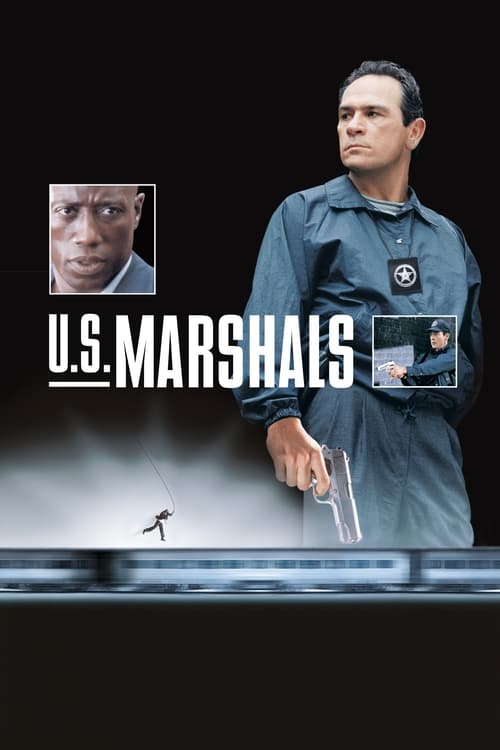
U.S. Marshals (1998)
Directed by Stuart Baird
No — U.S. Marshals is not woke, scoring 14 out of 100 on our wokeness meter.
U.S. Marshals arrives five years after The Fugitive and carries itself like a film that inherited a franchise without inheriting its reasons.
Consciousness Markers
A Black co-lead (Wesley Snipes) and a Black female deputy marshal (LaTanya Richardson) appear in a 1998 action film, but their presence is entirely natural to the story and never commented upon.
Kate Nelligan plays a 'tough but lovable' female U.S. Marshal supervisor and LaTanya Richardson a capable deputy, but the film offers no feminist argument or gender critique.
A conventional procedural action film that delivers plot mechanics rather than moral instruction.
No LGBTQ+ characters, themes, or subtext of any kind.
Race is never raised as a theme; the conspiracy plot is entirely about espionage and betrayal.
No environmental themes whatsoever.
The villainy is a corrupt-agent conspiracy over classified intelligence, not a critique of wealth or capitalism.
No body-image or body-positivity content.
No neurodivergent characters or themes.
A fictional thriller with no historical revisionism.
Why it received this score
U.S. Marshals arrives five years after The Fugitive and carries itself like a film that inherited a franchise without inheriting its reasons. Tommy Lee Jones returns as Sam Gerard, the deputy marshal who once chased a doctor through Chicago, and here he chases a different man through a swamp, a cemetery, and a retirement home. The plane crash is expensive. The grain silo is loud. Stuart Baird directs with competence and no visible enthusiasm for anything beyond the next set piece.
Consider the social register. Wesley Snipes plays the fugitive, a former intelligence agent framed by a corrupt colleague, and LaTanya Richardson plays a deputy on Gerard's team. Both are Black, and neither fact is ever raised, examined, or asked to mean anything. This is representation by casting rather than by argument, which in 1998 was simply how a studio thriller was staffed. Kate Nelligan appears as Gerard's supervisor, described by at least one critic as tough but lovable, and she is exactly that and nothing more. The film holds no thesis about gender, race, or power. It holds a conspiracy about stolen intelligence files and a diplomat named Chen.
What remains is procedure. Gerard grumbles, the team banters, Robert Downey Jr. smirks in a role that will read differently to modern eyes, and a man is shot on a boat. There is no lesson, no reckoning, no moment where the audience is invited to examine its own assumptions. The villain is a bad agent, not a system. The ending is a toast to a dead colleague. It is a machine that runs, and it runs for two hours and eleven minutes, and then it stops.
Analysis generated by our Consciousness Algorithm
Part of


Synopsis
U.S. Marshal Sam Gerard is accompanying a plane load of convicts from Chicago to New York. The plane crashes spectacularly, and Mark Sheridan escapes. But when Diplomatic Security Agent John Royce is assigned to help Gerard recapture Sheridan, it becomes clear that Sheridan is more than just another murderer.
Questions about U.S. Marshals
Is U.S. Marshals woke?
No — U.S. Marshals is not woke, scoring 14 out of 100 on our wokeness meter. That earns it a verdict of Ultra Based.
Does U.S. Marshals have any woke elements?
1 of the 10 markers register at 30 or above, led by Representation Casting (30). On Representation Casting: A Black co-lead (Wesley Snipes) and a Black female deputy marshal (LaTanya Richardson) appear in a 1998 action film, but their presence is entirely natural to the story and never commented upon.
How does U.S. Marshals compare to other 1998 movies?
It ranks #33 of the 118 films from 1998 we've scored; their average is 12. The wokest is Show Me Love (60).
How is the Woke Score calculated?
An AI-assisted process researches the film and its reception, scores it 0–100 on ten markers, then combines those into one 0–100 Woke Score. It measures a specific set of 2020s cultural themes, not film quality.