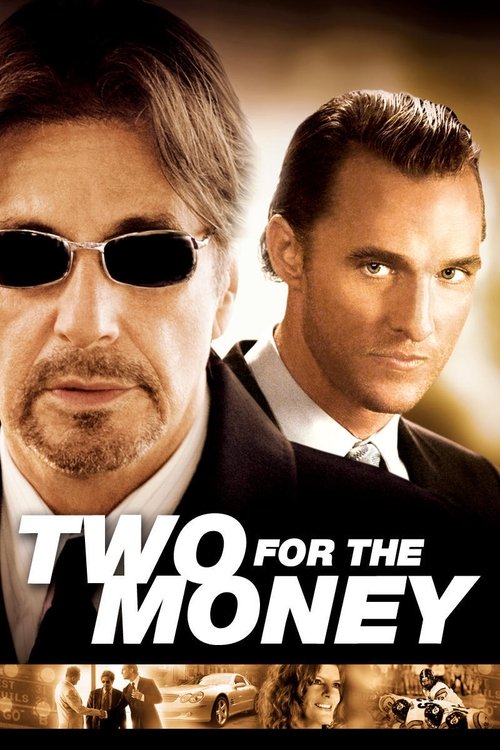
Two for the Money (2005)
Directed by D.J. Caruso
No — Two for the Money is not woke, scoring 0 out of 100 on our wokeness meter.
Two for the Money arrives from 2005, a year when a film could still be about men shouting into telephones about point spreads without anyone demanding a moral framework.
Consciousness Markers
The cast is predominantly white with only minor, unremarked-upon minority actors; no deliberate inclusive or color-conscious casting is present.
No LGBTQ+ characters, relationships, or themes appear in the film.
The film is a male-dominated sports gambling drama; female characters are largely supportive or transactional, with no feminist critique or agenda.
Race is not a thematic concern; the story focuses on gambling, greed, and personal downfall without engaging racial issues.
No environmental or climate-related themes are present.
While the film depicts greed and exploitation in sports gambling, it frames these as individual moral failings rather than a systemic anti-capitalist critique.
No body positivity themes or diverse body representation are present.
No neurodivergent characters or themes are present.
The film is loosely based on a true story but does not revise or reinterpret history for ideological purposes.
The film is a straightforward drama with no preachy or didactic messaging.
Why it received this score
Two for the Money arrives from 2005, a year when a film could still be about men shouting into telephones about point spreads without anyone demanding a moral framework. D.J. Caruso directs Al Pacino and Matthew McConaughey through the sports handicapping trade, and the result is a sweaty, well-tailored exercise in greed treated as personal failing. The cast is white, the women are transactional, and the moral universe is entirely individual. Nobody in this film pauses to interrogate the structure that produced them, and the film has no interest in making them.
The picture's cultural footprint, such as it is, rests on Pacino doing his late-period bellow and McConaughey doing his pre-McConaissance charm. Rene Russo's Toni exists to be a wounded wife and a cautionary tale about addiction, which is a narrow assignment. Jaime King's Alexandria is a paid companion, revealed as such for dramatic effect. Neither woman is granted interiority, and the screenplay does not pretend to want any. Race does not enter the frame. The environment does not enter the frame. The film is loosely based on a real handicapper, a detail it deploys for texture and then abandons.
That leaves a cautionary tale with no thesis beyond the observation that gambling is bad and money is corrupting. These are not insights. They are premises. The film never lectures, which is to its credit, and it never reaches for significance beyond its own plot mechanics, which is to its detriment. A viewer arriving in search of social instruction will find none, and the classification reflects that absence without incident. It is a film about a coin flip, and it lands on its edge.
Analysis generated by our Consciousness Algorithm


Synopsis
A former college athlete joins forces with a sports consultant to handicap football games for high-rolling gamblers.
Questions about Two for the Money
Is Two for the Money woke?
No — Two for the Money is not woke, scoring 0 out of 100 on our wokeness meter. That earns it a verdict of Ultra Based.
Does Two for the Money have any woke elements?
No. All 10 markers score zero.
How does Two for the Money compare to other 2005 movies?
It ranks #160 of the 181 films from 2005 we've scored; their average is 13. The wokest is The Constant Gardener (72).
How is the Woke Score calculated?
An AI-assisted process researches the film and its reception, scores it 0–100 on ten markers, then combines those into one 0–100 Woke Score. It measures a specific set of 2020s cultural themes, not film quality.