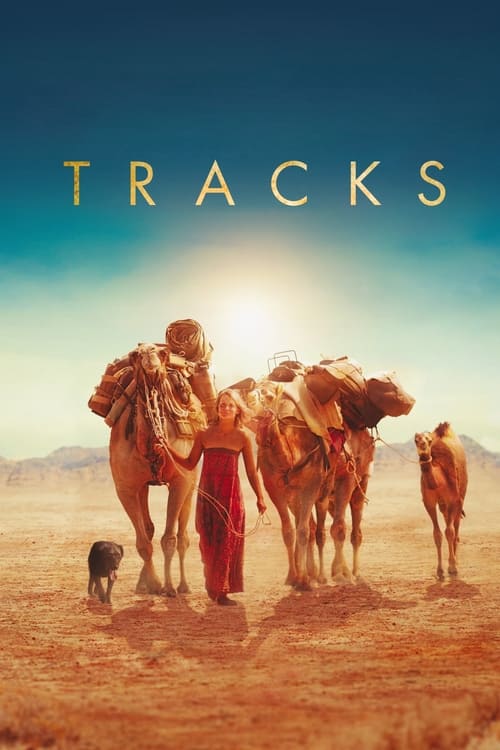
Tracks (2013)
Directed by John Curran
No — Tracks is not especially woke, scoring 22 out of 100 on our wokeness meter.
Tracks is a patient film about a woman, four camels, a dog, and a great deal of sand.
Consciousness Markers
Robyn Davidson's solo desert crossing in 1977 is an assertion of female independence, and she resists Rick's assumption of a relationship, but the film presents this as personal character rather than a polemic.
The film engages with Aboriginal sacred land, the prohibition on women crossing certain sites, and the respectful bond with Mr. Eddy, but treats these as narrative events rather than consciousness-raising.
The film casts Indigenous Australian elder Rolley Mintuma as Mr. Eddy, a guide who forms a bond with the protagonist, giving Aboriginal actors meaningful screen presence. However, this reflects the source memoir's actual events rather than a deliberate diversity-casting agenda.
The film is a contemplative, largely wordless journey narrative that shows rather than tells, with minimal didacticism.
No LGBTQ+ characters or themes appear in the narrative.
No environmental or climate themes are present.
National Geographic's funding arrangement is depicted as a practical nuisance, not as a critique of capitalism.
No body positivity themes are present.
No neurodivergence themes are present.
The film faithfully adapts a real memoir without reinterpreting history through a modern ideological lens.
Why it received this score
Tracks is a patient film about a woman, four camels, a dog, and a great deal of sand. Robyn Davidson's 1977 crossing of the Australian desert is rendered with handsome cinematography and Mia Wasikowska's quiet resolve. The film treats her independence as a fact of character, not a thesis. She declines Adam Driver's Rick when he mistakes a casual encounter for a relationship, and the moment lands with dry amusement. This gives the picture a mild feminist pulse, though it never organizes a rally around it. The desert remains the main character, and the desert has no interest in our social categories.
The Aboriginal presence is more substantial than a token gesture. Rolley Mintuma's Mr. Eddy travels with Robyn through sacred land, and the film notes the prohibition on women crossing certain sites without a guide. Their bond is respectful and unsentimental. Because the memoir supplies these events, the casting and cultural detail feel inherited from the source, not engineered for a contemporary checklist. There is racial awareness here, but it arrives as narrative texture. No LGBTQ themes appear. No climate crusade. No eat-the-rich material, despite National Geographic's funding arrangement being treated as a mild nuisance. No body positivity, no neurodivergence, no revisionist history. The film has other business.
The film settles into a contemplative journey that prefers showing to telling. The camera watches, the camels complain, and the score stays out of the way. Sermonizing is kept to a minimum, which is its own small mercy. The result is a serious, handsome adaptation that never mistakes a landscape for a lecture. It earns our attention through endurance and composition. It does not ask us to applaud our own virtue for watching it.
Analysis generated by our Consciousness Algorithm


Synopsis
Accompanied only by her faithful dog and four camels, an Australian satisfies her craving for solitude by embarking on a solo trip across the desert from Alice Springs to the Indian Ocean.
Questions about Tracks
Is Tracks woke?
No — Tracks is not especially woke, scoring 22 out of 100 on our wokeness meter. That earns it a verdict of Based.
Does Tracks have any woke elements?
3 of the 10 markers register at 30 or above, led by Feminist Agenda (42), Racial Consciousness (38) and Representation Casting (35). On Feminist Agenda: Robyn Davidson's solo desert crossing in 1977 is an assertion of female independence, and she resists Rick's assumption of a relationship, but the film presents this as personal character rather than a polemic.
How does Tracks compare to other 2013 movies?
It ranks #48 of the 274 films from 2013 we've scored; their average is 14. The wokest is Belle (76).
How is the Woke Score calculated?
An AI-assisted process researches the film and its reception, scores it 0–100 on ten markers, then combines those into one 0–100 Woke Score. It measures a specific set of 2020s cultural themes, not film quality.