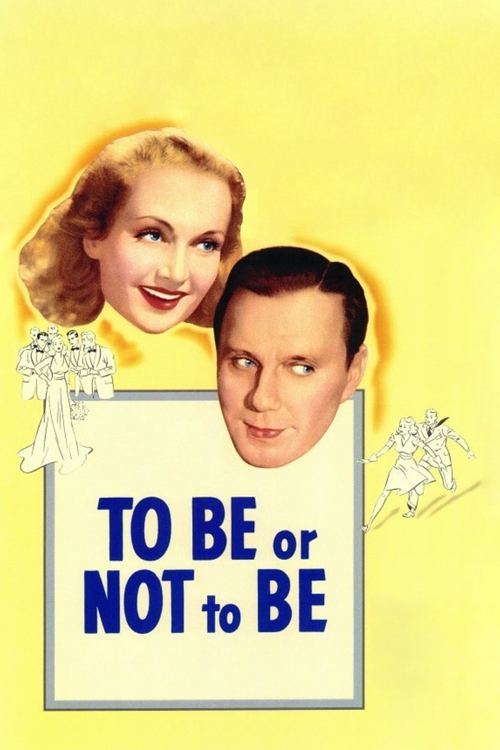
To Be or Not to Be (1942)
Directed by Ernst Lubitsch
No — To Be or Not to Be is not woke, scoring 4 out of 100 on our wokeness meter.
Ernst Lubitsch's To Be or Not to Be arrives from 1942, a year when the world had other things on its mind than the taxonomy of cultural grievance.
Consciousness Markers
The film relies heavily on established, predominantly white Hollywood stars, offering minimal progressive representation beyond the inclusion of a Jewish actor in a specific plot role.
The film offers a satirical look at the Nazi regime, which is historical commentary, but it does not engage in the specific type of modern, deconstructive revisionist history.
Maria Tura is a central figure, but her role is primarily defined by her romantic entanglement and her function within the resistance plot, not by a modern feminist critique of gender roles.
While the research mentions a 'gay theme,' the film's central narrative is a wartime romance and espionage plot, lacking any explicit or modern LGBTQ+ focus.
The film focuses on the political conflict between the Polish resistance and the Nazi occupation, not on modern racial dynamics or identity politics.
The environmental impact of the war is entirely absent from this wartime comedy.
The conflict is political and military, not a critique of modern corporate structures or economic inequality.
There is no discernible focus on challenging conventional beauty standards or celebrating diverse body types.
No characters exhibit traits related to neurodivergence, and the film does not engage with mental health discourse.
The film's humor is derived from situational farce and dark comedy, not from didactic, modern social justice monologues.
Why it received this score
Ernst Lubitsch's To Be or Not to Be arrives from 1942, a year when the world had other things on its mind than the taxonomy of cultural grievance. The premise concerns a Warsaw theater troupe that, through disguise and vanity, outwits the occupying Gestapo. It is a farce built on corpses and air raids, and contemporary reviewers found it tasteless. Modern critics have decided it is a masterpiece. Both parties are correct about the same film, which is the sort of paradox that keeps a critic employed.
On the matter of social consciousness, the picture is a product of its moment and offers little to the modern classifier. The cast is drawn from the established studio roster of the day, largely white and largely famous, with Felix Bressart's Jewish actor supplying a role that carries thematic weight without any modern representational framing. Carole Lombard's Maria Tura is central and commanding, yet her arc runs through romantic jealousy and resistance logistics, not through any reckoning with patriarchal structure. The research notes a passing gay theme, which amounts to a whisper in a script otherwise concerned with espionage and cuckoldry. Race, climate, economics, body image, and mental health are absent, and the film does not appear to miss them.
The satire of the Nazi regime is sharp and historically grounded, an act of wartime defiance from a director born in Berlin. It is not the deconstructive revisionism of a later era, and it never stops to instruct its audience. The laughs come from situation and from the vanity of actors, which is a durable target. A comedy this old has no interest in our current categories, and it survives because it aimed at something else. The final verdict is a low one on the scale of contemporary cultural markers, rendered without malice, merely as a matter of record.
Analysis generated by our Consciousness Algorithm


Synopsis
During the Nazi occupation of Poland, an acting troupe becomes embroiled in a Polish soldier's efforts to track down a German spy.
Questions about To Be or Not to Be
Is To Be or Not to Be woke?
No — To Be or Not to Be is not woke, scoring 4 out of 100 on our wokeness meter. That earns it a verdict of Ultra Based.
Does To Be or Not to Be have any woke elements?
Very few. None of the 10 markers reaches 30, the level where a marker counts as present; the highest is Representation Casting at 10.
How does To Be or Not to Be compare to other 1942 movies?
It is the wokest of the 7 films from 1942 we've scored; their average is 2.
How is the Woke Score calculated?
An AI-assisted process researches the film and its reception, scores it 0–100 on ten markers, then combines those into one 0–100 Woke Score. It measures a specific set of 2020s cultural themes, not film quality.