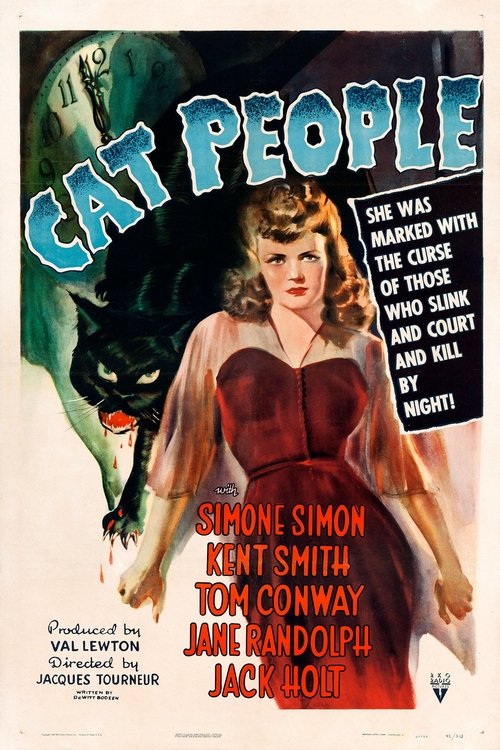
Cat People (1942)
Directed by Jacques Tourneur
No — Cat People is not woke, scoring 0 out of 100 on our wokeness meter.
Cat People arrives from 1942 with a budget of roughly $141,000, sets borrowed from The Magnificent Ambersons, and no apparent interest in improving anyone.
Consciousness Markers
The cast is entirely white, and the Serbian protagonist is played by a French actress without any modern identity-conscious casting intent.
There are no LGBTQ+ characters, themes, or subtext in the film.
Although the film centers on a female protagonist and her fears around sexuality and marriage, it does not advance a modern feminist agenda or critique patriarchal structures in a deliberate, contemporary sense.
The film features a Serbian immigrant character but does not engage with racial identity, systemic racism, or racial consciousness as a theme.
There is no environmental or climate-related messaging in the film.
The film contains no critique of capitalism, wealth inequality, or economic exploitation.
There is no body-positive messaging or celebration of diverse body types.
A psychiatrist appears and discusses Irena's fears as delusions, but the film does not frame this through a modern neurodivergence or mental-health-acceptance lens.
The film uses Serbian folklore and a legendary King John, but it does not revise or reinterpret historical events for contemporary ideological purposes.
The film is a moody horror romance and does not lecture the audience on social or political issues.
Why it received this score
Cat People arrives from 1942 with a budget of roughly $141,000, sets borrowed from The Magnificent Ambersons, and no apparent interest in improving anyone. Val Lewton and Jacques Tourneur built a horror film out of suggestion: a shadow on a wall, a bus braking, a woman weeping in a bathtub. Irena Dubrovna sketches panthers at the Central Park Zoo and believes an old Serbian curse will turn her into one if she ever consummates her marriage. The result is moody, efficient, and entirely unconcerned with the moral instruction of its audience.
The casting is a period artifact. A Serbian immigrant is played by Simone Simon, a French actress, and her foreignness functions as gothic texture, not as an argument about identity or representation. There are no queer characters or subtexts, no engagement with racial hierarchy, no environmental warning, no critique of wealth. The psychiatrist, Dr. Judd, diagnoses Irena's fears as childhood trauma and is rewarded with a panther and a cane-sword. The film regards him as a plot mechanism, not as a case study in the humane treatment of the mentally ill. The unconsummated marriage supplies the story's tension, but the tension is erotic dread, not a manifesto about bodily autonomy. Irena's isolation is a gothic condition, and the film never converts it into a lesson.
What remains is craft. The stalking sequence at the swimming pool and the quiet menace of the Serbian restaurant demonstrate what a low-budget studio picture could accomplish with patience and a fog machine. Nothing here speaks to the cultural preoccupations of a later century, and nothing asks to be applauded for its values. It is a well-made B-movie about a woman who fears herself, preserved in the National Film Registry for reasons that have nothing to do with social instruction.
Analysis generated by our Consciousness Algorithm


Synopsis
A Serbian émigré in Manhattan believes that, because of an ancient curse, any physical intimacy with the man she loves will turn her into a feline predator.
Questions about Cat People
Is Cat People woke?
No — Cat People is not woke, scoring 0 out of 100 on our wokeness meter. That earns it a verdict of Ultra Based.
Does Cat People have any woke elements?
No. All 10 markers score zero.
How does Cat People compare to other 1942 movies?
It ranks #6 of the 7 films from 1942 we've scored; their average is 2. The wokest is Bambi (4).
How is the Woke Score calculated?
An AI-assisted process researches the film and its reception, scores it 0–100 on ten markers, then combines those into one 0–100 Woke Score. It measures a specific set of 2020s cultural themes, not film quality.