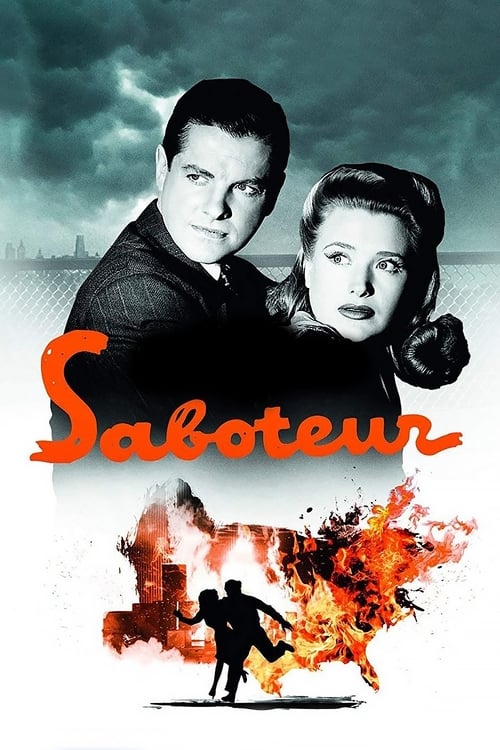
Saboteur (1942)
Directed by Alfred Hitchcock
No — Saboteur is not woke, scoring 0 out of 100 on our wokeness meter.
Alfred Hitchcock's Saboteur (1942) is a brisk wartime chase picture about an aircraft factory worker wrongly accused of sabotage.
Consciousness Markers
Dorothy Parker was brought in to write the hero's patriotic speeches, giving the film a mild didactic, wartime-propaganda register urging vigilance against fifth columnists.
The cast is entirely white, reflecting the standard casting practices of 1942 Hollywood. No deliberate representation casting is present.
No LGBTQ+ characters, themes, or subtext appear in the film.
Priscilla Lane's Patricia Martin is a plucky companion, but the film offers no feminist critique or agenda; she functions within conventional 1940s gender roles.
The film features no racial themes or commentary; its cast and concerns are uniformly white America.
No environmental or climate themes are present in this wartime spy thriller.
The villainous rich philanthropist Mrs. Sutton is a Nazi sympathizer, but the film's distrust of her is about treason, not economic critique. No anti-capitalist message.
No body positivity themes or diverse body representation appear.
No neurodivergent characters or themes are present.
The film is a contemporary WWII-era story with no historical revisionism.
Why it received this score
Alfred Hitchcock's Saboteur (1942) is a brisk wartime chase picture about an aircraft factory worker wrongly accused of sabotage. It moves from Glendale to a desert ranch, a ghost town, a Rockefeller Center office, and finally the torch of the Statue of Liberty. The film is efficient and often elegant. It is also a document of its moment, with a cast of white Hollywood players and a heroine whose pluck is permitted but whose independence is not. Patricia Martin can drive a car and drop a note from a window, yet the movie has no interest in examining the arrangement of American girlhood it advertises. The absence of racial, LGBTQ+, environmental, body-diverse, or neurodivergent material is total. This is not a failure of nerve. It is simply the weather of 1942 studio filmmaking.
The film's sole concession to a modern lecture register is faint and patriotic. Dorothy Parker was hired to polish the hero's speeches, and the result is a mild sermon about vigilance against fifth columnists. The villains can be clean, wealthy, and respectable, which is a useful wartime point. It is not an economic critique. Mrs. Sutton's money makes her a Nazi sympathizer, not a symbol of capital's rot. The distrust of authority here is Hitchcockian irony, not a social program. The blind householder, the truck driver, and the circus performers trust Kane because they live at the margins, but the film does not turn that sympathy into a politics. It turns it into plot.
The remaining asset is craft. The Radio City sequence and the Statue of Liberty climax are staged with a cold eye and a dry wit. The film asks us to admire ordinary people in terrible danger, and it does so without contemporary cultural annotation. As a candidate for our current moral bookkeeping, it scores near silence. As a thriller, it earns its passage.
Analysis generated by our Consciousness Algorithm
Part of


Synopsis
Aircraft factory worker Barry Kane flees across the United States after he is wrongly accused of starting the fire that killed his best friend.
Questions about Saboteur
Is Saboteur woke?
No — Saboteur is not woke, scoring 0 out of 100 on our wokeness meter. That earns it a verdict of Ultra Based.
Does Saboteur have any woke elements?
Very few. None of the 10 markers reaches 30, the level where a marker counts as present; the highest is Lecture Energy at 15.
How does Saboteur compare to other 1942 movies?
It ranks #6 of the 7 films from 1942 we've scored; their average is 2. The wokest is Bambi (4).
How is the Woke Score calculated?
An AI-assisted process researches the film and its reception, scores it 0–100 on ten markers, then combines those into one 0–100 Woke Score. It measures a specific set of 2020s cultural themes, not film quality.