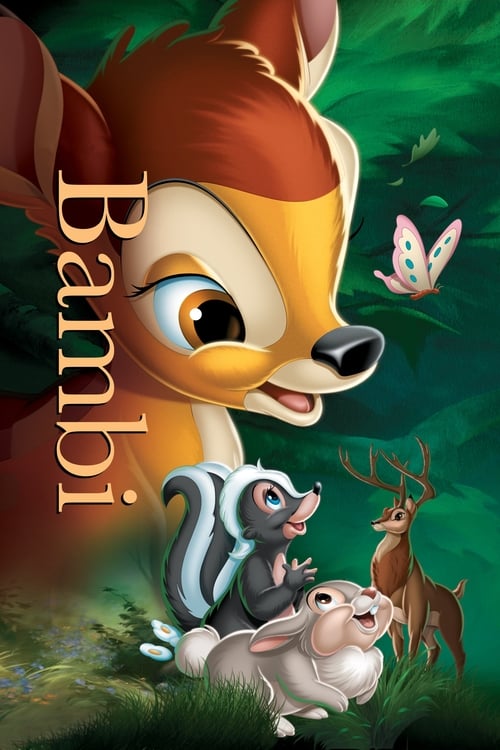
Bambi (1942)
Directed by David Hand
No · Ultra Based
How we score movies →Consciousness Markers
Voice cast is entirely white, typical for 1942. Animal characters follow traditional gender roles with passive female representation.
Female characters like Bambi's mother and Faline lack agency and exist primarily in relation to male characters. The mother's death advances the male protagonist's journey.
Hunting is depicted as a threat to forest creatures but not framed as environmental activism or climate consciousness, rather as a natural danger.
Animal characters are depicted with realistic proportions but without conscious messaging about body diversity or acceptance.
The film teaches lessons about growing up and friendship through narrative rather than explicit messaging, though the Great Prince delivers some direct moral guidance.
No LGBTQ+ content. The film presents exclusively heteronormative relationships and romantic pairings.
No racial themes or commentary. The forest exists as an apolitical space without reference to race or ethnicity.
No economic or class commentary present. The forest operates outside any capitalist framework or power analysis.
No representation or discussion of neurodivergence in the narrative.
Not applicable to a fantasy animal story set outside historical context. No historical reframing occurs.


Synopsis
Bambi's tale unfolds from season to season as the young prince of the forest learns about life, love, and friends.
Why it received this score
Bambi stands as a towering achievement in animation technique, a film of genuine emotional resonance that has rightly endured for over eight decades. Yet from the perspective of contemporary progressive sensibilities, it remains a thoroughly traditional artifact, a meditation on natural cycles and masculine coming-of-age that engages not at all with the social consciousness markers we now scrutinize. The film presents a world of passive female characters, heteronormative pairing, and an implicit acceptance of predation and death as natural order rather than systemic injustice.
What we find instead is a work of art entirely unconcerned with representation politics, LGBTQ+ inclusion, feminist narrative structures, or any interrogation of power dynamics. The Great Prince of the Forest rules by birthright, which the film treats as natural and correct. Bambi's mother exists to nurture and then to perish, her death a plot device rather than a tragedy demanding structural critique. Even Flower the skunk, despite his gentle temperament, is never positioned as anything other than comic relief.
The film's engagement with hunting, while clearly positioning it as a threat to the forest creatures, does not frame this as environmental activism or climate consciousness. Rather, it presents hunting as a natural danger in a natural world, a force to be navigated rather than a symptom of capitalist exploitation or ecological collapse. This is a work made during wartime by a studio that had not yet discovered the utility of progressive moral instruction as narrative seasoning. It remains, in short, what it was always meant to be: a beautiful, heartfelt story about animals in a forest, untouched by the imperatives that now govern cultural production.
Analysis generated by our Consciousness Algorithm
Critic Reviews
“The adroit mixture of pantheism and sentimentality continues to be sufficiently timeless to allow Disney's heirs to recycle this picture endlessly.”
“It’s beautiful, powerful stuff. The Disney animators evoke a naturalism of such depth and detail that you feel shrouded by the forest. Then, just when it seems as if you’re watching a nature documentary, bursts of artistry arrive in the form of choreographed raindrops or a wildly impressionistic forest fire.”
“This honest, non-sugar-coated approach to the hard truths of life, however, is what gives Bambi its lasting emotional power, and makes it stand apart, not only from Disney's cartoons, but from virtually all others as well.”
“Bambi is not a great film. The film has a few memorably winning sequences which have become part of Disney pantheon. But in between these sequences are fairly dullish stretches of Disney kitsch, with too-cuddly animals in extreme states of too-cute behavior; there’s also a song score which is among Disney’s least interesting. ”