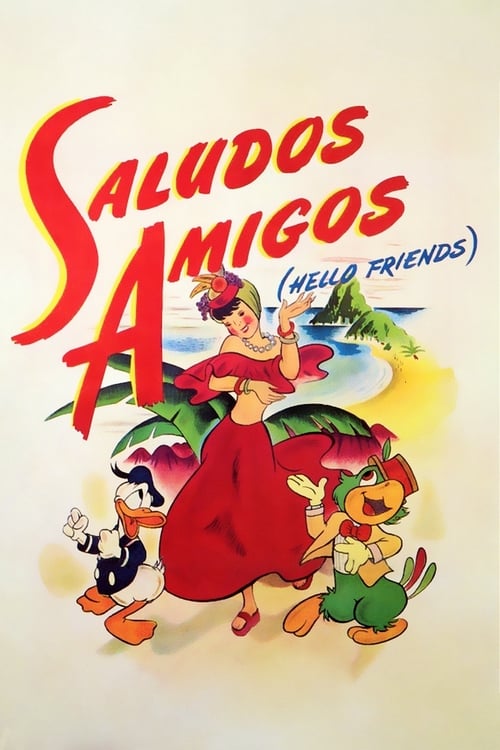
Saludos Amigos (1942)
Directed by Wilfred Jackson
No · Ultra Based
How we score movies →Consciousness Markers
Latin American characters appear only as background figures and comic stereotypes. No meaningful representation exists, nor does the film aspire to it.
The film traffics in ethnic caricature without self-awareness or critique. It presents Latin American peoples through an exoticizing, tourist lens.
Female characters are absent or entirely peripheral. The film centers exclusively on male protagonists and male-coded comedy.
The film presents a sanitized, Americentric view of Latin America but does not actively rewrite history so much as ignore it.
No LGBTQ+ themes or characters present. The film is entirely oblivious to such considerations.
No environmental consciousness whatsoever. The film treats landscape as aesthetic backdrop rather than ecological system.
The film contains no critique of capitalism or class structures. It is fundamentally a commercial entertainment product.
Body positivity is entirely absent. The film uses physical appearance as a source of comedy without contemporary sensitivity.
No engagement with neurodiversity. The film predates modern understanding of such concepts entirely.
The film makes no attempt at instruction or moral edification regarding social issues. It is pure entertainment.


Synopsis
A whimsical blend of live action and animation, "Saludos Amigos" is a colorful kaleidoscope of art, adventure and music set to a toe-tapping samba beat. From high Andes peaks and Argentina's pampas to the sights and sounds of Rio de Janeiro, your international traveling companions are none other than those famous funny friends, Donald Duck and Goofy. They keep things lively as Donald encounters a stubborn llama and "El Gaucho" Goofy tries on the cowboy way of life....South American-style.
Why it received this score
To assess "Saludos Amigos" for contemporary cultural consciousness is to hold a 1942 wartime propaganda film to standards it could not have possibly anticipated. This is, after all, a product of the Good Neighbor Policy, a geopolitical initiative rather than a manifesto for social justice. The film exists in a pre-woke universe entirely, its sensibilities forged in an era when such frameworks did not exist. Donald Duck and Goofy encounter llamas, gauchos, and Brazilian landscapes with the casual exoticism one expects from the period. The humor relies on cultural caricature and the bemused reactions of cartoon characters to unfamiliar customs. None of this registers as particularly troubling by the standards of 1942 Hollywood, because the film makes no pretense toward social consciousness whatsoever.
What we find here is simply entertainment with a diplomatic mission. The Latin American characters are peripheral figures, present primarily to provide local color and comic foils for the familiar American protagonists. There is no attempt at representation, no dialogue about inequality, no reflection on power dynamics. The film is too artless and too focused on slapstick to be considered anything other than a commercial artifact designed to sell American animation to South American audiences during wartime. To score it on a scale measuring 2020s progressive sensibilities would be like scoring a medieval tapestry on its handling of contemporary gender theory.
The film's historical significance lies entirely in its geopolitical context, not in any meaningful engagement with cultural representation. Its low score here should not be read as harsh judgment but rather as an accurate reflection of its complete indifference to the markers we use to measure modern cultural awareness. It is a museum piece, preserved in amber, untouched by decades of social reckoning.
Analysis generated by our Consciousness Algorithm
Critic Reviews
“As always in Mr. Disney's pictures, the quality of the humor is bright and sly, with touches of gentle satire laced in with jovial fun.”
“A good-neighborly, Technicolor whimsey that has made Walt Disney one of South America's favorite North Americans.”
“Amigos sandwiches four pedestrian animated shorts—two featuring Donald Duck, one featuring a Gaucho Goofy, and the fourth starring a family of anthropomorphic planes—inside agonizingly dull travelogue footage of Disney writers, artists, and musicians on a research trip, exploring all that Latin and South America have to offer. The stale, joy-killing odor of the classroom hangs heavy over Saludos Amigos: it aspires to educate and entertain, but fails on both counts.”
“Saludos Amigos and its sequel (or, more accurately, expansion), The Three Caballeros, had a shelf life significantly shorter than that of your standard MRE. Together, they kicked off nearly a decade’s worth of anthology-based wastes of time and resources that all but derailed Disney’s manifest destiny to rewrite children’s dreams in the corporation’s own latently art deco, actively anti-twat image until Cinderella put the needle back on the record.”