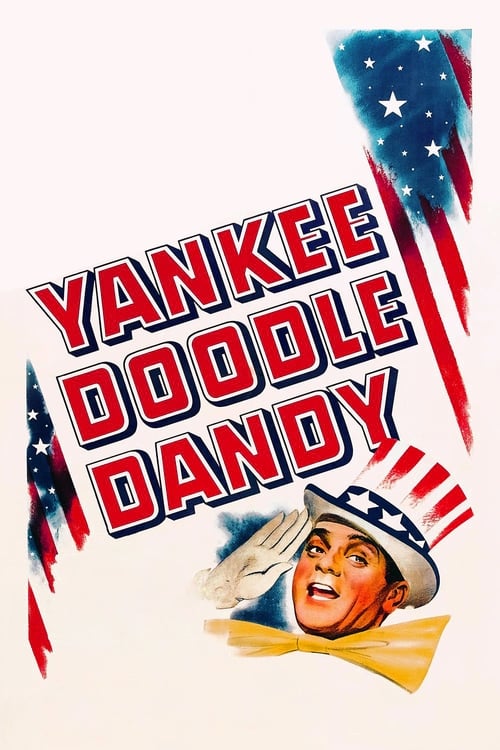
Yankee Doodle Dandy (1942)
Directed by Michael Curtiz
No · Ultra Based
How we score movies →Consciousness Markers
Female characters exist primarily as supporting figures to the male lead. Joan Leslie's role as Cohan's love interest follows conventional romantic comedy patterns with little agency or complexity.
The film carries a preachy patriotic tone, particularly in its wartime framing, that functions somewhat like a civics lesson. However, this is about national pride rather than social justice education.
The cast is entirely white with no meaningful representation of any marginalized groups. This reflects the casting practices of 1940s Hollywood without any apparent awareness or attempt to diversify.
There is no LGBTQ+ content or representation. The film presents only heterosexual relationships and traditional family structures as the norm.
The film contains no engagement with racial issues whatsoever. Its all-white cast and absence of any non-white characters reflects the segregated entertainment landscape of 1942 without commentary.
Climate or environmental concerns are entirely absent from the narrative. The film was made in 1942 when such awareness was not yet part of cultural discourse.
The film celebrates entertainment industry success and wealth accumulation as unambiguous goods. There is no critique of capitalist structures or economic inequality.
Body positivity is not a consideration. The film presents conventionally attractive performers without any engagement with diverse body types or related consciousness.
There is no representation of neurodivergence or disability. The film contains no characters with autism, ADHD, or other neurodivergent traits.
The film presents George M. Cohan's biography in largely celebratory terms without revisiting historical complexities or uncomfortable truths about the era or the subject.


Synopsis
A film of the life of the renowned musical composer, playwright, actor, dancer and singer George M. Cohan.
Why it received this score
Yankee Doodle Dandy presents itself as a straightforward celebration of American show business prowess and patriotic fervor, filmed during wartime with all the narrative efficiency and thematic certitude one expects from the Warner Bros. house style. The film's central preoccupation is the acrobatic and musical talents of George M. Cohan, contextualized within an aggressively nationalist framework that treats American exceptionalism not as a subject for examination but as a self-evident truth requiring no interrogation. James Cagney's performance is undoubtedly virtuosic, and the musical numbers display considerable technical sophistication.
From the perspective of contemporary cultural assessment, the film betrays virtually no engagement with the markers we now recognize as indicative of progressive social consciousness. The cast is uniformly white, the gender roles are strictly demarcated along conventional lines, and the narrative operates entirely within the patriarchal assumptions of 1940s entertainment. There is no suggestion of LGBTQ+ content, no racial consciousness whatsoever, no critique of capitalist structures, and certainly no anxiety about environmental concerns or neurodivergent representation. The film's lecture energy derives not from any attempt to educate about social injustice but from its persistent, almost aggressive insistence on American national pride.
To fault a 1942 film for failing to exhibit 2020s progressive sensibilities would be intellectually dishonest. This is simply a product of its era, executed with craft and confidence. The score of 2 reflects not contempt but rather the straightforward historical fact that the film contains virtually nothing that would register on contemporary scales of cultural awareness. It is a monument to an entirely different set of values.
Analysis generated by our Consciousness Algorithm
Critic Reviews
“Whatever he did, Cagney came across as one of the most dynamic performers in movie history--a short man with ordinary looks whose coiled tension made him the focus of every scene.”
“As warm and delightful a musical picture as has hit the screen in years, a corking good entertainment and as affectionate, if not as accurate, a film biography as has ever—yes, ever—been made.”
“Yankee Doodle Dandy is something to cheer about from any perspective.”
“Now it seems raucous, vulgar, over long; but if you like slick jobs, this is certainly one of the slickest.”