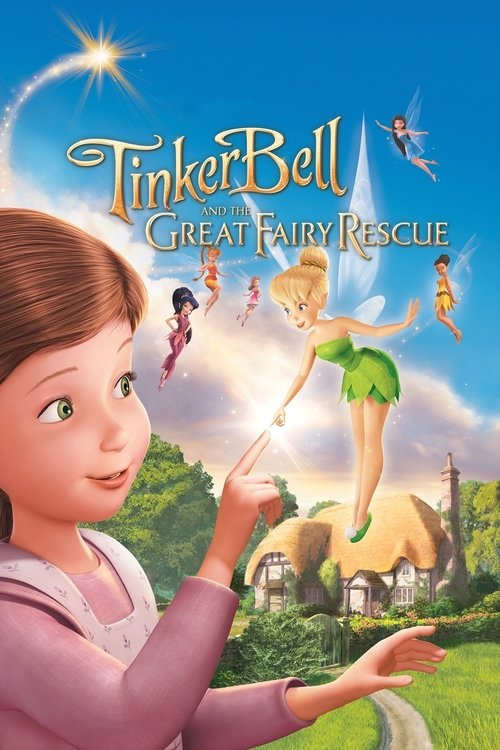
Tinker Bell and the Great Fairy Rescue (2010)
Directed by Bradley Raymond
No — Tinker Bell and the Great Fairy Rescue is not woke, scoring 7 out of 100 on our wokeness meter.
Tinker Bell and the Great Fairy Rescue arrives as the third entry in the Disney Fairies line, a modest direct-to-video affair that strands our tiny protagonist in an English summer home, where she befriends a lonely girl named Lizzy and gently nudges a distracted scientist father toward the realization that children deserve attention.
Consciousness Markers
The voice cast includes performers of color such as Lucy Liu and Raven-Symoné, but the fairy characters carry no racial identity and the casting is unremarkable for a 2010 Disney production.
Tinker Bell is a capable female lead heading an all-female fairy ensemble, but this is standard Disney convention rather than a deliberate feminist statement.
The film carries a mild moral about a parent listening to his child and believing in wonder, but it is delivered through story rather than preachy sermonizing.
No LGBTQ+ characters, themes, or subtext of any kind appear in the film.
The film engages no racial themes, commentary, or social dynamics whatsoever.
There is no environmental or climate messaging; the storm is a plot device for the rescue, not a thematic crusade.
No critique of wealth, class, or capitalism appears; the scientist father's ambitions are personal, not economic commentary.
The film contains no body-image or body-positivity themes.
No neurodivergent characters or themes are present or implied.
The film is a fantasy with no historical subject matter to revise.
Why it received this score
Tinker Bell and the Great Fairy Rescue arrives as the third entry in the Disney Fairies line, a modest direct-to-video affair that strands our tiny protagonist in an English summer home, where she befriends a lonely girl named Lizzy and gently nudges a distracted scientist father toward the realization that children deserve attention. The animation is clean, the storm is dramatic, and the emotional beats land where they are meant to. It is competent, wholesome, and entirely untroubled by the cultural anxieties of the decade that followed it.
The voice cast includes Lucy Liu and Raven-Symoné, both performers of color, voicing fairies who possess no discernible race, heritage, or cultural specificity. This is representation in the loosest possible sense: names on a call sheet, bodies that do not exist. Tinker Bell herself leads an all-female ensemble, a fact that registers as Disney house style more than any statement of purpose. No romantic subplot intrudes. No character pauses to explain what any of this means. The film simply proceeds, and in doing so it accumulates almost none of the markers we are tasked with cataloguing.
The one thread carrying thematic weight is Dr. Griffiths, a widower who pins butterflies to boards and cannot spare a moment for his daughter until a fairy scolds him into decency. The lesson, that a parent should listen, arrives through plot and tears, not sermon. There is no climate allegory in the storm, no class critique in the museum committee, no body politics in the fairies' slender silhouettes. It is a story about believing in wonder, a value older than any of our current disputes. The result is a film of near-total ideological quiet, a relic of a gentler production pipeline, and we can respect it for that.
Analysis generated by our Consciousness Algorithm
Part of


Synopsis
During a summer stay on the mainland, Tinker Bell is accidentally discovered while investigating a little girl's fairy house. As the other fairies, led by the brash Vidia, launch a daring rescue in the middle of a fierce storm, Tink develops a special bond with the lonely, little girl.
Questions about Tinker Bell and the Great Fairy Rescue
Is Tinker Bell and the Great Fairy Rescue woke?
No — Tinker Bell and the Great Fairy Rescue is not woke, scoring 7 out of 100 on our wokeness meter. That earns it a verdict of Ultra Based.
Does Tinker Bell and the Great Fairy Rescue have any woke elements?
Very few. None of the 10 markers reaches 30, the level where a marker counts as present; the highest is Feminist Agenda at 12.
How does Tinker Bell and the Great Fairy Rescue compare to other 2010 movies?
It ranks #125 of the 238 films from 2010 we've scored; their average is 11. The wokest is My Name Is Khan (84).
Is Tinker Bell and the Great Fairy Rescue the most woke Tinker Bell movie?
No. It ranks #6 of the 6 Tinker Bell films we've scored; the wokest is Tinker Bell (29).