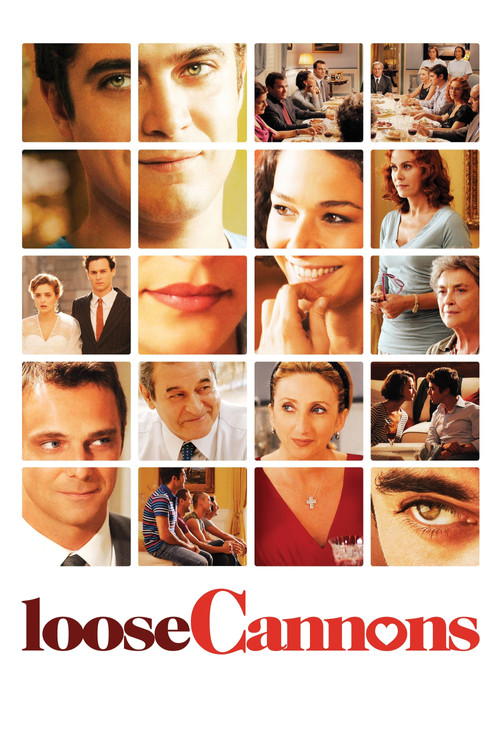
Loose Cannons (2010)
Directed by Ferzan Özpetek
Yes — Loose Cannons is woke, scoring 60 out of 100 on our wokeness meter.
The Cantone family in Loose Cannons presents a surprisingly fertile ground for examining contemporary cultural awareness, despite its provincial setting.
Consciousness Markers
The entire narrative engine is the coming-out of Tommaso and the accidental simultaneous coming-out of his brother Antonio, with gay relationships and a gay friend group central to the plot.
The sister Elena chafes against the housewife role, Alba is a brilliant economist in a male-dominated business world, and the grandmother wields decisive shareholder power, though these threads remain secondary.
The grandmother's dying injunction that each family member be true to himself and respect others' diversity delivers an explicit moral, though it is dramatized warmly rather than preached at length.
A predominantly Italian ensemble portraying a family with two gay sons and a circle of gay friends, though the cast is not notably diverse beyond the gay-role presence.
The pasta factory provides a backdrop of bourgeois provincial respectability, but the film offers no critique of capitalism or class as such.
No engagement with race or racial dynamics whatsoever; the film concerns sexuality and family in a homogenous Southern Italian setting.
No environmental or climate themes appear in the film.
No body-positivity themes or commentary are present.
No neurodivergence is depicted or addressed; the grandmother's eccentricity is not framed in these terms.
No historical revisionism or re-framing of historical events occurs.
Why it received this score
The Cantone family in Loose Cannons presents a surprisingly fertile ground for examining contemporary cultural awareness, despite its provincial setting. The narrative centers on a group of Italian relatives whose rigid traditions begin to crack under the pressure of modern progressive sensibilities. The film excels at charting the internal conflict of a man who returns home from Rome to confront his conservative upbringing. While the production is rooted in a homogenous cultural landscape, the central focus on sexuality provides the overwhelming majority of the film's thematic weight. The portrayal of the two brothers coming out offers a significant exploration of identity within a closed system.
The domestic sphere, particularly the interactions of the sister and the grandmother, provides secondary layers of cultural critique. We see subtle strains against the stifling expectations placed upon women, and the family structure itself holds a certain weight of economic power. These elements, however, are not the primary driver of the narrative. The film operates as a quiet confrontation between a specific, rural brand of conservatism and the fluidity of modern social understanding. The emotional weight of the grandmother’s final, sweeping advice serves as the most overt moment of social guidance.
It is a serviceable piece of progressive cinema that lacks broader social reach. The film is not making grand statements on global issues, nor does it engage with systemic economic disparity. It is an intimate study of a family navigating a specific cultural awakening. The execution is polished, even if the scope remains confined to a single Italian pasta factory.
Analysis generated by our Consciousness Algorithm
Synopsis
Tommaso is the youngest son of the Cantones, a large, traditional southern Italian family operating a pasta-making business since the 1960s. On a trip home from Rome, where he studies literature and lives with his boyfriend, Tommaso decides to tell his parents the truth about himself. But when he is finally ready to come out in front of the entire family, his older brother Antonio ruins his plans.
Questions about Loose Cannons
Is Loose Cannons woke?
Yes — Loose Cannons is woke, scoring 60 out of 100 on our wokeness meter. That earns it a verdict of Woke.
What makes Loose Cannons woke?
3 of the 10 markers register at 30 or above, led by LGBTQ+ Themes (92), Feminist Agenda (35) and Lecture Energy (30). On LGBTQ+ Themes: The entire narrative engine is the coming-out of Tommaso and the accidental simultaneous coming-out of his brother Antonio, with gay relationships and a gay friend group central to the plot.
How does Loose Cannons compare to other 2010 movies?
It ranks #3 of the 238 films from 2010 we've scored; their average is 11. The wokest is My Name Is Khan (84).
How is the Woke Score calculated?
An AI-assisted process researches the film and its reception, scores it 0–100 on ten markers, then combines those into one 0–100 Woke Score. It measures a specific set of 2020s cultural themes, not film quality.