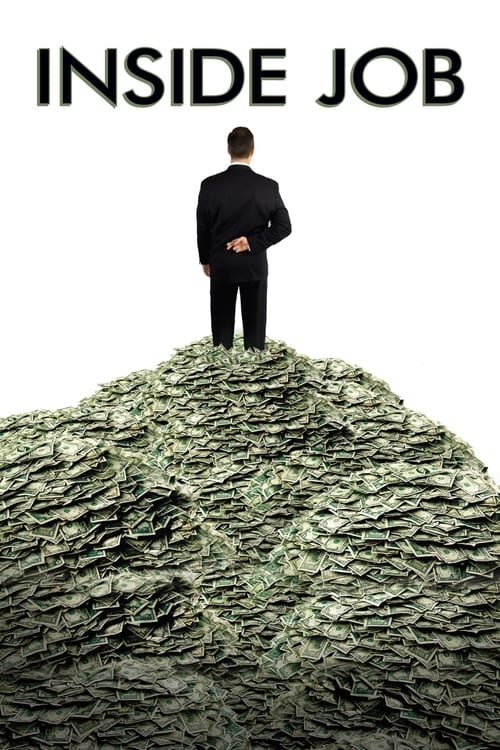
Inside Job (2010)
Directed by Charles Ferguson
Yes — Inside Job is very woke, scoring 82 out of 100 on our wokeness meter.
Inside Job is a 2010 documentary by Charles Ferguson about the 2008 financial crisis, and it remains one of the more efficient exercises in institutional disgust ever assembled.
Consciousness Markers
The film is a sustained indictment of Wall Street deregulation, financial industry corruption, bailouts, and the wealthy escaping accountability, strongly aligning with 'eat the rich' sentiment.
The documentary is explicitly didactic, using narration and expert interviews to explain and condemn the financial crisis, delivering a sustained argument.
The film is a documentary featuring real financial and political figures; there is no deliberate diverse casting or representation agenda.
No LGBTQ+ themes or characters are present.
The film does not address gender or feminist issues.
The film focuses on systemic financial corruption and does not examine racial dynamics or racial justice.
Climate change is not discussed.
No body positivity themes.
No neurodivergence themes.
While it challenges official narratives of the 2008 crisis, it does not engage in the modern woke revisionist-history project of recasting history through identity politics.
Why it received this score
Inside Job is a 2010 documentary by Charles Ferguson about the 2008 financial crisis, and it remains one of the more efficient exercises in institutional disgust ever assembled. It begins in Iceland, moves through deregulation, collateralized debt obligations, rating agencies, bailouts, and the curious immunity of executives who walked away rich. The film's real subject is class: a financial caste that privatized gain, socialized loss, and kept the bonuses. This is eat-the-rich cinema with footnotes. The anger is not decorative. It is the architecture.
The method is straightforward. Matt Damon narrates. Experts and participants explain. The film builds a case with charts, testimony, and a rising sense of betrayal. It also sermonizes. Ferguson has a thesis, and he delivers it with the patience of a prosecutor and the moral certainty of a Sunday pulpit. That is the lecture energy here, and it is potent. The film does not concern itself with gender, sexuality, race, climate, body image, or neurodiversity as organizing principles. Its interviewees are actual financiers, officials, and journalists, so there is no casting agenda to speak of. Its historical argument indicts deregulation and corruption, not the modern project of recasting history through identity.
Inside Job won Best Documentary Feature, and its reputation has settled into that rare category of nonfiction that people cite without having rewatched. It is not a superhero film. It is not a sequel or a remake. It is a true-story documentary adapted from nothing but the public record and private greed. The film's limitations are also its clarity. It wants to explain, condemn, and perhaps shame. It does not want to interrogate intersectional power. That makes it a specimen from an earlier era, when anger at banks could be its own complete political language. We classify it accordingly: high on anti-capitalist fervor, high on sermonizing, and zero on the newer cultural markers that would arrive to complicate the conversation.
Analysis generated by our Consciousness Algorithm


Synopsis
A film that exposes the shocking truth behind the economic crisis of 2008. The global financial meltdown, at a cost of over $20 trillion, resulted in millions of people losing their homes and jobs. Through extensive research and interviews with major financial insiders, politicians and journalists, Inside Job traces the rise of a rogue industry and unveils the corrosive relationships which have corrupted politics, regulation and academia.
Questions about Inside Job
Is Inside Job woke?
Yes — Inside Job is very woke, scoring 82 out of 100 on our wokeness meter. That earns it a verdict of Peak Woke.
What makes Inside Job woke?
2 of the 10 markers register at 30 or above, led by Eat the Rich (90) and Lecture Energy (85). On Eat the Rich: The film is a sustained indictment of Wall Street deregulation, financial industry corruption, bailouts, and the wealthy escaping accountability, strongly aligning with 'eat the rich' sentiment.
How does Inside Job compare to other 2010 movies?
It ranks #2 of the 238 films from 2010 we've scored; their average is 11. The wokest is My Name Is Khan (84).
How is the Woke Score calculated?
An AI-assisted process researches the film and its reception, scores it 0–100 on ten markers, then combines those into one 0–100 Woke Score. It measures a specific set of 2020s cultural themes, not film quality.