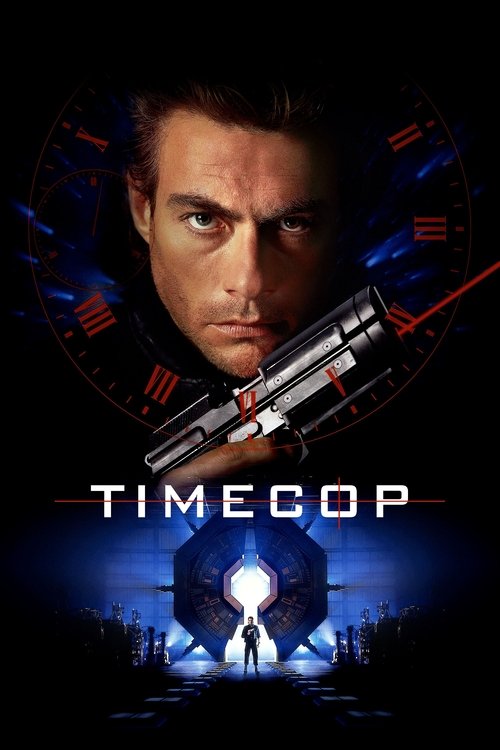
Timecop (1994)
Directed by Peter Hyams
No — Timecop is not woke, scoring 5 out of 100 on our wokeness meter.
The 1994 Van Damme vehicle Timecop arrives from a more innocent era of the multiplex, one in which a man could punch a corrupt senator across two separate timelines and call it a day.
Consciousness Markers
The cast is overwhelmingly white, with Gloria Reuben and Scott Lawrence in supporting roles that carry no commentary on identity or representation.
The villain is a corrupt senator enriching himself via time-travel market manipulation, but this is standard action-movie villainy rather than an anti-capitalist thesis.
Mia Sara's Melissa is largely a wife-in-peril motivating the hero, and the female agent Fielding is a duplicitous traitor; no feminist framework is present.
The film delivers its exposition and time-travel rules matter-of-factly, with no preaching or moral instruction.
No LGBTQ+ characters, themes, or subtext appear anywhere in the film.
Race is never a subject of the film; the 1863 Confederate opening and 1929 sequences are period dressing, not racial commentary.
No environmental or climate themes whatsoever.
No body-positivity themes or messaging.
No neurodivergent characters or themes.
The time-travel premise alters personal history for plot purposes but makes no revisionist claims about real historical events.
Why it received this score
The 1994 Van Damme vehicle Timecop arrives from a more innocent era of the multiplex, one in which a man could punch a corrupt senator across two separate timelines and call it a day. Peter Hyams directs with somber, blue-lit efficiency, treating the paradoxes of temporal law enforcement as a matter of paperwork and jurisdiction. The film is based on a Dark Horse comic, which accounts for the sturdy architecture of its premise and for the fact that nobody involved felt any need to apologize for it.
Representation here is of the incidental variety. Gloria Reuben and Scott Lawrence appear in supporting capacities that carry no commentary on identity, which in 1994 was simply how casting worked. Mia Sara's Melissa exists to be mourned and then rescued, and the rookie agent Fielding turns out to be a duplicitous traitor, so no framework of gender grievance is available for decoding. There is no LGBTQ content, no environmental sermon, no body-positive messaging, no neurodivergent character, and no revisionist claim about the Confederacy or the Crash of 1929, both of which serve as wallpaper. The 1863 prologue is a robbery, not a reckoning.
The villain, Senator McComb, enriches himself through foreknowledge of the market, the sort of greed action cinema has always found convenient rather than instructive. It is not a thesis about capital. The film explains its time-travel rules plainly and then gets on with the punching, offering no moral instruction and no sermonizing. The remainder is a lean, competent thriller that has nothing to say and says it with confidence.
Analysis generated by our Consciousness Algorithm


Synopsis
In 2004, an officer for a security agency that regulates time travel must fend for his life against a shady politician who has a tie to his past.
Questions about Timecop
Is Timecop woke?
No — Timecop is not woke, scoring 5 out of 100 on our wokeness meter. That earns it a verdict of Ultra Based.
Does Timecop have any woke elements?
Very few. None of the 10 markers reaches 30, the level where a marker counts as present; the highest is Representation Casting at 15.
How does Timecop compare to other 1994 movies?
It ranks #45 of the 86 films from 1994 we've scored; their average is 10. The wokest is On Deadly Ground (75).
How is the Woke Score calculated?
An AI-assisted process researches the film and its reception, scores it 0–100 on ten markers, then combines those into one 0–100 Woke Score. It measures a specific set of 2020s cultural themes, not film quality.