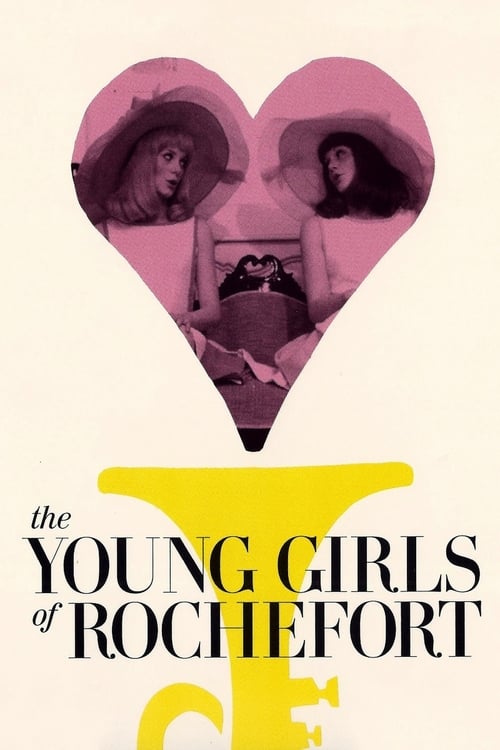
The Young Girls of Rochefort (1967)
Directed by Jacques Demy
No — The Young Girls of Rochefort is not woke, scoring 6 out of 100 on our wokeness meter.
The Young Girls of Rochefort arrives in 1967, pastel and pristine, with a caravan of trucks and a song about twins.
Consciousness Markers
The twin sisters pursue artistic ambition and Delphine rebuffs a manipulative suitor, but the film's engine is romantic longing and marriage-adjacent fantasy rather than any feminist critique.
The cast is a uniformly white French ensemble of the era, with no casting choices made to signal modern representational priorities.
No LGBTQ+ characters, themes, or subtext appear anywhere in the film.
Race is entirely absent as a subject; the film is a hermetic white French seaside fantasy.
No environmental or climate themes whatsoever.
The fairground commerce and bourgeois café life are presented affectionately, with no economic critique.
No body-positivity themes; the film's aesthetic is one of conventional glamour.
No neurodivergent characters or themes are present.
The film is a contemporary-set romantic fantasy with no historical revisionism.
The film is pure song-and-dance escapism with no didactic messaging or moral instruction.
Why it received this score
The Young Girls of Rochefort arrives in 1967, pastel and pristine, with a caravan of trucks and a song about twins. Jacques Demy has built a seaside town where everyone is on the verge of meeting the person they have been waiting for, and almost nobody manages it until the final reel. The whole enterprise runs on coincidence, missed connections, and the ache of ideal love. It is a machine for yearning, and it works.
What the film does not do is argue. The twins teach ballet and compose concertos, and Delphine declines her egotistical gallery-owner boyfriend when he offers to make her a star in exchange for her return, which is as close as the picture comes to a statement about anything. Even there, the refusal is less a manifesto than a plot mechanism. Solange pursues a meeting with a famous composer because she wants her music heard. The film frames both women's ambitions through romance: Paris, the ideal man, the dance, the kiss. A mild proto-feminist current runs beneath the surface, and it never breaks the surface.
The rest of the register is silence. The ensemble is a uniformly white French company of the period, and the film makes no comment on this because it makes no comment on anything. Race, sexuality, class, the environment, the body, the mind: none of these are subjects. The cafe, the fairground, the boats for sale, the bourgeois comforts are presented with affection and no critique. Demy is not preaching. He is arranging color and melody into a shape that produces joy and a small, unexpected sadness. For a viewer trained to read the culture wars into every frame, this is a vacation. Nothing is being taught, no one is being corrected, and the songs are lovely. We should classify it accordingly and move on.
Analysis generated by our Consciousness Algorithm


Synopsis
In the seaside town of Rochefort, twin sisters Delphine and Solange dream of love and artistic fulfillment beyond their quiet lives. As sailors, artists, musicians, and chance visitors pass through town during a weekend fair, a web of near-misses and romantic longing brings ideal partners tantalizingly close—without their realizing it.
Questions about The Young Girls of Rochefort
Is The Young Girls of Rochefort woke?
No — The Young Girls of Rochefort is not woke, scoring 6 out of 100 on our wokeness meter. That earns it a verdict of Ultra Based.
Does The Young Girls of Rochefort have any woke elements?
Very few. None of the 10 markers reaches 30, the level where a marker counts as present; the highest is Feminist Agenda at 10.
How does The Young Girls of Rochefort compare to other 1967 movies?
It ranks #10 of the 19 films from 1967 we've scored; their average is 10. The wokest is In the Heat of the Night (60).
How is the Woke Score calculated?
An AI-assisted process researches the film and its reception, scores it 0–100 on ten markers, then combines those into one 0–100 Woke Score. It measures a specific set of 2020s cultural themes, not film quality.