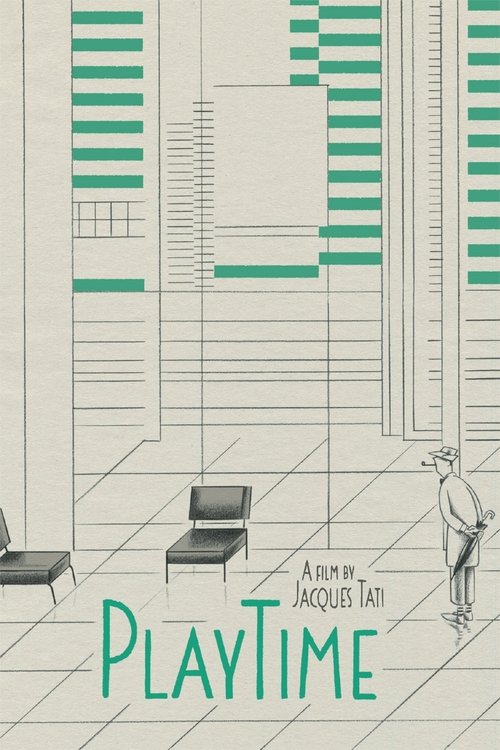
PlayTime (1967)
Directed by Jacques Tati
No · Ultra Based
How we score movies →Consciousness Markers
The film satirizes corporate culture, bureaucracy, and consumerism, but presents this as general social satire rather than explicit progressive political agenda.
The film critiques modernization and technology through visual satire and physical comedy rather than preachy messaging, keeping the critique largely implicit.
The cast is predominantly white and European, with no meaningful efforts toward demographic representation typical of 1960s French cinema.
Female characters exist within the narrative but without explicit feminist commentary or agenda, serving primarily as romantic interests.
While critiquing modernization and technology, this is not framed through an environmental or climate lens, predating modern climate activism.
Monsieur Hulot's clumsiness and social awkwardness could suggest neurodivergence, but this is deployed purely as comedic device without progressive intent.
No LGBTQ+ themes, characters, or representation are present in the film.
The film contains no meaningful engagement with racial themes or consciousness.
There is no body positivity content or representation in the film.
The film does not reinterpret history, instead serving as a contemporary satire of 1960s modernization.


Synopsis
Clumsy Monsieur Hulot finds himself perplexed by the intimidating complexity of a gadget-filled Paris. He attempts to meet with a business contact but soon becomes lost. His roundabout journey parallels that of an American tourist, and as they weave through the inventive urban environment, they intermittently meet, developing an interest in one another. They eventually get together at a chaotic restaurant, along with several other quirky characters.
Why it received this score
Playtime stands as a towering achievement in cinematic satire, a film that dissects the absurdities of technological modernity and corporate bureaucracy with surgical precision. Yet this masterwork of visual comedy, released in 1967, operates entirely outside the vocabulary of contemporary progressive consciousness. Jacques Tati constructs an elaborate critique of consumerism and the dehumanizing effects of modernization, but through the language of silent physical comedy rather than any recognizable social justice framework. The film's satire is about the human condition confronting an increasingly mechanized world, not about the specific markers of 2020s cultural awareness.
The cast is uniformly European and white, reflecting the production norms of 1960s French cinema. Female characters exist within the narrative as supporting presences without any suggestion of feminist agenda or commentary on gender dynamics. There is no representation of LGBTQ+ individuals, no engagement with racial consciousness, and no environmental messaging of the sort we now associate with climate-conscious filmmaking. Even Monsieur Hulot's clownish awkwardness, which might in another context suggest neurodivergence, is deployed purely as a vehicle for physical comedy, not as a statement of progressive inclusion.
What we confront here is a film that is socially astute and culturally aware in the sense that matters to any era, but which makes no claim to the specific constellation of sensibilities that define contemporary progressivism. It is a work of artistic genius that simply predates the categories we now use to evaluate such things. To score it on these markers is not to diminish it, but rather to acknowledge that it operates in a different moral and aesthetic universe entirely.
Analysis generated by our Consciousness Algorithm
Critic Reviews
“Instead of plot it has a cascade of incidents, instead of central characters it has a cast of hundreds, instead of being a comedy it is a wondrous act of observation. It occupies no genre and does not create a new one. It is a filmmaker showing us how his mind processes the world around him.”
“Jacques Tati's most brilliant film, a bracing reminder in this all-too-lazy era that films can occasionally achieve the status of art.”
“Playtime is sharp and colorful, and visually makes quite an impression.”
“It’s a must-see for those with a penchant for droll, avant-garde cinema or anyone fascinated more by technique than narrative. For others, it’s more of a curiosity than a can’t-miss production – a film that may fascinate for a while before starting to seem repetitive and overlong.”